It may surprise some to know that the National Captioning Institute of Virginia opened an office in Santa Clarita last summer; but it came as even more of a revelation to learn that live sporting events and children’s shows were among the early adopters of closed captioning in the early 1980s.
The first live sports event with closed captioning was the Sugar Bowl on Jan. 1, 1981, according to the nonprofit organization. That version of communicating with the deaf and hard-of-hearing was a simplified version of a special system which connected to the New Orleans Superdome’s electronic scoreboard where the Georgia Bulldogs and Fighting Irish of Notre Dame squared off.
By 1985, real-time captioning of commentary on a live sports event was provided for the first time for the Super Bowl that aired on Jan. 20 of that year. And in September 1985, ABC’s Monday Night Football became the first sports series to include real-time captioning of commentary.
Children’s programming followed next when an educational science show produced by Children’s Television Workshop aired on PBS with closed-captioning from 1980 to 1988. And later in 1980, “Sesame Street” followed suit, becoming the second children’s show to include captions.
Formed in 1979, the National Captioning Institute has since been providing closed captioning not only for the benefit of the deaf and hard-of-hearing, it has also become a tool used by those learning to speak English as a second language, said its President and Chief Operating Officer, Jill Toshi. The firm also provides the same service for movies, scores of TV shows and other broadcast services.
“We’d had an office in Burbank for approximately 20 years because of its proximity to the production houses and studios. At the time it made sense for us to be there because that’s where the business was going on and we could provide pre-recorded services,” Toshi said. “As technology evolved, it made that proximity less important and so we looked for a location less costly than Burbank.”
So the group signed a lease for 4,000 to 5,000 square feet of space on Constellation Road and relocated to Santa Clarita in August. Whereas being located in Burbank was helpful when physical media such as tapes would be provided, digital files are now used in the process of converting audio to close captioned text.
With a staff of 25 in Santa Clarita, the hope is to grow the staff to 35. Although the space doesn’t seem that large for the size of the staff, closed captioning is provided out of the office 24/7, 365 days a year so that not many people are in the office at the same time, Toshi said.
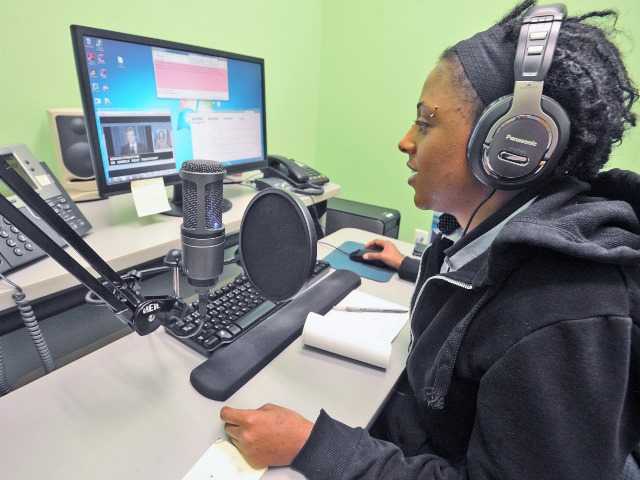
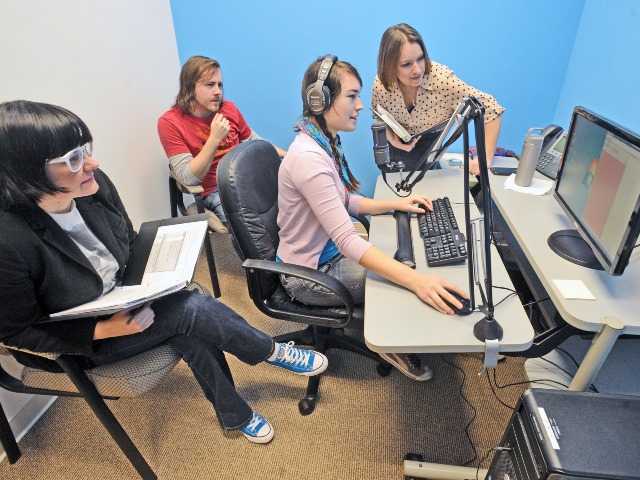
But perhaps the most difficult of their tasks is when their captioners are turning audio into text onto the screen in real-time for a live broadcast. The translator of sorts is hearing the broadcast at the same time as the audience is hearing it and that can be very stressful, she said. Using rooms that are referred to as studios, a captioner works with a computer and a phone in a quiet room producing real time closed captioning in two ways.
In one case a stenographer, or court reporter, transcribes speech into a special machine to create the captions on-screen. In the second case, the nonprofit also uses a voice recognition system where a person re-speaks everything they hear into the system while the software translates it. That person also helps with punctuation and by adding any other important information for the software, Toshi said.
The institute also offers descriptive audio for blind viewers by adding an audio track to a broadcast or movie that describes the onscreen information the blind otherwise wouldn’t have access to.
“Our mission is to provide access to communications for those who need it,” she said.
Producing 150,000 hours of close captioning services per year in both English and Spanish, the National Captioning Institute’s audience size is in the millions, according to Toshi. But, its services aren’t only for the hard of hearing.
“Closed captioning services are used by people in environments that are very noisy, like airports, gyms and more,” she said.