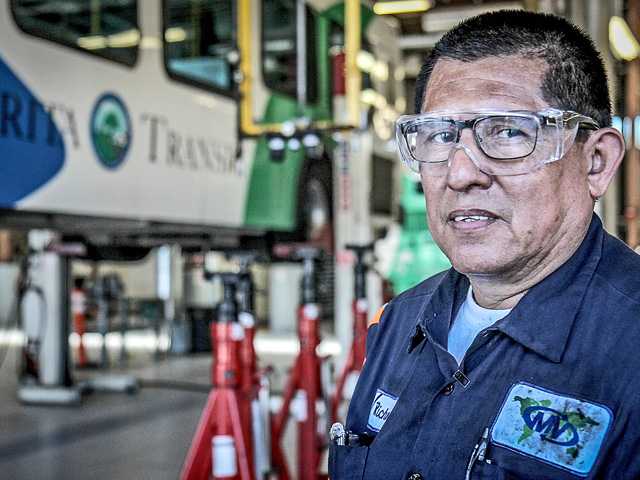
Myriad engine parts make up Richard Cabrera’s puzzle – the same puzzle that attracts the 18-year veteran mechanic to the hustle and bustle of Santa Clarita’s transit facility.
“I enjoy the mystery of solving the problem and repairing it,” Cabrera said. “That’s the fun part of the job.”
Cabrera and his team are the doctors to Santa Clarita’s growing fleet of bright blue, green and white public buses.
From the early morning hours through the evening commute, the mechanics serve the city’s Transit Maintenance Facility every day, poking and prodding around the 20-ton buses that roll into their garage.
Every member of the team is coated in brake dust, sweat and a glossy red transmission fluid they call “bus blood.”
They work to solve some of the most complex problems facing the city’s sprawling 110-bus transit fleet.
“There are a lot of challenges,” Cabrera said of the task at hand. “When you have something wrong with the electrical, sometimes it’s hard to find those problems.”
Throughout the city’s 28-year history, transit planners have purchased and replaced more than 150 buses.
With every wave of new vehicles comes several hours of training for the mechanics.
For Cabrera, it just boils down to simple mechanics.
In comparison to the size of an average sedan, “a bus is just bigger,” he said tapping on the plump black wheel dangling a few feet above his shoulder.
“It has tires and brakes just like a car.”
Rarely does the job call for a clean and simple tightening of a few loose bolts.
A majority of the work involves heavier mechanics, as well as the patience and know-how of a skilled detective – and getting over the daunting fear of walking under the city’s 20-ton behemoths.
“At first it’s intimidating, but it doesn’t bother me,” Cabrera said as he gingerly strolled under the doorway of a bus his team had spent the day servicing. “Once you get underneath them all the time, you get used to them.”
Externally, each bus sports the same city-sponsored livery, but the journey to their wide variety of ailments, or breakdowns, begins in the same place — inside.
From broken fan belts to malfunctioning air compressors, the group of troubleshooters often manages to turn over vehicles same day — unless it’s an electrical problem.
“Electrical is one of the hardest things to troubleshoot,” Cabrera said as he interlaced a pair of red and black wires between his fingers.
The longtime mechanic said his team often spends hours combing through every inch of the coach searching for a small power issue.
And with manufacturers packing on new gadgets designed to aid drivers in maneuvering each new fleet of buses, Cabrera’s puzzle becomes more complex.
“It’s really different,” he said gazing at a pair of newly painted gas-powered commuter buses.
“Because of the multiplex systems that came in, you have to learn the whole bus from top to bottom.”
But that doesn’t stop or slow the man, the team or the six-wheeled metal and glass giants.
“When I go home, I know I gave it my all and we got the buses back out there,” he said as he tapped on a Santa Clarita city seal emblazoned onto the coach’s side.
“It makes me feel good.”