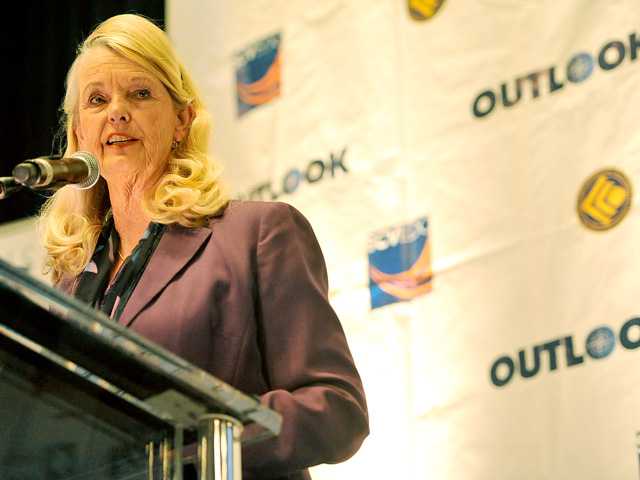
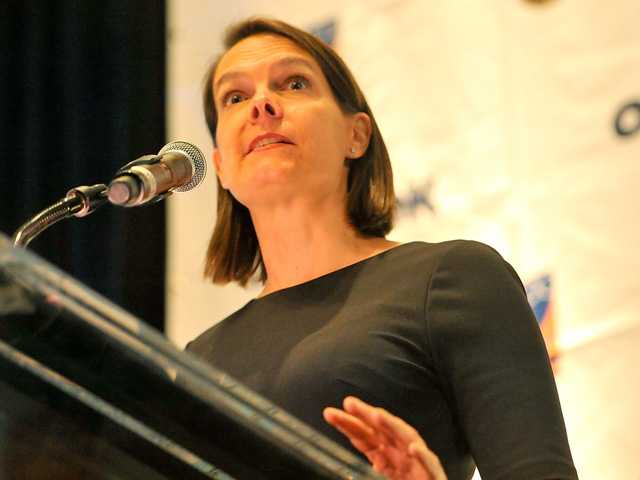
In the absence of a crystal ball, economists at the Santa Clarita Economic Outlook Conference Thursday said key economic measurements do not point to a recession occurring anytime soon.
But if anything is hindering growth locally, it has been the absence of new construction – residential and commercial – in the Santa Clarita Valley, according to Mark Schniepp, director of the California Economic Forecast.
“Don’t pack up the recession bags yet,” Schniepp said. “We just don’t see it.”
As for the risk of the United States slipping into another recessionary period, Mark Vitner, senior economist for Wells Fargo, pegged the risk at somewhere between 23 and 25 percent – a number he deemed to be very low risk. The lowest the risk of recession ever gets is 15 percent, he said.
Also, due to over-production, oil prices have most likely not yet bottomed out, with Vitner predicting that the price of oil will fall to less than $20 a barrel by mid-year.
“Continue to look for economic growth of 2 percent this year,” he said.
Despite the fact that many people still reserve a somewhat pessimistic perspective of the recovery, the economists pointed to ongoing job growth, wage increases that began in the fourth quarter of 2012, steadily increasing home prices and interest rates still near record lows, the smallest household debt in a generation, stock market highs last year, and flush corporate bank accounts as signs that the economy is still healthy.
As for California’s and Santa Clarita’s unemployment rate, Schniepp said the jobless rate alone is not the full measure of a healthy labor force.
“The true gauge is when employers are having trouble finding the right people to fill jobs, which is the situation employers are in today,” he said. “We’re back at the point where if you can fog a mirror, you can get a job,” Schniepp said.
In a conference packed wall to wall with attendees, an interactive query tool allowed people to text replies to questions which punctuated the three-hour event – assembling and displaying instantaneous responses on screens at the front of the conference.
Responses like “fabulous” and “great” were the leading one-word answers conference participants gave when asked to describe their outlook for business in the coming year.
“To the economists in the room, I hope you took note,” said Holly Schroeder, president and CEO of the Santa Clarita Valley Economic Development Corp. as she invited Schniepp to address the local economy.
Santa Clarita
The Santa Clarita Valley is following much the same recovery path as California economically. But job creation is affected by the lack of existing office space, industrial building, and new and affordable housing, Schniepp said.
In addition to the lasting effect the recession had, the price of land and building costs, coupled with myriad growth measures such as the California Environmental Quality Act, pockets of community resistance, and government regulations have led to relatively little new construction in the SCV during the past eight years.
Restrictive building situations have had “unintended consequences,” and Schniepp cited the delays in getting the master-planned Newhall Ranch community off the ground as one example with housing.
The shortage of housing drives prices up, undermining affordable housing options, restricts the ability of families to live in the same community, makes it more difficult for firms to attract skilled employees locally, and forces residents to commute for work, adding more traffic on the freeways.
“Housing controls constrain economic growth,” he said.
Schniepp also pointed to data showing traffic on Valencia Boulevard to have reached an all-time high by 2014, housing prices to have shot up 34 percent over the past three years, and apartment rents to be at an all-time high, having increased 16 percent over the past three years.
And the virtual lack of new office, retail and industrial building over the last eight years has created one of the tightest markets in the entire state with industrial vacancy rates at 1.5 percent.
“As a result, tens of thousands of people are on the I-5 commuting to work each day,” Schniepp said. “The jobs should be (located) here, and they would be if we were building.”
That scenario could become even more dire.
With several years of population growth running at 4 to 5 percent per year, he said, the population in the Santa Clarita Valley should reach 315,000 in the next five years, he said.