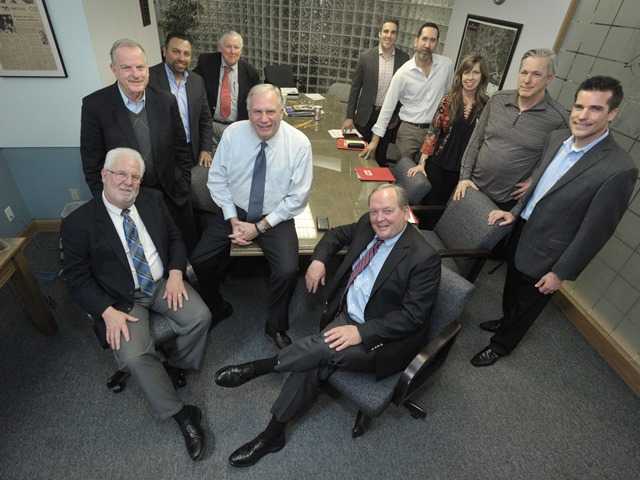
Click here to see the Paladin Multi-Media Group Board of Directors .
The SCVBJ welcomed new buyers on Jan. 1, the Paladin Multi-Media Group. In a stunning announcement on Dec. 15, 2015 ownership of the 97-year old Signal newspaper, ownership of this publication’s media company, came back home to Santa Clarita. The hometown and homegrown newspaper had been owned by Georgia-based Morris Multimedia group for more than three decades.
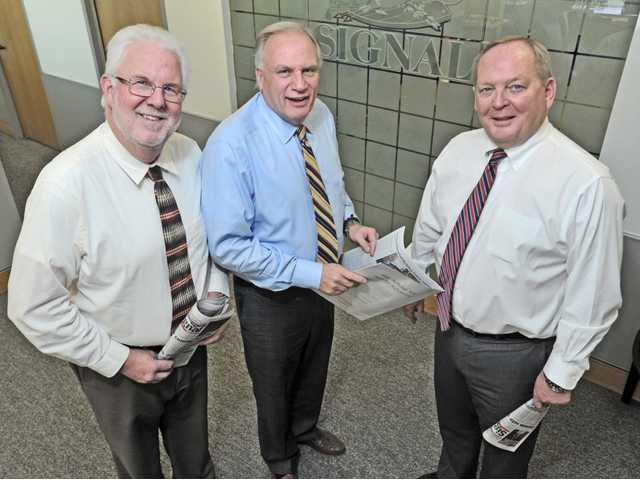
Now privately owned, the Paladin Multi-Media Group consists of Charles F. Champion, longtime business partner Gary Sproule, and former Signal Publisher Russ Briley.
Of special note, the new ownership team personally prefers not to be called “owners” saying they are only stewards whose role is to ensure the continuation of the newspaper and its products for generations to come.
During this sit down Q&A with the new owners, questions were plentiful and specific responses somewhat elusive – for good reason. It had only been six weeks into the ownership at the time of this interview, and while deals are in the making, not all can be announced until deals are closed. The staff has had, however, a rare chance to see what it is like to operate with invested owners’ onsite and on hand after more than 30 years.
The Back Story
SCVBJ: As background, this was a privately financed, asset-only purchase by Paladin Capital Partners. Who are the shareholders?
Champion: Russ, Gary and myself.
SCVBJ: Would you disclose the purchase price or what the gross revenues of the media company at the time you bought it?
Sproule: We don’t want to disclose either at this time, but revenue had been declining over the last several years. It was part of the downward trend in the industry affecting most newspapers. The decline we saw was pretty consistent with what we saw throughout the industry.
SCVBJ: What made this property unique or attractive? Why take a risk?
Champion: Contrary to the public wisdom about media, not one-size-fits all. There are plenty of community newspaper and media enterprises out there that are profitable and doing well. Those who understand who their audiences are, and are providing news and advertising content to fill their readers’ needs are in fact doing well. We reviewed the financial and operation sides of the The Signal and believed changes could be made to both that would provide a greater return on the capital than had been realized before.
Sproule: There were a number of things that made purchasing the newspaper attractive – the history and legacy of the paper; it’s a great foundation to build on. Also, it’s the community. The demographics, the insulation from the Los Angeles basin, the quality of life in the community and the loyalty residents have for their community is amazing. All of those are remarkable things to build a paper from.
Briley: A lot of my motivation was having lived here for 36 years and to be able to see local news be in local hands again. But, I would not have even ventured into this arena if not for Chuck and Gary. I can’t imagine myself getting into any transaction without them.
Champion: And we would have not moved forward without Russ’s deep understanding of the market and his understanding of the readers and community as a whole.
SCVBJ: What are your growth expectations?
Champion: Some modest growth in the first year, and accelerated, substantial growth in years two and three.
Sproule: We have a five-year business plan that is pretty comprehensive detailing our revenue plan. But, the only way to make the company successful is to probably spend 90 percent of our time focused on revenue growth. That’s reflected in our plan. Chuck and I tend to reduce the success of any business down to five or eight key drivers and that becomes the foundation of our key assumptions. We track those on a daily or weekly basis.
Risk-Tolerant
SCVBJ: You’ve described yourselves as extremely risk-tolerant? Explain this a little.
Sproule: There are business risks associated with any newspaper across the country, whether a national one or a community paper, daily, weekly or monthly. My partners and I look at that type of situation, which while risky, is also an opportunity to come in and turn that trend around, reverse it. We’ve done a lot of due diligence and understand the risk profile we’re dealing with but believe we can make the paper successful again.
Briley: Many newspapers haven’t learned how to deal with disruption; we think we can turn the model around for this paper.
Champion: Darwin said it (success) doesn’t go to the strongest or fastest; it goes to the one that most quickly adapts to its environment.
Conventional wisdom tells you that newspapers are not good investments. And while we concur that, there are newspapers with financial models flawed at their core. This is not one of them. One shouldn’t confuse a flawed model with flawed execution. If you understand what your core competencies are, then you can leverage off of that work and possibly secure a greater return.
SCVBJ: Explain what you mean by flawed.
Champion: Newspapers made massive investments of capital to buy presses, for instance, but presses weren’t the company’s core competency – the gathering verification, distillation and distribution of news and information is the core competency and not just putting ink on paper
Briley: Same thing with distribution. Newspapers all delivered their own products. But, they aren’t in the door-to-door delivery business either. They’re news gatherers.
Champion: Also, the erection of a wall between church and state (editorial and advertising) was far too thick when it should have been transparent. Instead it’s opaque and has affected the health of the entire industry. It didn’t allow the newspapers to get close enough to its potential subjects in order to properly serve its communities. While the media needs to stand watch and protect its communities from the abuses of power and the powerful it doesn’t mean you criticize everyone and everything the powerful do. It also doesn’t mean that to maintain your journalistic independence and integrity that you need to kick the heck out of your advertisers and elected officials to show everyone you can and will.
The Community
SCVBJ: You invited Tony Newhall, one of the newspaper’s former owners/publishers and a member of one of the community’s founding families, to the staff meeting when you announced that you had acquired the newspaper. You also invited all former employees to the 97th anniversary celebration. What was the thinking behind these invitations?
Champion: To communicate to associates at The Signal and community as a whole that the new stewardship understands how important the values that were embodied by the Newhalls and what they represented to the community; and to former employees, who, while no longer still with us, are still very important parts of what made the newspaper what it is and to thank them for the work they did while they were here.
Briley: Tony Newhall and I had a lot of conversations during my tenure as publisher. We felt it was important for his whole family to be the first ones to know when we bought the paper.
Champion: He was the first person outside of the transaction to know.
Briley: And regardless of why employees left, we wanted them to celebrate 97 years with us. It was an important milestone.
We also wanted to share our vision for a community newspaper, their newspaper. We didn’t want to be referred to as owners; we wanted to be referred to as stewards of the newspaper so that the paper will be here long after we’re gone. That’s why we held the reunion for any person who has ever worked at The Signal – the paper wouldn’t still be here today if not for their efforts over the years. The community owns this newspaper.
Champion: We believe the franchise is not made in a single season. One could not possibly argue whether or not those people at the reunion made significant contributions and came in to do their best work.
SCVBJ: Why was it important to add a nonprofit component of the media group?
Briley: We understand the needs of the nonprofits. With the Signal Charity Trust we’re forming, it gives us the ability to contribute and help many of those organizations.
Champion: At the Chicago Sun Times I saw how a paper could use its reach and funds to help charity.
SCVBJ: You’ve clearly been working on winning the hearts and minds of the community through scores of one-on-one and group meetings? Why is that important?
Sproule: As Chuck mentioned before, it’s really about the community that “owns” the newspaper. We respect The Signal and respect the community. It’s important to us that we have the support of the community leaders as we move forward. It’s really a tough challenge without that, and is really one of the basic fundamentals of our investment and initial steps – a very high priority to meet the leaders of businesses, non-profits, academia and government. We’ve done a lot of that in the past 30 days with, I think, a lot of positive response.
Champion: Russ has been here 36 years. When I first started meeting people we had only been in the market for 36 minutes. We needed to meet individuals to understand from their perspective what the SCV and the neighborhoods within it mean to them, and therefore should mean to us. We needed to talk with politicians and understand their aspirations, as well as those of the business owners. We need to be able to identify and empathize with what problems they struggled with and what dreams they have. How can you begin to serve someone if you don’t understand what they want served?
Nuts and Bolts
SCVBJ: Regarding newspapers, what has their Achilles heel been?
Champion: In the recent past newspapers began trying to cut their way to profitability. That’s like starving my own cow, not buying hay for it and hoping as a dairy farmer I can improve my profits. What happens with that strategy is the farmer ends up with a skinny cow that can’t even be taken to the slaughterhouse.
Additionally what happened in our industry was loss of local control. When local owners traded their papers to corporations that only cared about making a dime, and as those corporations went public, the 13 week earnings grind changed decision making. It drove innovation and risk taking out of the equation leaving an industry run for the short term. Yes, the corporatization of media in America destroyed its very mission.
With a local community paper, owned and operated in the community for the community, you don’t have to worry about those conflicts.
SCVBJ: Any entity has to be profitable, but, how do you view the public service aspect of journalism?
Champion: When we cover the news we can’t care if it’s going to make us profitable or not, otherwise you subject it to fear and compromise. You have to have tremendous courage; you have to be willing to literally subject the business to the risk of bankruptcy.
First, you want to position yourself as, and want to be, the first citizen of the community you serve. A news organization has a unique position in our society to focus the light of scrutiny on our public officials, and to hold them to the high standards they were elected to. Profit and fear of loss cannot enter into that equation ever. News formulation decisions, selection, coverage must always be divorced and separate from profit motives.
If Katharine Graham of the Washington Post were still with us she would tell you that when she published the Pentagon Papers she did just that. God rest her soul. She understood newspapering.
SCVBJ: What is your business plan?
Sproule: Our business plan is based on growing top-line revenue. Most newspapers, including The Signal, have already done a pretty good job of taking expenses out by outsourcing printing or distribution. So our plan is really based on growing revenue as opposed to reducing manpower or taking costs out.
The obvious key drivers are circulation and advertising revenue. The other significant opportunity is our whole digital strategy with a revenue model. We’re still working through it and we’re testing it now. We have a significant amount of unique visitors to our website every month which positions us well to do well on digital. We’re also building a brand new website which will have an email communication component to it.
There will also be a video component.
We’ll be basically focused on digital space for the first several months, because currently there is no revenue as we took down the paywall.
SCVBJ: What are you doing with video?
Champion: We’ll build out our video assets. In large measure, we’re story tellers of non-fiction and fact, but story tellers all the same. It can be done in text-based format as well as video and infographics, but we need to do more on multi-media format.
Sproule: We have someone in here working with the video team. They’re looking at producing everything from 1-2 minute features, to short vignettes which appeal to community to longer documentaries; and obviously advertising with videos built into them.
SCVBJ: And, are you also building a new website?
Sproule: The problem we have with the existing website is the features and the functionality are not user-friendly. The way the content is conveyed to the user - whether it be photo, video, or print content – is pretty antiquated. Over half of our website visitors come in on a mobile phone so we’re going to want to make sure that whatever we do on that website, it is compatible with all types of mobile devices. That’s a high priority for us. We’re doing a complete overhaul.
The Board
SCVBJ: Who is doing all this work?
Sproule: We’ve got five of our board members who have very strong IT/e-commerce backgrounds. They’re working with the management team here to develop that strategy, so we have some terrific horsepower if you will.
SCVBJ: To that point, Paladin Multi-Media Group has built a very deep bench of talent on the Board of Directors. Are you planning to tap into this talent pool?
Champion: It’s two-fold. They’re individuals who Gary, Russ and I have known for a long time. Their value systems are identical to our own, and their commitment to journalism is identical to ours. These members give us a group of people whose expertise we can draw upon that we could never afford as a small business and newspaper of this size. Secondly, it allows us scalability in terms of acquisitions; licensing of intellectual property; and programs that are successful here that can be replicated at other places.
Sproule: It’s a diversified talent pool with a lot of depth and breadth and really a two-for-one. Initially it’s to tap into their expertise and also serve in an advisory role in addition to the traditional Board of Directors role. I don’t think there’s any other Board of Directors in the country that has the depth and breadth that this board has.
The Future
SCVBJ: Down the road, how do you see the Paladin Multi-Media Group morphing? Where do you hope to take it?
Sproule: I don’t think we have a good answer for that yet. The entity we’ve created though gives us flexibility. It’s important to know that the three of us are committed full time here and working some ungodly hours.
SCVBJ: Can you be more specific, more detailed, about future plans?
Sproule: We’ve got a lot of meat but we can’t share it publicly just yet because we don’t have agreements in place. We don’t want to create expectations we can’t deliver on or tip our hand too much until we have agreements secured. But, we would like to be in the position where every few weeks something comes up that’s of substance that we can release.
SCVBJ: Is the acquisition of other types of media properties – building a portfolio – in the future?
Sproule: Obviously. If and when we do something like that, no doubt we’ll be very successful here first which will get the attention of other community papers – who, at a minimum, will want to know and understand what we’ve done. It could open up a lot of doors because there are probably thousands of then in similar situations.
Champion: Right now our plan is to take one day at a time and continue to add value and make the paper an integral part of the community and everyone’s everyday life. That has to be done to be successful. Other than that, we’re really only thinking in 36 to 60 month increments, but the longer we’re here the more we realize how much can be done.
SCVBJ: Do you believe community-based media groups have any particular advantage?
Champion: Absolutely. Metropolitans or large regional dailies will struggle because they need to serve too many masters concurrently. This newspaper has the opportunity of being hyper-local with delineated content that can’t be found in other places.
Briley: Community newspapers with local ownership enable you to decide on and implement projects very quickly without going through a lengthy process for approvals. If newspapers were ships in our U.S. Navy I would say large metropolitan newspapers would be like an Aircraft Carrier, while very powerful, just turning them around takes a lot of doing. Navy destroyers, which I liken to community newspapers, are more agile, versatile and can get a lot done quickly.
Sproule: There’s a void in many communities as major papers have pulled back and covered less and less news. It creates a real opportunity for community newspapers.
SCVBJ: How does that role translate into being profitable?
Champion: We have a financial focus, but it’s not the sole driver and not done with control as a principle function. It’s used as a guide, much like a road trip. There are things that will divert you off the road. There’s no way to completely eliminate all the risks and ensure success. You have to have adaptability, have situational awareness and not be afraid to try and fail - fear of failure stifles many great businesses.
Briley: If this was based strictly on financial gain I wouldn’t have been interested.
Champion: We could have invested in something else far more profitable, with a greater financial return. This is about building a business in a critically important space. Simply to make it financially viable to do the work is nice, but I’m a big believer in Jefferson who said “If I have to choose between government and newspapers, I’d choose newspapers” because you cannot have a free society, a thriving democracy, without what media does.
Other Turnarounds
SCVBJ: Okay, so as investors you’ve acquired or turned around other companies. What do you cite as your most successful turnaround, and what was the most difficult?
Sproule: Youbet.com was a publicly traded online horse wagering site the only type of wagering that was allowed by federal law to be conducted online... We (Chuck and Gary) were hired to come in as CEO and CFO. It was probably the most challenging turnaround I’ve ever done. There was six weeks of cash left in the company and they would have to shut their doors. We ended up taking the market value from $8M to $238M in three years. It was hard, but extremely rewarding for the shareholders and employees.
Champion: That was a success story. The company was burning through $500,000 a month with only $750,000 in the bank. It had 80 employees and was being delisted by NASDAQ. Virtually everyone believed it was going to go bankrupt in a matter of weeks. It was difficult, sure. We ended up laying off 22 people in the first two weeks through voluntary layoff, but all of them got generous severances. You take care of your employees and your employees will take care of you. T
he competitor was ten times larger. When we started we transacted $90 million in wagers and when we finished we were placing over a billion dollars in pari-mutuel pools.
After we left, it was eventually sold to Churchill Downs for $128 million, although its value peaked much higher.
Herculean Task
SCVBJ: You have taken on a lot at once – acquisition of the media group, needing to find new office headquarters, bringing in new benefits, operating systems, online and digital tools, revamped website, building up the sales, marketing and editorial efforts. How do you go about getting your arms around all of this at once?
Champion: There are three of us. Each one has different segments of the responsibilities and we’re accountable for delivering on these priorities. We’re accountable to each other, to the 39 people who work here, and to the 280,000 people who live here in the valley. We talk constantly during the course of day, coordinating activity in virtual real time. Tactical decision-making is flattened considerably, decisions are made almost instantaneously.
Sproule: The three of us sit down daily, and discuss the priorities. We as a company can’t do all these things immediately so we identify those activities where we can create the most value and build from there. And we make sure what we do is consistent with what we built into the five-year business plan.
Champion: We very much believe in the old concept of plan your work, and work your plan, but our plan is also very flexible. We had the first 60 days in the can before we ever bought the newspaper.
Sproule: I’m very fortunate to have two great partners who believe in working very hard, and playing hard. There is a great bunch of employees here; we couldn’t have asked for any better transition. We know we have to earn the trust of the employees and that it takes time, but we do it by walking the talk and doing things like meeting expectations. Slowly, over time, we will earn their trust. My job is air traffic controller. While my partners are out in public putting deals together. I’m the guy who implements them, makes sure they work and that we achieve the target.
Click here to see the Paladin Multi-Media Group Board of Directors .