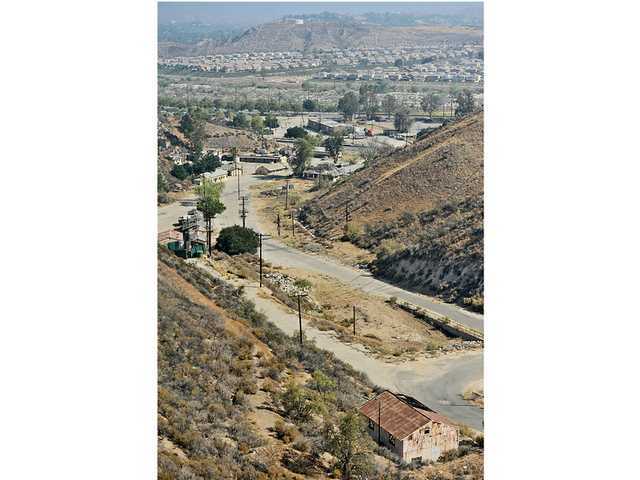
The ongoing cleanup of almost 1,000 acres of contaminated land at the heart of the Santa Clarita Valley is now measurable on a timeline of years, not decades.
Cleanup of the entire site — from Soledad Canyon Road and the Santa Clarita Metrolink station all the way south to Circle J Ranch and east to Golden Valley Road — should be completed before 2020, said Jose Diaz of the California Department of Toxic Substances Control, a division of the state Environmental Protection Agency.
When the cleanup is done, there will be 996 hilly acres of centralized open space on which to build schools, restaurants, corporate offices and parks — all with an opportunity to preserve huge tracts of open space, according to city planners and state officials.
A few areas will never be cleaned up enough to allow homes, Diaz said, but most of it remains a canvas ready to be painted.
And by next month the only official vision for development of the area — the only specific plan filed for use of the land — expires, said James Chow, senior planner for the city of Santa Clarita.
Called Porta Bella and approved in 1995, that plan allowed for more than 1,200 homes to be built on the site along with schools, parks and nearly 100 acres of commercial property. The plan was conceived before the extent of pollution on the property was realized.
The original business on the Whittaker-Bermite site was called the Bermite Powder Co. and dates to the 1930s. At the time it was built, the location was relatively isolated.
In 1967 Whittaker Corp. bought the site and it was renamed Whittaker-Bermite. Although the property is now owned by another firm, Whittaker — through its insurer — is financially responsible for cleaning it up.
The property was found to contain pollutants including volatile organic compounds, uranium and perchlorate, a salt shown to interfere with uptake of iodide by the thyroid gland. Perchlorate is also found in groundwater in the area.
But as two decades of environmental cleanup have progressed and the city has grown up around its so-called “doughnut hole,” some residents and city leaders have allowed themselves to talk about the centrally located site as a gem in the city’s crown, rather than a brownfield.
“It is an important piece of property,” Chow said in an interview Thursday.
Soil and air
Cleanup of Whittaker-Bermite is carried out according to a grid of seven areas, called operating units, or “OU” for short.
The first OU was cleaned to the satisfaction of state officials by 2010.
Operating Unit 5 was cleaned up eight weeks ago and is now at the point where crews are grading, restoring soil and planting trees, Diaz said.
Operating Units 2 through 6 are at various stages of “soil remediation,” which essentially involves venting the soil for toxic gases.
Fumes captured from soil on adjacent OU areas are piped into a fully functional volatile organic compound cleaning unit on OU2.
The state Department of Toxic Substances Control has paid particular attention to removing VOCs in Operating Units 2 through 6. Each site varies, given toxic gases are trapped at different depths, Diaz said.
According to the Environmental Protection Agency, VOCs are organic chemicals that have a high vapor pressure at ordinary, room-temperature conditions. Many believe they are carcinogenic.
“OU2, OU3 and OU4 are still areas where soil vapors are present and the VOC cleaning machines have been running for a year already,” Diaz said.
“They will need to run, at least, for another year,” he said.
Water cleanup
Construction began at OU7 last month for the pumps, pipes and cleaning machinery needed to decontaminate groundwater at the Whittaker-Bermite site, Diaz said.
Shortly after the groundwater cleanup plan was approved last year, city and Whittaker cleanup crews built a temporary facility at Whittaker-Bermite called the Saugus Aquifer Treatment Plant.
Construction of a permanent plant began last month.
“The construction is estimated to take about 10 months,” Diaz said. “After that, there’s a trial period. We hope to see it fully operational within two years — by 2018.”
The water cleanup plan addresses three distinct groundwater areas and aims to eliminate perchlorate from the watershed.
Four years of drought have dried up some underground tributaries of a migrating underground plume of perchlorate, Diaz said. “That’s good because the perchlorate doesn’t move from the site, but we have to wait to catch it later.”
Insurance deadline
The insurance policy taken out by Whittaker-Bermite to cover the cost of the cleanup expires in 2019. State officials were initially concerned about the looming deadline but have since received assurances of a 30-year plan to cover “maintenance,” Diaz said.
“The responsible party (Whittaker-Bermite) has to ensure the funds exist for 30 years to cover the cost of “long-term operation and maintenance,” Diaz said.
“They have to provide this through a letter of credit, a trust or bond,” Diaz said. ”Whittaker-Bermite had the foresight to secure a good insurance policy.”
661-287-5527
on Twitter @jamesarthurholt