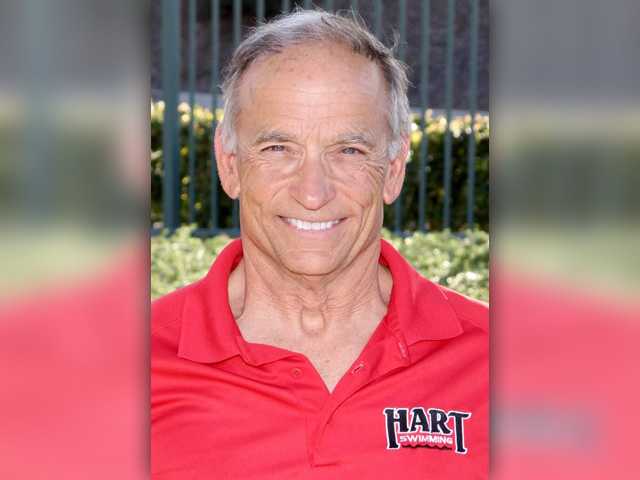
Editor’s note: This is the latest installment of an ongoing series we introduced earlier this year called Coach’s Corner, in which we feature Q&A sessions with prep and college coaches from around the Santa Clarita Valley.
I’m not a swimmer. I’ve never been a swimmer.
Frankly, I tire out just watching the 500-yard freestyle, so I admire anyone disciplined, and athletic, enough to do everything required to be elite in the pool.
All that said, some of the questions in this Q&A are basic. Like, very basic.
Hart boys and girls head swim coach Steve Neale was gracious enough to bear with me on those queries, and to talk about his time captaining the first-ever Hart swim team his senior year.
He also talked about how his time at Hart and Cal State University, Northridge affected how he’s coached the Santa Clarita Valley’s most successful swim program since 1984 and about competing in the Hawaiian Ironman World Championships.
Hart boys and girls both opened Foothill League swim this season with upsets of two-time-defending-league-champion Valencia, and are both 3-0 in league.
So here’s our latest Coach’s Corner, this one with the longtime Hart High history teacher:
Q: You moved to the SCV in 1960, but where were you born?
A: I was born in Honolulu, Hawaii. I spent my early childhood there. My dad was a Navy pilot.
Q: What do you remember about being captain of the first Hart High swim team as a senior back in 1970?
A: All those years ago. I really thought it was, for me, it was very special. It was very, very important. It was the first year that there had been swimming. I think, at that time in my life, it was a huge sense of identity. When you’re a young person, you’re looking around for an identity, for a place where you feel like you belong. I really enjoyed the whole swimming scene. To represent the high school, it meant a lot. I guess (after all these years), it ended up being a big part of my identity.
... When I started my senior year, it was the winter of 1969. The Vietnam War was all crazy during my high school years. A lot of things were going on in the world. Even for sleepy Newhall, the outside world was coming in. Maybe it was the times, too, (why Neale looked for his identity in swimming), a lot of people, a whole generation, kind of looking for an identity.
Q: How do backstrokers know when to go into their flip turn?
A: They have flags (hanging above the pool), and the flags are out about maybe 15 feet in front of the wall. You swim enough laps backstroke, and you know your pace. And you take a look at the flags, and usually it’s about two to three rotations of your arms and as you turn to your stomach, you’re allowed one arm stroke, and then you do your flip turn.
Q: How often do backstrokers hit their head on the wall?
A: I don’t know if I keep a list. There have been some, usually the head-hitters are beginning swimmers, you know. The headbangers, they’ll be the JV (swimmers). Very seldom have I ever seen a varsity person smack their head.
Q: Had you participated in any competitive swimming before your senior year at Hart?
A: Just with L.A. County Parks and Recreation during the summer. I really had no idea about higher levels of swimming except what I read in magazines. LIFE Magazine, way back (in the 1960s), I was just a kid, ran a great article about the Olympians out of Santa Clara. And I think, with the photographs, it just captured me, and to me, those guys were my heros. ... Those guys are the kind of people, swimmers, I could relate to — representatives of the United States, going on to college. They looked like the all-American kids, and I guess I wanted to be one of those.
Q: So where did your swim career go from there?
A: I graduated (from Hart), and I loved (the swimming experience). I went to Cal State Northridge, at the time, and they had a swim team, a very good (NCAA) Division 2 swim team. In fact, they ended up winning (nine Division 2 men’s team championships from 1975 to 1985). So I went there. Pete Accardy was the swim coach. He’s passed away, but he is kind of a legend of college swimming back there in the day.
I came in non-recruited, just kind of walked on. Funny story: Everybody else was twice my size and really experienced swimmers. So the first workout, I told (Accardy) I wanted to join the swim team. So we had two pools ... one where everyone worked out and a little four-lane, learn-to-swim pool that was like 3 feet deep. So he sent me in the little pool to swim laps. Then I showed up the next day, and he goes, ‘Hmm and OK,’ and then I showed up again the third day. And the third day, he knew I wasn’t going to leave, so he said, ‘OK, come on over to the big pool.’ But then after I did that, I got the opportunity to go to three NCAA championships (he placed 13th in the 100-yard breaststroke at the 1974 Division 2 championships).
Q: How has your experience as a swimmer affected you as a coach?
A: Basically, what I know about swimming was not the ‘age group’ (philosophy of swimming), which might be different than most coaches nowadays. It was all college and high school, which is kind of a different philosophy. It’s a team philosophy, as opposed to the age group, where it’s more about individual performance and individual improvement. That was my background, which has all been team — like, ‘Hey, I don’t really want to swim the 1000. But I’ll do it to get the team some points.’
To me, that was the norm. That’s what I brought to high school. ... I made lifelong friends at college swimming. That’s really what I kind of would love my swimmers in high school to take with them: that they have friends and memories that will last a long time.
Q: How has Hart High swimming changed since 1970?
A: Oh my gosh. In 1970 ... people didn’t even know we had swimming pools and swam competitively. Since then, the whole Santa Clarita Valley has undergone an athletic renaissance in every sport, and particularly swimming, because we’ve had (Saugus High graduate) Abbey (Weitzeil) swimming, an American record holder; (Hart grad) Anthony Ervin, world record holder, Olympic gold medalist. It’s huge. (The SCV) is recognized a lot of places. Especially Hart High, thanks to some of our swimmers from (the past), has received a lot of regional and national recognition.
... It’s a whole new category of swimmers and expectations nowadays. Magnitudes, magnitudes more advanced.
... (When I was a senior at Hart), we won, I forget our league record, because we were just freelance, and we got together with three or four other teams, and we won our little league. But right now, we’d be destroyed by any of (the SCV’s) JV teams.
Q: How hard does a swimmer actually have to touch the pad on the wall for their time to register?
A: Not really too hard. ... You can’t touch on top of the pad. A lot of times, you’ll get an inaccurate time, and it may not set off the timing system. ... They’ve become more sensitive, so you kind of want to aim for maybe 3 inches below the water level. It shouldn’t be too hard. Your momentum should do it. Some kids, of course, touch the pad more vigorously than other kids and sometimes injure themselves. Cole Cogswell (a CIF champion and 2015 grad) actually, I think, broke his thumb about his sophomore year touching a touch pad.
Q: What did you enjoy most about competing in the Hawaiian Ironman World Championships in 1992 and 1998?
A: Wow. I think the most enjoyable thing about that was the qualifying, because it’s very, very difficult to qualify. You have to place very high in a competition. So that was No. 1: just to be among the elite in an age group to qualify for that. And then when you’re there, you just kind of soak everything else in. So I would say the highlight was everything except the race. The race was, even though I trained, downright grueling. I don’t know if I’ve ever heard anyone say, ‘Oh I just loved the bike ride. Oh, I just loved the run. I don’t think they’re telling the truth (if they say that).”
Q: What part of winning CIF-Southern Section Division 2 titles in 2002 (boys) and 2008 (girls) do you cherish the most?
A: The thing that you really relish is jumping in the pool with your team (a celebratory tradition) and being together with the guys or girls, having all those long workouts pay off in the competition. You just have to take time and savor the moment, and I think that’s the biggest thing I remember.