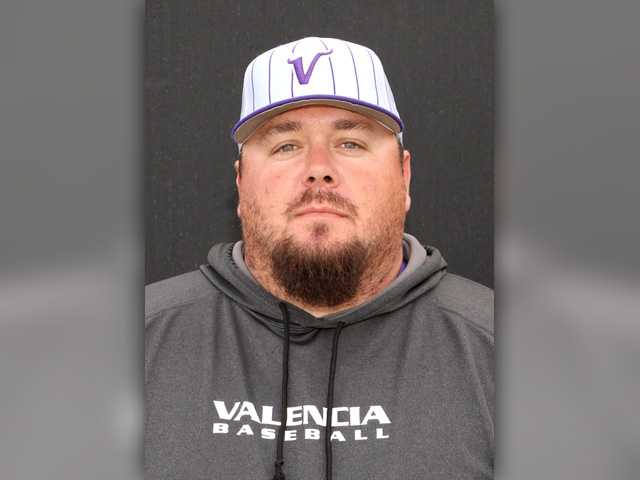
Editor’s note: This is the latest installment of an ongoing series we introduced earlier this year called Coach’s Corner, in which we feature Q&A sessions with prep and college coaches from around the Santa Clarita Valley.
Valencia baseball needed someone to take over the program early in the 2014 season.
After two Foothill League games, then-head coach Jared Snyder was put on a leave of absence.
Valencia Athletic Director Brian Stiman turned to Mike Killinger.
Killinger was the assistant coach for much of Snyder’s decade-long tenure, so he knew the ins and outs of the program.
As interim coach in 2014, he led the Vikings to a second-place finish in league and advanced the team to the second round of the CIF-Southern Section Division 1 playoffs.
Based on his accomplishments, Stiman offered Killinger the head coaching on a permanent basis.
This season Killinger and the Vikings — who open the postseason at home against El Dorado of Placentia on Friday — got their hands on the program’s first league title since 2011.
We had a chance to catch up with the Valencia coach to talk about teaching science, stepping into a head-coaching position and his background in baseball.
Q: Let’s get the basics out of the way. What got you into the sport?
A: I played my entire life — since I was about 8 years old — and played in high school and college, and I wanted to stay involved in the sport. So I took up coaching.
Q: Did you grow up in the Santa Clarita Valley?
A: No, I grew up in Washington state.
Q: What was it like growing up there?
A: I grew up in a small farming town, so it was kind of your typical small-town life that you’d expect.
Q: What college did you go to?
A: I went to Central Washington University, and I played two years of baseball there. I played first base.
Q: I just finished up school, so I’m curious what was life like after college for you?
A: I graduated with a teaching credential, and I went to a job fair in Tacoma and got hired on the spot by Valencia High School. This was in the spring of 1999. To get hired on the spot was pretty awesome, and then I decided to move down here to see if I liked it. Obviously I did, because I stuck around.
Q: I noticed you’ve been teaching science. Have you been a science teacher the entire time?
A: Yeah – a variety of classes, but mainly biology and anatomy. Some earth science back in the day.
Q: Why science?
A: I just always enjoyed it growing up. It’s the little subjects that captured my interest, and I just thought it was pretty good to get into.
Q: Were you ever the kid that would pick up bugs or venture into the wild? Was that what sparked your interests?
A: I think it was more about trying to figure out how things worked and how things bloomed. I was never the bug-spider-snake-typed kid.
Q: When did you become an assistant coach at Valencia?
A: (In) my first two years, I was the freshman head coach, and then I moved up to junior varsity for two or three years. Then I was the (varsity) assistant from 2005 all the way until I took over two and a half years ago.
Q: Obviously you took over the program under tough circumstances. What was the transition like?
A: It was a difficult time. It was hard because of trying to take over right in the middle of a very tough situation, but the kids made it easy. They just bought in and we kept going.
Q: How does it feel to be the head coach of the team after two years? Are you comfortable with it yet, or are you still learning the ropes?
A: The whole (thing about) being able to call the shots and control the game how I want is fun, but it does take getting used to. I think I’ve been able to utilize input from other coaches and other things to help make decisions. ... It takes some getting used to, but I think I’m pretty comfortable with it now.
Q: You’ve been praised for being calm in certain pressure situations, how do you keep your cool in those situations?
A: No kid ever wants to fail in a situation – no kid wants to make an error, no kid wants to throw a ball away, so I don’t think it does any good to freak out and yell and scream at any point. But I may look calm on the outside sometimes, but I’m not on the inside. I have a good ability to hold it in until the appropriate time.
Q: I talked to some former Valencia players and they mentioned that coaching had prepared them to play beyond high school. What do you guys do to prepare your players for college sports and life?
A: There are two sides to coaching. There’s teaching them the skills and the fundamentals and all that kind of stuff. But the other side is teaching them how to overcome adversity when it happens, work hard when things aren’t going their way and know how to focus and know how to train yourself in a way to be successful.
Q: What’s your favorite part of coaching?
A: Seeing the kids succeed is the best part, by far. Whether it was the kid who was less talented and was able to perform or it was the kid that performs beyond the high school (level). That’s the best thing, and you’ll see them go out and experience the joy of baseball because there’s so much frustration in it that when you have that success,
Q: So when you were playing baseball, was that one of the things your coaches taught you? Or what were some of the things your coaches taught you that you still teach today?
A: Perseverance, because baseball — and you’ll hear the cliche — is a game of failure. You have to know how to handle the bad because the good is going to be only so good, but the bads sometimes are really hard, and so you’re going to have to be able to overcome those times, and the strongest survive.