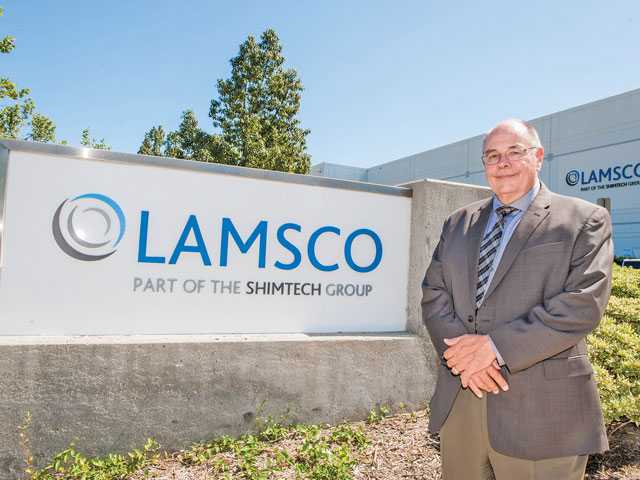
Aerospace supplier Lamsco West Inc. of Santa Clarita threw open the doors to its new, state-of-the-art, 75,000 square foot building on The Old Road by Henry Mayo Drive – a move that cost the company some $4 million to double its space and increase capacity. And, it completed the move without skipping a beat in supplying high performance parts to any of its clients.
Lamsco produces high-tech versions of shims – parts used as wedges to align parts, close gaps, or make parts fit tightly – for commercial and military airplanes.
“With the official opening of this new facility, we are absolutely delighted to be cementing the foundations for the next phase of exciting growth at Lamsco,” said CEO Howard Kimberley.
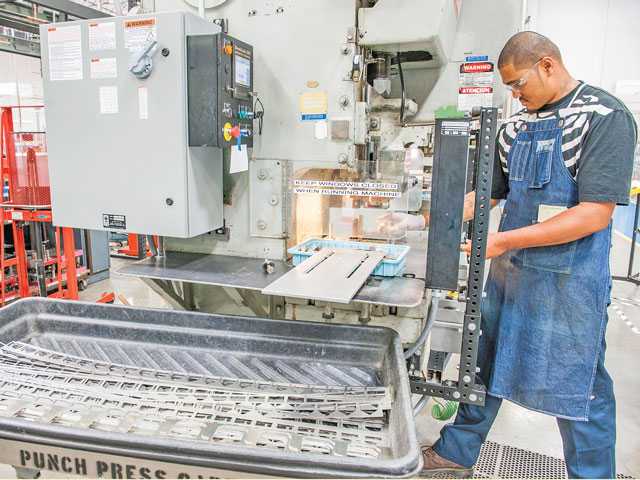
Not your grandfather’s manufacturing shop, aside from the high-tech computerized machinery, the open floor space is well lit with skylights and LED lighting. Heavy duty ceiling insulation drops the ambient temperature by 10 to 15 degrees.
And a special massive environmental ducting system continuously sucks out any dust or debris from the shop, leaving the air smelling clean and a pristine clean room in the computerized machine shop.
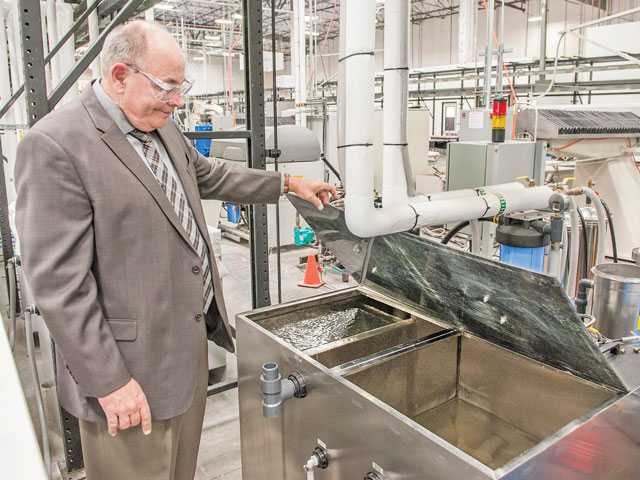
Even the water used in the manufacturing process is cleaned and recycled, eliminating discharge into the sewer systems.
The investment Shimtech has made in Lamsco will help set even higher benchmarks of performance, which in turns brings greater value to its customers, Kimberly said.
How Lamsco creates its products, however, is a fascinating process to witness.
Production
Holding approvals from all North American airframe manufacturers, Lamsco was originally founded as Pacific Hills Manufacturing, founded in 1961. Today Lamsco, a division of U.K.-based Shimtech, is the largest single manufacturer of shims and laminated shim stock in the world for the global aerospace industry.
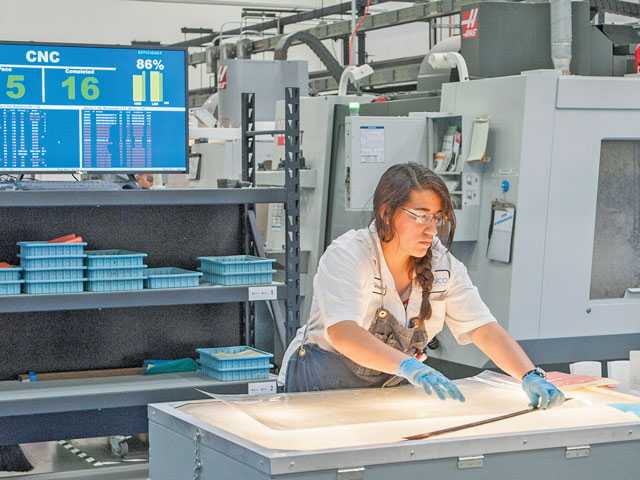
Five years ago or more, every part was made out of metal. Today, solid metal-like sheets of varying thickness are made by adhering layer after layer after layer of materials from tinfoil to stainless steel to titanium. Every single layer is treated for corrosion.
The tinfoil products, for instance, are layered until the sheets measure in various fractions of an inch and the finished product looks like a solid metal plate. But, each layer measures as little as .003 inches and can be peeled away. Other products can be peeled away at .002 inches.
Composites
“We make composite panels of different thicknesses,” said Steve Griffith, president of Lamsco. “Boeing takes some of the panels (intact) and we machine tool the others in-house to produce the shims.”
The multiple layering process serves two purposes – it results in a stronger sheet of material; and it makes the end product adjustable, allowing aviation mechanics to peel back the layers as needed to ensure perfect fit for the shims.
Composite sheets are carefully encased in heavy black plastic to protect them from ultra violet rays, he said. Sheets can run from $50 to $6,000 per sheet. And all those sheets are later used to make parts.
Parts
Somewhat simplistically, like leveling a kitchen counter or installing a front door to a house, Lamsco manufactures shims of all shapes and sizes to fill any number of needs throughout the building of an airplane – whether a shim is needed to fit a cargo door, fill a gap, or to help lift the flaps on the wing of a Boeing 777.
Producing five to six million parts per year, running in cost from 50 cents to $5,000, Lamsco efficiently tools parts in 20,000 different shapes and makes 35,000 shipments a year. But producing massive volumes of shims isn’t a matter of merely creating a precision tooled part.
Those composite parts also need to be “lightening resistant” – in other words, you don’t want electricity passing through a plane full of people thousands of feet up in the air and then make contact with fuel in the wing or plane, Griffith said.
And so, Lamsco also insulates the materials as it layers them in the manufacturing process so that its parts do not conduct electricity.
Employing their own proprietary manufacturing system for production, used by some 150 employees, Lamsco inspects every single part it produces. It even has a special operations unit for customized production that comprises five to 10 percent of its business.
But, operating as a manufacturing plant and relocating are two different stories.
The move
Key suppliers couldn’t be left hanging while Lamsco moved its massive operation, inventory, systems and machinery.
“Those are $150 million planes; there were no chances of putting them on hold,” Griffith said. “We pre-built all parts that would need to be shipped out to be prepared for the move. We moved from Anza Drive to here without any shortages (of parts) and without creating any delays for Boeing.”
To ensure operation without interruption, its IT department built in a triple redundancy along with a Halon fire extinguishing system, a dry fire suppression unit to protect the servers from water in event of a fire.
Awards
That attention to detail has earned the supplier eight of nine excellence awards from Boeing, among the aircraft builder’s 14,000 suppliers. In 2012, Lamsco also won Supplier of the Year from them, Griffith said. It maintains a 99 percent manufacturing rating for quality and delivery; it won a Boeing Performance Excellence Award in 2013.
“That’s highly unusual for a company making parts this small; a company our size,” Griffith said.
And speaking of size, Lamsco traces its roots back to 1961. It relocated from Glendale to Santa Clarita in the 1980s, Griffith said. But Griffith is no stranger to his key supplier, Boeing. In 1997, Lamsco West opened a division in Kent, Washington, to manufacture shims and provide Lamsco West with an in-house painting source for Boeing Shims and fillers. Named Lamsco Northwest, Griffith was the General Manager of the division when the company was acquired by Shimtech in 2005.
As for revenue, the privately owned Shimtech doesn’t release gross sales or revenue figures, but Griffith assured us it was in the many multi-millions of dollars annually – at least healthy enough to continue expanding, acquiring firms, and investing.