It was still dark when Lloyd “Lou” Lubensky took off with 4,000 pounds of bombs on the morning of June 6, 1944 — he was heading for the beaches of Normandy on D-Day.
He was part of a flight of 64 B-26 medium bombers of the 322nd Bomb Group that morning.
“Our first mission was to knock out the German guns that were firing at all the boats,” Lubensky said. “It was a complete failure.”
Lubensky’s second D-Day mission was to create bomb craters on the beaches to offer cover for the landing troops.
“We bombed the hell out of that beach at Normandy just to make fox holes” he said.
According to the National D-Day Memorial website, Lubensky’s B-26 twin engine bomber was one of 11,000 aircraft involved in the D-Day invasion of Hitler’s “fortress Europe” that day.
“Operation Overlord” involved more than 5,000 allied ships and landing craft supporting the 150,000 American, British and Canadian soldiers that swarmed onto the beaches of Normandy in France 72 years ago.
“I was completely awed by the number of boats in that channel. It was just unbelievable and I took pictures of it,” Lubensky remembered. “We were flying at only 1,500 feet, close enough that the pictures I took were pretty good.”
But all of Lubensky’s photos of the D-Day landing were confiscated for security reasons.
He entered the service as an infantryman at age 17 in May 1940 and then applied for the U.S. Army Air Corps — not yet called the Air Force — where he excelled in high-speed code transmission during radio school training in Illinois. This skill earned him a technical rating, equivalent to staff sergeant. Lubensky was just 19 years old when he was commissioned as a flyer in 1942.
Now, at 93, Lubensky, wears a colorful golf shirt, bearing images of WWII bombers. He’s the last of his crew.
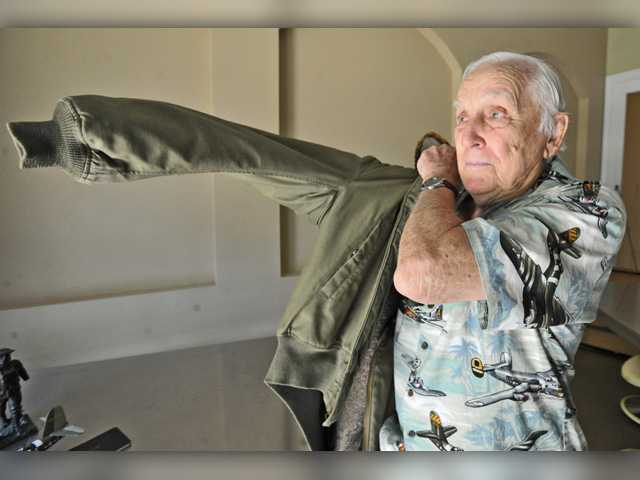
His squadron “stopped having reunions because there’s none of us left,” Lubensky said, standing in the clubhouse of the gated community in Valencia where he now lives. He pulls on his olive-drab flight jacket. He adjusts the fur collar and then zips up the quilted jacket — it still fits just fine.
“This was original issue ... what they gave me when I started flying in combat, without it you’d a froze to death,” he said.
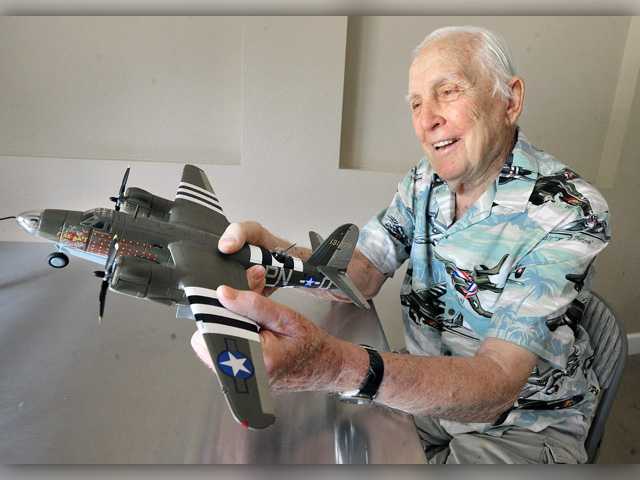
Lubensky was part of the 322 Bomb Group, the “Nye’s Annihilators.” He flew 70 missions in Europe from 1942 to 1945 in the Martin B-26 Marauder, a twin engine bomber which carried the same bomb load as the famous B-17 four engine bomber, but with a shorter range.
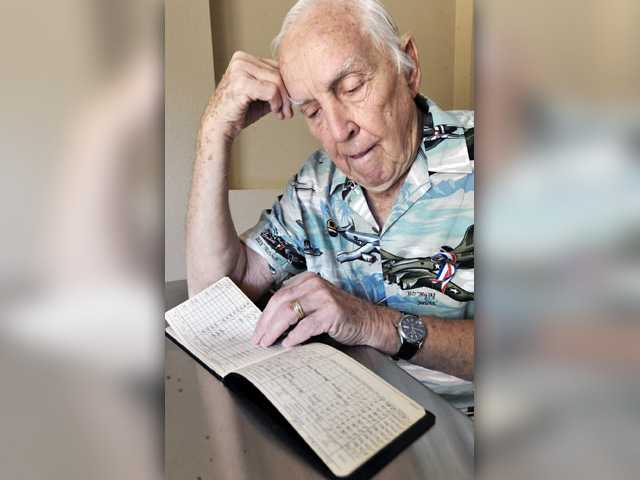
“Twenty-five missions was the normal tour of duty, I had flown 48 but they said, ‘You have to fly until we get replacements,’” he said. “A normal mission was 36 bombers (each) with a crew of six. We flew at around 300 miles per hour.”
Lubensky piloted many harrowing daylight and night missions over France, Holland and Germany, but he remembered the day in February 1944 when he had to crash land at his home base in England. Flak had knocked out all the hydraulics in his plane. Only the nose gear was down and the bomb-bay doors were locked open.
Lubensky ordered four other crew members to bail out. Co-pilot Ed Vollenweider and pilot Lubensky stayed to bring the plane in. He made a perfect two-point landing on only the nose gear and the tail skid.
“The plane I crashed in was named ‘Patches’ and I can’t praise the plane enough,” Lubensky said. Living up to its name, Patches was repaired and flying again in two days.
“Since I lived through it, I guess it was an exciting adventure. A lot of guys didn’t live through it, but it was a job that had to be done.”
He remembers seeing many bombers full of his comrades knocked out of the sky.
“I was just lucky,” Lubensky said. He never received a scratch.
Lubensky left the Air Force as a captain and returned home with 13 Oak Leaf Cluster medals and the Distinguished Flying Cross. He went on to earn a degree in accounting from the University of California, Los Angeles, and made Los Angeles his home. Later, he owned an aircraft parts manufacturing company that made parts for NASA’s Apollo 1 project.
Lubensky never piloted a plane again.
“I kind of regret that,” he said, holding a metal scale model of a B-26 bomber.
But he did return to Normandy in 1992. He walked on the same beaches that he’d bombed 48 years earlier, and visited the American Cemetery and Memorial, looking for the friends that he had lost.
He shook his head.
“The thing that gets to you when you walk in the cemetery is the tombstones — unidentified, unidentified — that kind of impressed me the most.”