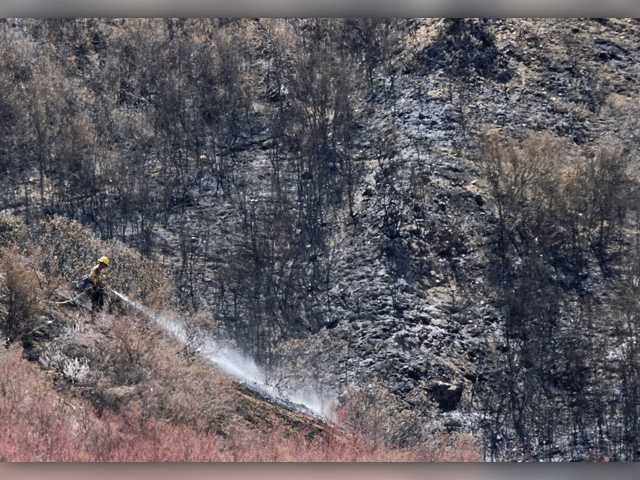
As firefighters continued Monday to rein in what’s left of the Sage fire that burned 1,100 acres on Santa Clarita Valley’s West Side last weekend, investigators scrutinized fire pattern indicators as small as a bent blade of grass in a bid to determine the cause of the blaze.
The fire in the Stevenson Ranch area was declared 85 percent contained Monday as some
700 firefighters remained on the lines overnight Sunday and kept it from expanding through the day Monday. No homes were believed lost to the fire.
An investigation into its cause was under way, Fire Department Inspector Gustavo Medina said.
“Typically, we begin by looking at the fire pattern,” Los Angeles County Fire Investigator Randy Brown said of the job that follows knocking down flames and hosing off hot spots.
“Investigating brush fires, for instance, we look at micro and macro indicators,” Brown said. “Trees would be a macro indicator. Micro ones might be the way the grass lays.
“Typically, in light grass, the blades of grass lean towards the origin of the fire,” he said.
And determining the origin of the fire is key, he added.
“We’re constantly working back towards the origin of the fire,” he said.
Brown, in an interview with The Signal about investigations into fire causes, said he could speak only in general terms, not specifically about the Sage fire. He said he and his fellow fire sleuths completed at least eight mandatory classes to become official state fire investigators.
When they emerge from fire school fully trained, they are subjected to a series of purposely set fires used in practical testing.
The trained fire investigator looks at the big picture and also at the microscopic, which they refer to as macro and micro indicators.
If witnesses can point to where they believe the fire started, all the better, Brown said. The investigation becomes challenging when no one can say where it started.
A case in point would be a fire started by a lightning strike with no one around to witness the ignition.
“In that case, we go to the weather stations which document all lightning strikes,” Brown said.
One of the realities fire investigators are compelled to face, however, is that not all fire origins can be identified and labeled.
Particularly difficult to determine are originals if fires that grow very large, Brown said.
“When the fire runs for a long time and the brush fire, typically, grows big, you come to an area we call ‘the area of confusion,’” Brown said, referring to indicators that seem to contradict each other.
For example, the cause of last year’s Calgrove fire, which burned more than 415 acres in Newhall, was undetermined, fire officials said more than a month after the blaze was doused.
If Fire Department investigators suspect a fire was caused by human activity, the investigation is turned over to Sheriff’s Department fire investigators, said Assistant Fire Chief Gregory Hisel.
Also speaking in general terms and not specifically about the Sage fire, Hisel described fire investigation as a “combined work effort” with Fire Department investigators working closely with their counterparts at the Los Angeles County Sheriff’s Department.
“If they suspect there is a human factor they will notify law enforcement right away,” Hisel said. “If it’s arson, it becomes a law enforcement criminal investigation. Even if it looks like it has the potential for arson.”
One fire that was determined to be human-caused was the Buckweed Fire, which destroyed 21 homes and charred more than 38,000 acres, mostly in Saugus and Canyon Country, in October 2007.
A 10-year-old boy playing with matches during high winds was blamed for touching off the fire.
The case went to the District Attorney’s Office, but prosecutors declined to file charges.