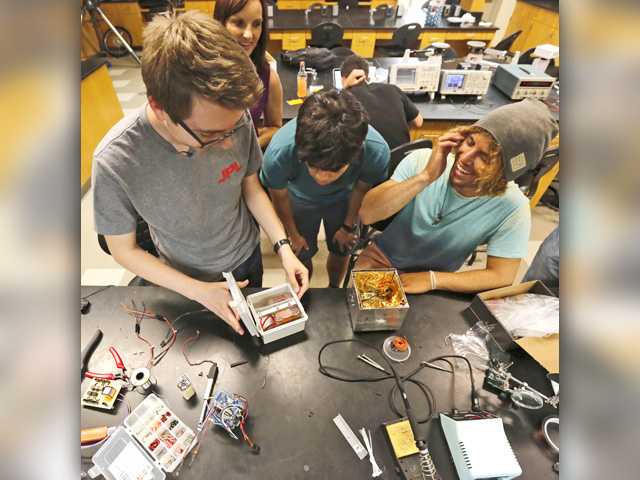
College of the Canyons has become one of four community colleges to build a science balloon as part of the High Altitude Student Platform program sponsored by NASA.
A six-person team will be traveling to NASA's Columbia Scientific Balloon Facility in Palestine, Texas, from next week to test the science balloon to assure it is prepared for its launch in late August from Fort Sumner, New Mexico.
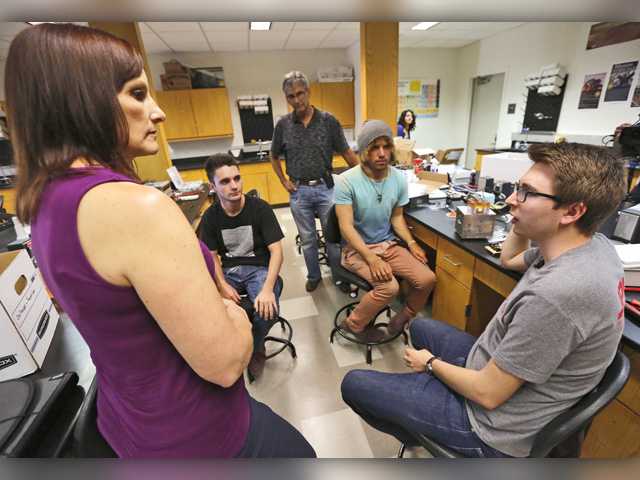
“I am excited to watch the students be creative, be innovative and be competitive with multiple universities,” said Teresa Ciardi, faculty adviser for the program and a professor for general education sciences at College of the Canyons.
College of the Canyons will be among 120 colleges, including the Massachusetts Institute of Technology, that have launched a science balloon as part of the High Altitude Student Platform program during the past 10 years it has existed.
The project at College of the Canyons was spearheaded by Daniel Tikhomirov, a 20-year-old engineering major, who was originally inspired by his 12th grade astronomy teacher at West Ranch High School, Christine Hirst, to build such a science balloon.
In fact, this is not the first balloon Tikhomirov has made.
In 2014, with the assistance of Hirst and five other students, he built a balloon that soared 87,000 feet high and was in the air for two hours until it landed in a backyard in Pasadena.
Unfortunately, all the data was lost because the balloon encountered a barbecue upon landing.
Tikhomirov has used his experience building his last balloon to improve upon the science balloon he is building at College of the Canyons. He expects this science balloon to go up to 124,000 feet high and stay in the sky from five to 24 hours.
The science balloons are used to capture Interstellar Dust Particles, otherwise known as cosmic dust. The samples tell about how the early solar system was formed.
“I have a contact at Johnson Space Flight Center, Dr. Susan Lederer, who is going to work with us to analyze the particles, which may result in a published astrophysics paper,” Ciardi said in a news release.
Eight students with the assistance of two faculty advisers have spent 200 hours since January making the science balloon. Support for the project was provided by the COC Foundation, while the trip to Texas was funded by the COC Center for Applied Competitive Technologies.
“We’ve had full support from the administration since Day 1,” said Tikhomirov.
The High Altitude Student Platform program is supported by the NASA Balloon Program Office and the Louisiana Space Consortium. It will install a camera onto the weather balloon platform so students can watch a live feed from home when their science balloon is launched at the Columbia Scientific Balloon Facility in Fort Sumner as early as Aug. 25.