The summer’s high temperatures and long, sunny days have driven up ozone levels in the South Coast Air Basin, exceeding the national standard during all but three days since June 17.
Since that date the Santa Clarita Valley has seen 24 days that exceed the national standard for ozone, according to the California EPA website.
On three of those days, the valley had the highest ozone level recorded for the entire South Coast Air Basin, which takes in parts of Orange, Los Angeles, Riverside and San Bernardino counties.
Hot days increase the ozone in the air, said Sam Atwood, spokesman for the South Coast Air Quality Management District.
“It is unfortunate that we have had weather this summer that has produced high levels of ozone, which has serious health effects,” said Atwood.
Ground-level ozone has the potential to cause many short-term and long-term health problems, Atwood said.
Short-term health problems include coughing, wheezing and watery eyes. It can drive up the number of hospitalizations in communities.
Long-term effects include heart and lung disease such as asthma in people with no previous history of the condition, as well as premature death.
Ground-level ozone is just one of the pollutants monitored by the Air Quality Management District. Others include particle pollution, carbon monoxide, sulfur dioxide and nitrogen dioxide.
Environmental activist Lynne Plambeck blames high ozone levels in the Santa Clarita Valley for her adult-onset asthma.
“I used to be a runner, and it got to the point where I had very bad asthma,” Plambeck said Monday. “I couldn’t run anymore.”
Atwood said the Santa Clarita Valley tends to have high ozone levels because wind pushes ozone emissions toward the valley from the Los Angeles area as it blows inland from the coast.
“It is basically at the end of a conveyor belt of slow-forming emissions,” he said.
Eighty-five percent of ozone emissions in Southern California are still caused by motor vehicles, but only 25 percent of ozone emissions are caused by passenger vehicles, according to numbers provided by the AQMD. The other 60 percent comes from trains, ships, aircraft and construction equipment.
Port areas like Long Beach and Los Angeles are the biggest source of air pollution in California.
Still, air quality officials urge residents to reduce household and vehicle pollutant production, including reducing driving, using electricity efficiently and reducing the use of paints and solvents.
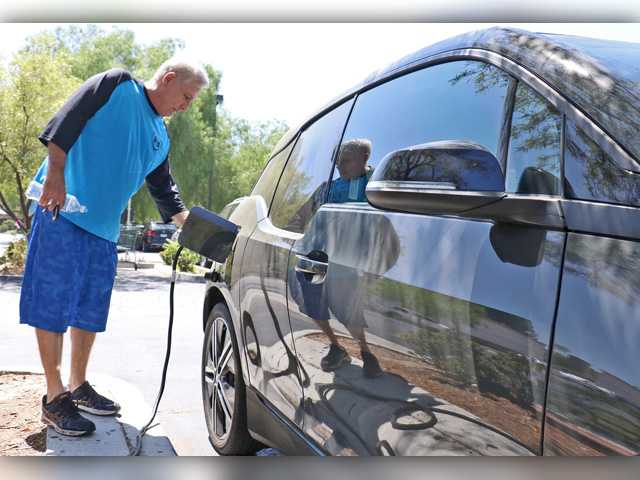
Atwood suggests combining errands to reduce vehicle emissions and considering the purchase of electric vehicles.
Santa Clarita Valley residents who are considering an electric car should keep in mind that the city of Santa Clarita is working to support and expand public charging infrastructure locally.
“We are going to need a transformation to zero emission and near-zero emission vehicles” to reach the goal set by the Environmental Protection Agency's Clean Air Act, Atwood said.