Our group of climbers readied to scale a mountain on Aug. 11, the night before our ascent on Washington’s Mount Rainier in knowing we would be doing more than climbing the 14,410 foot high mountain.
We were about to make our climb in honor of my sister Lauren, now nine years into remission from breast cancer, and raise more than $30,000 to support cancer research. Our bodies would propel us up the steep mountain, but our donor’s funds would help to work miracles.
The group of climbers included Mike Leum, John Rodarte, Robert Sheedy, Lisa Lampkin, my son, Eric, and me. All but Eric are active members of Sheriff Search & Rescue Teams; Lisa from the Orange County team, Mike, John and Robert from the Montrose team, and I from the Santa Clarita team.
This climb was a reunion in a sense for Mike, John, Robert and myself as we had summited Rainier nine years ago, raising over $25,000 for cancer research.
The night before the climb we set out on Seattle streets looking searching for dinner and found a small Italian restaurant tucked away on a side street. Five courses later, it was one of the best Italian meals we had ever had. We could feel our good fortune was only beginning, and now the next day’s climb was on.
Muir Camp and onward
With alarms going off early, my son Eric and I and the team travelled to the Alpine Ascents by 6 a.m. It was then a 2.5 hour van ride to Paradise National Park at the base of Rainier.
One half hour later we were beginning an all uphill, six hour hike to Muir Camp. The first part was packed with tourists, but they disappeared the further we advanced and the quieter it became.
Within an hour we were hiking in snow, weighted down with 40-50 pound packs, advancing one step at a time. Six hours later, Muir Camp and the stone-plywood hut that would be our abode for the night was a welcome sight. Bunk beds consisted of plywood planks with half-inch sleeping pads. I won’t describe the joys of having to use a pee bottle or the “carry-them-out” blue bags.
Morning greeted us with a huge breakfast in the Guide tent, followed by ice axe and crampon training, along training to cut down on fatigue while walking, and the teaching of safety maneuvering and self-arresting with the ice axes.
Confidence and excitement mounting, we donned our gear and stood ready for rope team assignment – each team consisting of three to four people spaced 25 feet from each other for safety reasons should one slip or fall into a crevasse.
First stage
Eric and I were assigned to climb with Dawa Sherpa; Dawa means Monday – the first name of all Sherpa’s is the day they were born – and her last name is Sherpa. Born at 14,000 feet in Nepal, Dawa, 25 had already scaled Mount Everest, and was part of the first women’s team to climb K-2.
Weather was exceptional; sunny skies and warm temperatures prevailed.
The hike to the first high camp was short, no more than 2 hours and another 1,000 feet gain, working across a crevasse field, switch-backing up loose rock, and at times steep outcrop ever mindful of rock falls that occur with no warning.
“Have your head on a swivel,” to watch for loose rocks a guide told us. More than 100 people have died attempting the climb according to MyNorthwest.com analysis.
Working around deep crevasses, mindfully watching the threatening haggard rock walls to our side, we climbed up the slope.
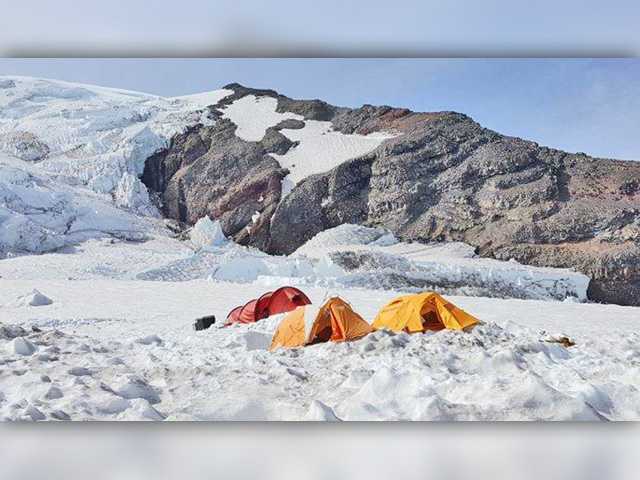
Reaching the first high camp, a series of tents were tethered to mountain side to remain earthbound in the higher winds. Dinner was served in the group tent as we prepared and strategized for our next day’s climb. The meal was an amazing stew, sprinkled with Fritos and cheese.
Bedtime came at 4 p.m., sleeping in a mummy bad on a pad anchored to a glacier surface. We would begin climbing again later that night at 11:30 p.m. Sun filtered through the tent walls making sleep difficult. Breakfast was served at 11 p.m.
Shuffling to the food tent, Dawa was already melting snow for hot drinks and cooling the water that we would be carrying up the mountain. It was recommended that we carry two liters per climber.
I only drank hot chocolate mixed with coffee; a nagging stomach bug concerned me.
The ascent
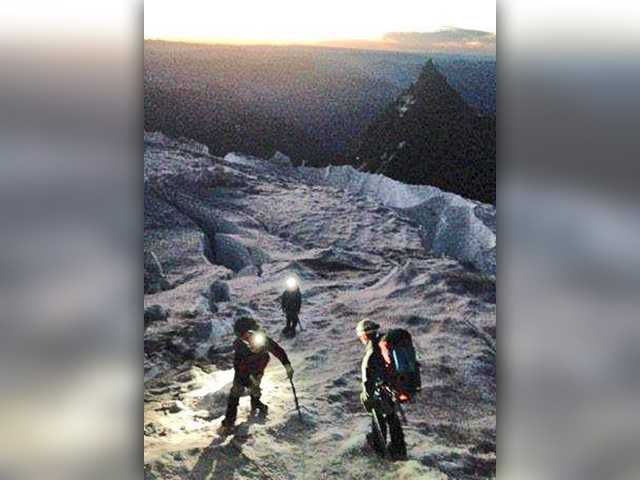
Roped up, headlamps on, we began our assent hiking across the glacier and then ascending alongside a very large bottomless crevasse near the glacier’s debris field.
Crossing a number of smaller crevasses, we soon faced ‘Disappointment Cleaver’ – perhaps a 1,000 foot high rock face that had the hint of a trail worn from years of ascents.
Loose difficult footing, steep drop-offs, and threatening rock falls challenged our climb. The 25 foot roped space between us was shortened to 5 feet so we could move as one, each take their steps knowing that we survive together.
Occasional cries of ‘rock’ warned us to press against the rock face or crouch down. Except for the cone of light from our headlamps, there were only the stars and the moon lighting our way.
It was a sensory heaven. The sights combined with the effects of high altitude, time spent together with my son, new friends, spectacular views, awesome stories, and the magnitude of the mountainous world in which we placed ourselves, added to the effect – along with a great cause for which we scaled the face of the mountain.
I had a number of proud moments watching my son Eric interact with the mountain and our team. This was not a beginner’s climb and Eric was handling it like a pro.
In the midst of one tough section Eric calmly said, “Dad, maybe next year we should do a fishing trip.”
Nearing the top
Now reaching 13,200 feet, we prepared for the final two to three hour climb to the top of Cleaver and then Mt. Rainier.
Checking on the climbers, we were asked how we felt on a scale of one to 10. I registered a barely audible ‘four.’ The nagging abdominal bug and altitude combined made me nauseous.
I had to make a choice. Waiting an hour or two might have helped repress the sickness, or not. I, and one other climber, chose to call it a day and head back to high camp. Eric chose to join me and see me safely down. The experience we shared on our climb together was already his reward, he said.
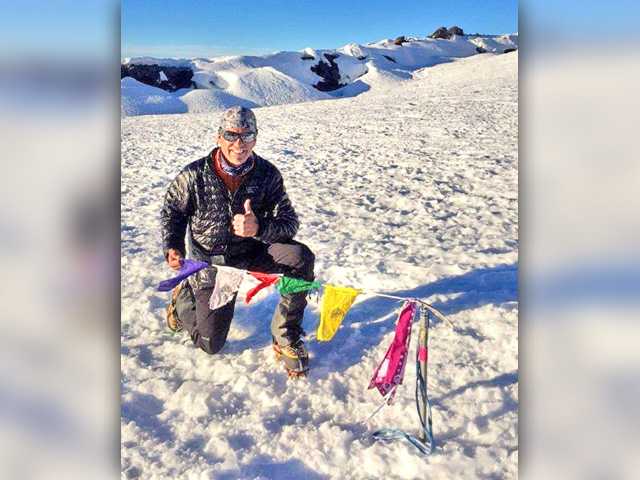
Mike Leum, Search and Rescue Group Leader and 25-plus years Search & Rescue Team member, agreed to take my prayer flag to the top.
That was important to me, as it had the names of many who had struggled with cancer, and my resolve was that the flag needed to summit.
Dawa adds John to our rope and sets up Eric to lead us down Disappointment Cleaver to the high camp.
Down-climbing is always more difficult. Darkness hid the extent of the drop-offs. Positioned away from the rock and wall of the mountain, falls and balance can be more severely affected going down. Later in the day, a woman broke both her legs along this path.
Return to the glacier
Early dawn greets us we make it to the bottom of the rock face and step off onto the glacier.
Thirty minutes later we are back to our tent and stretching out to rest. We awake a few hours later to the brightly shining sun heating our tent.
Hours later we get word that our other team – Mike, Lisa, Robert, and Dan and Liz - is heading down the mountain after successfully summiting the mountain.
We were thrilled for them and knew there would be amazing stories to hear and photos to see.
Backtracking through the crevasses and rock faces we faced to reach high camp, we were mindful of the growing heat which causes more rocks to fall as ice bonding the crumbing rock face begins to melt.
We see an avalanche of rock fall where we had passed hours earlier when coming down from our summit effort. The rumble and cloud of dust reminds us of how we are merely mortals. The best of climbers can perish in these moments.
Return home
An hour later we reach our starting point, Muir Camp, and prepare for the three to four hour hike back down to the Paradise parking lot and civilization.
No more roping in, crampons, or ice axes. No more avalanche beacons. And, on this late Sunday morning, we are able to don T-shirts for the descent.
Behind us lay the adrenaline of the adventure and wonderment of the new experiences as we walked our heavy packs down the snow fields to the alpine meadows. Pulse and respirations continued to calm as the altitude diminished.
Again, the number of people taking day hikes grew exponentially the closer we got to Paradise.
Upon arriving, we loaded reached the waiting Alpine Ascents Van to begin our trip back home to our families. But resting first, laying back and looking back up the mountain was a momentary heaven. It had been four wonderful days.
But, the hot dogs and apple juice from the park cafeteria was amazing too.
Two hours later, the rest of our team came out of the trailhead and joined us. High fives, hugs, pictures, and contentment resounded.
Our trip was now culminating with a celebration dinner, a two-hour drive back to Seattle, and another night at our hotel, and then the flight home to family.
Soon the time on Rainier would simply be a wonderful memory, while adding lasting impacts on our confidence, our resilience, our appreciation for life, and yes, our own contribution towards the eradication of cancer – perhaps even in our lifetime.
Readers can make donations on this Fred Hutch Researcher fight cancer website, at this
at this link: http://getinvolved.fhcrc.org/site/TR?px=1028801&pg=personal&fr_id=1480&et=lXLv6j447FikkI2lYgewnQ&s_tafId=15981
Editor’s Note: Ken Wiseman is the CEO and Managing Partner of Valencia-based AMS Fulfillment. After his team raised $30,000 – he and his son raised $10,000 of that – the group of climbers toured the Seattle-based Fred Hutchinson Cancer Research Center where researchers were studying a new chemical compound that can go into the body and search out tumors for targeted treatments. It is this research center where the climbers donor’s funds would be working miracles.