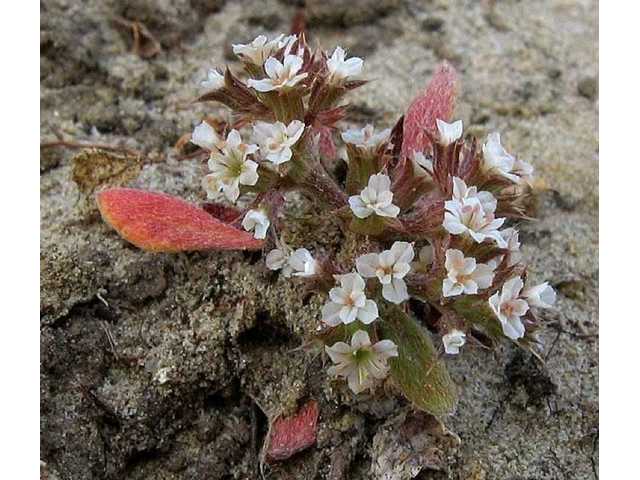
An extremely rare, tiny white flower may prove to be another blow in the Newhall Ranch new housing project.
The San Fernando Valley spineflower — so rare it was once thought to be extinct — grows in only 10 locations between the Santa Clarita Valley and Orange County.
Poised to be added to the nation’s list of endangered species — much to the delight of environmentalists — it is on the verge of getting federal protection.
It is also named in lawsuits aimed at stopping 21,000 homes being built for the Newhall Ranch housing development.
In response to a settlement with the Center for Biological Diversity to speed protections for 757 species, the U.S. Fish and Wildlife Service proposed Thursday to protect the San Fernando Valley spineflower as a threatened species under the Endangered Species Act.
“It’s wonderful news that this plant has finally been proposed for the Endangered Species Act protection. The Act can ensure it sticks around for future generations to enjoy,” said John Buse, senior counsel at the Center.
Historically, the flower was found in washes and sandy areas in the foothills of Los Angeles and Orange counties.
However, the spineflower was thought to be lost to development, according to Buse.
Scientists thought the species was extinct from 1929 until a population was discovered in 1999 in Ventura County and the service placed the flower on the candidate waiting list for protection. The next year, the flower was discovered in the SCV within the footprint of the planned Newhall Ranch development project.
Newhall Ranch
Buse and the Center for Biological Diversity named the spineflower in a lawsuit filed against Newhall Land and Farming, the developers for Newhall Ranch, in January 2011, alleging the housing project would destroy the flower’s natural habitat along the Santa Clara River.
In March 2012, the center named the spineflower when it sued Los Angeles County for having approved Newhall Ranch. Environmentalists asked the court to review the legality of the county’s approval process.
It was the center’s lawsuit against the U.S. Fish and Wildlife Service, however, that prompted the agency’s move to have the spineflower protected.
In 2011, the center and the wildlife service reached a landmark agreement requiring the agency to make decisions on all of the plants and animals on the candidate waiting list by the end of this fiscal year.
“This added federal protection is needed and welcome, because the current plan is inadequate to safeguard this unique wildflower from development,” Buse said.
Multiple petitions to protect the flower have been submitted over the years: the city of Calabasas (1999), the Santa Monica Mountains Conservancy (2000) and the Center for Biological Diversity (2004). It is already protected from development in Ventura County because it grows in a designated open space preserve.
Under the Newhall Ranch development plan, however, the developer proposed a conservation plan that allowed the company to remove part of the population in exchange for creating preserves to protect about 75 percent of the plants.
Federal protection
Protection under the federal Endangered Species Act, however, would require the developer and state to work with the wildlife service to develop an expanded and supplemented conservation strategy, Buse said.
Before the service finalizes protection for the plant, the public is expected to get a chance in the next few months to weigh in on plans.
The federal government has one year to act on the recommendation made by the U.S. Fish & Wildlife Service.
Developer Newhall Land suffered another setback in November 2015 when the California Supreme Court said the developer’s Environmental Impact Report failed to prove its project was consistent with state guidelines to control harmful greenhouse gas.
In February, the courts dealt another blow when they turned down a request for a chance to restate its case.
As developers work toward revamping their environmental proposals in response to state court rulings, they now will also have to revamp similar proposals relating to the spineflower if federal officials add it to the list of endangered species.
661-287-5527
on Twitter @jamesarthurholt