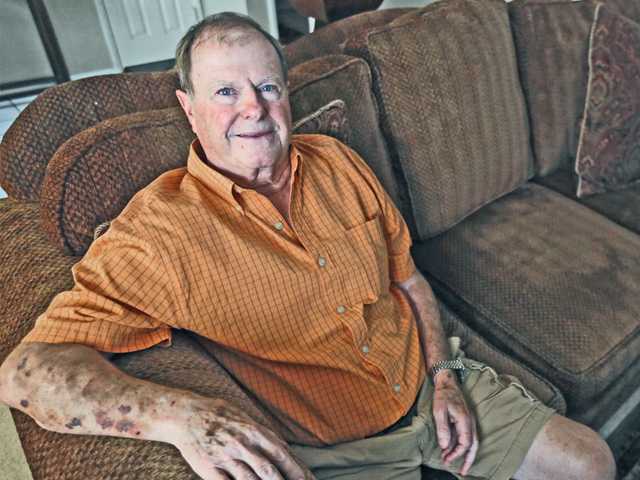
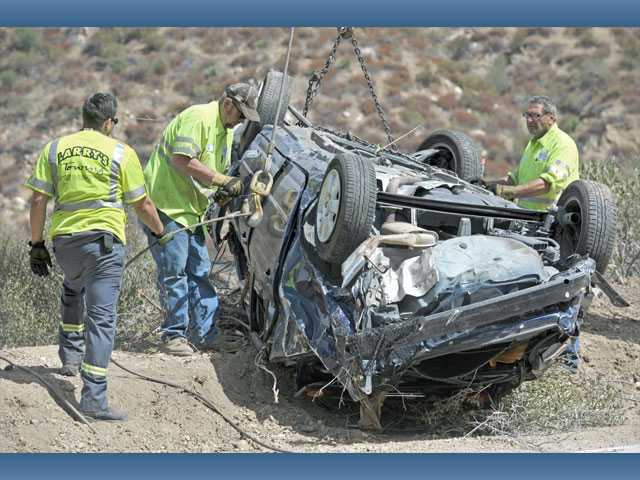
Five years after he drove over a cliff off of Lake Hughes Road, plunged 200 feet and survived, David La Vau is still hurting, still recovering and still in need of surgery but still has the love of his family who found and rescued him, he said.
When his interview with The Signal was set to begin Thursday, La Vau tried once to get up from the couch inside his daughter’s Canyon Country home but, instead, he fell back into it.
He tried a second time to stand but also fell back. He tried to stand a third time until his daughter, Chardonnay, helped him up.
Once on his feet, the man who in 2011 survived a life-threatening crash and then survived a week without water or food at the bottom of a ravine, managed to smile and share a joke.
He’s lived with pain, flashbacks, nightmares, hallucinations and, specifically, all of the nasty psychological effects common among sufferers of post traumatic stress disorder.
“I am so overwhelmed by the love and help of my family,” he said. “They went above and beyond. And I’m alive because they didn’t quit on me - and that has keep me alive.”
On the morning of Sept. 28, 2011, the La Vau children went looking for La Vau when they hadn’t heard from him in a couple of days. They searched canyons and ravines near Elizabeth Lake and along Lake Hughes Road.
On Thursday, La Vau talked to The Signal about the crash, his survival, the rescue and his recovery.
Hope saved him
“I was screaming every 30 minutes,” he said Thursday, reflecting on his plight at the bottom of the ravine. “And, I gave out one last squeak which I thought no one’s going to hear.”
That was the faint cry heard six days after his crash by La Vau’s son, Sean - the cry that led to his rescue.
“There were times I got feeling really down, times of really feeling sorry for myself, but every time I felt like that I would go over and look at my friend in the car and then I’d snap out of it,” he said.
When La Vau crashed at the bottom of the ravine, his car landed right next to another car that had gone over the same cliff, at the same spot, just two weeks earlier. That driver – his “friend” - was not as lucky as La Vau.
When searchers found La Vau at the bottom of the ravine between Castaic and Elizabeth Lake next to his own crumpled car, they also found the body of 88-year-old Melvin Gelfand, dead inside his crumpled Toyota Camry.
At the time of crash, rescuers reported that Gelfand’s car contained groceries.
La Vau, who survived eating bugs, flowers, leaves and branches, dismissed suggestions Thursday that he could have eaten Gelfand’s groceries to stay alive.
“There were no groceries, just folded up plastic bags,” he said. “I wasn’t hungry until the fifth day.
“I ate bugs, between 10 and 20 bugs, but they were tiny,” he said. “Then I ate flowers, leaves. I went to branches. I ate a spider. I ate a bumble-bee. The bumble bee kept annoying me for two or three days so I hit it with my hat.”
La Vau said he bit half the bee and almost threw up. “I took one bite to crack him in half and all this yellow orange blue yellow green stuff came out. I almost threw up because if was so nasty.”
What kept him alive, La Vau said, was hope.
The rescue
“I had no doubt that my family would realize I would be gone and that they would be looking for me,” he said.
He was right.
When paramedics finally rescued him, La Vau had three broken ribs and multiple other injuries.
What he didn’t realize then, but could clearly appreciate five years after the fact - is that some injuries took a while to reveal themselves.
On the day of the interview, La Vau was recovering from recent surgery to his left shoulder. He had to make a decision, he said, as to what shoulder should undergo surgery first. He also suffers nerve damage and from neck injuries which were not immediately evident at the time of the crash.
Then there’s the flashbacks which he’s experienced only lately, he said.
Asked if the flashbacks were good or bad, he said they were neither. “They were memories,” he said.
La Vau went through a long phase of constantly reliving the crash, he said, episodes that still occur.
Then La Vau paused from listing five years’ worth of ailments, pain and medical treatment.
“I lost my independence,” he said, noting a deep appreciation for the children and family who have helped him each step of the way.
The future
La Vau’s amazing story of survival is expected to be told in a book he hopes to see published soon.
At one point, there were considerations of a movie deal and a film to be made about his ordeal. And, during those discussions, the director had arranged for La Vau to revisit the site of his crash and confront his demons as it were.
“We were getting involved in a movie to be made and there was a crew that did go back there. And, it took a while for me to edge my way to look down at the bottom at the (crash) site,” he said.
Looking over the cliff was so steep, La Vau said, that he could only see the rock when his daughter held him as he leaned farther over the edge. He was looking for a rock he described as a “mini flying saucer.”
Finally, he said, having looked down the near vertical drop of rugged cliff side, he saw it.
It was the rock he landed on, he said, when his car finally hit the bottom of the ravine, smashing his car, breaking his bones and placing him on a six-day struggle that was the most demanding challenge of his life.
661-287-5527
on Twitter @jamesarthurholt