If passenger rail cars passing through Newhall Tunnel No. 25 lean too far to the left or the right inside the long and narrow underground passageway, disaster strikes.
Physically, the 140-year-old tunnel leaves engineers little room for error and emergency crews even less room for rescues.
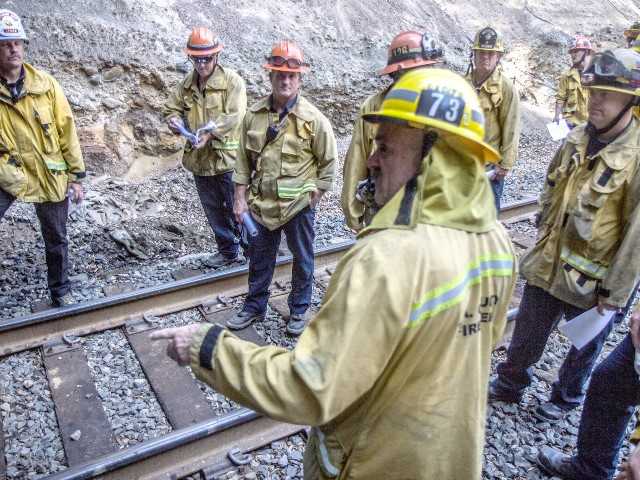
And that was the top concern for County Fire Battalion No. 6 Chief Chris Rash during a routine drill for such an incident.
“Thousands of people travel through this (tunnel) on a daily basis,” Rash said.
“Trains run through here every 30 minutes.”
Mile-long risk
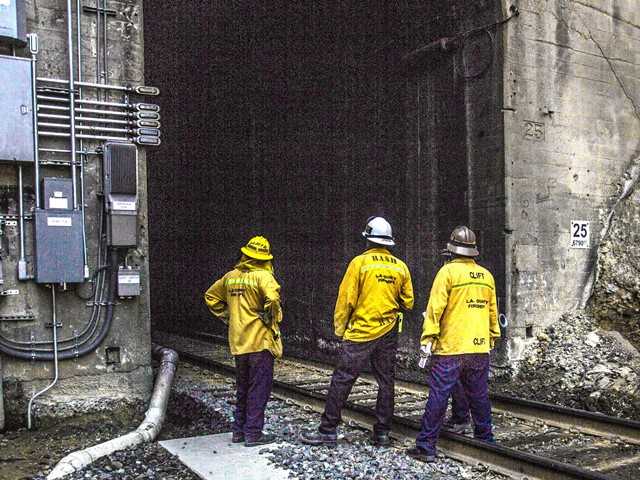
Built in 1876, the mile-long rail tunnel runs an underground route beneath Interstate 5’s interchange with Highway 14, south from Pine Street in Newhall to San Fernando Road in Sylmar.
It ferries thousands of commuters and travelers each day.
Fire crews met for an early morning training at the Newhall County Water offices near Newhall Avenue, about a mile from the tunnel's entrance.
A fire hydrant outside the office is the closest water source to the tunnel, so water would be very lacking, Rash said.
In the case of a train fire, “we would have to create a very elaborate system to provide water to the firefighters,” he said.
The obstacles and hazards cited by officials continued as long, low-hanging power lines which prevent a water tender from entering a narrow dirt road used to access the rail line.
But the convoy of red fire engines pressed on, kicking up a cloud of dust in their wake.
A large oak tree growing in the middle of the road added to the response time as the crews negotiated the oversized vehicles over roots and bumpy ground.
After about a mile in, the road ended and crews had to continue to the tunnel on foot.
“If we had injuries and casualties, getting those folks out of this area is going to be a significant challenge for us, due to accessibility,” Rash said.
For us to get to that tunnel, we are going to have to hike about a quarter of a mile from the end of the road, he said.
After a brisk climb down an embankment, the crews reached the rail bed leading to the dimly lit, concrete tunnel.
No room to work
Rash quizzed his battalion, asking if anyone knew how many feet of space existed between trains and the concrete walls.
The answer? One to two feet.
The chief then amended his question: how much space exists if the train derails?
The answer? Virtually none.
“If that train jumps the rail and accordions, how much room do you have with an attic ladder,” a crew captain asked.
The man dressed in yellow protective clothing explained a hypothetical inability to reach the damaged cars’ escape windows because of inaccessibility and a lack of space.
Passengers and first-responders could be trapped in the tunnel.
Plans for response to a train fire where temperatures can reach in excess of 2,000 degrees Fahrenheit inside the 6,790 foot tunnel were also discussed.
“Those things (trains) have 5,000 gallons of diesel in them,” the captain said.
“Who’s to say that once you’re inside and commit, that thing doesn’t catch on fire.”
Because County Fire is an all-risk agency, they follow procedures for several different scenarios and levels of precariousness.
But, an incident inside the lengthy underground passage would force responders to combine many of their tactics – and in some cases, without communication from deep within the bowels of the underpass.
“We need to be better prepared so we perform well in the event that we actually have the misfortune of a bad accident like we did in 1996,” Rash said, referring to a deadly train crash in the Cajon Pass.
That matter involved the fiery, high speed derailment of a freight train carrying hazardous chemicals.
Evacuation Limited
Rash’s main concern was for any evacuations of Metrolink passenger cars passing through.
Existing plans to remove crash victims through an exit door was modified because trains now have engines running on both ends. Recent configurations would prevent easy access to the passengers.
“We would have to find a way to physically remove anywhere from a couple of bodies to a full train load,” Rash said.
“That’s six, seven, maybe 800 folks.”
A glimmer of hope
Despite the challenges, improvements made over the last two years have helped to minimize the likelihood of a Metrolink passenger train speeding out of control.
Rail engineers have employed Positive Train Control, a technology aimed to cut down on human errors in relation to overspeed and failure to stop the train at red signals.
A train that slammed into a Hoboken, N.J. terminal Thursday morning killing one person did not have this technology on board.
Legislation introduced in 2008 mandated the installation of PTC technology across most U.S. railways by Dec. 15, 2015.
In Oct. 2015, Congress extended the deadline by three years.
According to a New Jersey Transit Rail report, none of their trains have the collision avoidance technology installed.
Newhall tunnel
Last year, Metrolink became the first commercial passenger rail agency to deploy PTC across its entire system.
Local emergency crews, however, are still exercising caution and stressed the importance of finding a way to ensure the safety of first responders and the passengers placed in their care.
If something disastrous happens here, “you're talking about getting more manpower than you can get ahold of,” a fire captain said.
“I’d basically call for the world.”