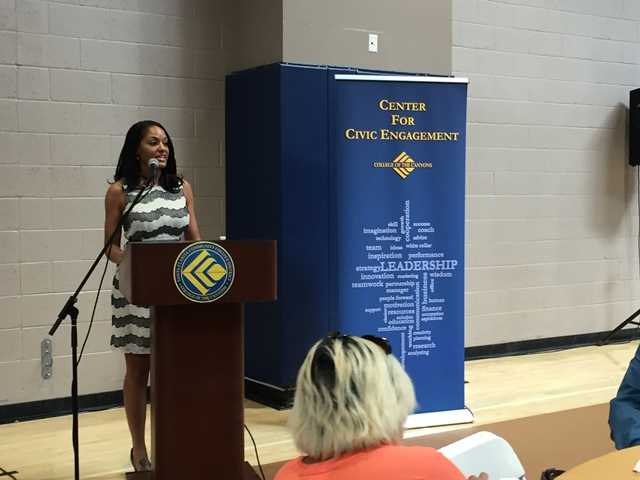
“You are beautiful. Have you ever tried modeling?”
Those were the first words Rachel Thomas, a survivor of human trafficking and director of the Sowers Education Group, heard from her oppressor, tormentor.
Thomas shared her story as a keynote discussion during a day-long seminar titled “It Happens Right Here! Understanding Human Trafficking” on College of the Canyon’s campus.
The seminar, presented by COC’s Center for Civic Engagement, COC’s Student Health and Wellness Center and SCV Committee on Human Trafficking, aimed to shed light on the fastest growing crime in the world.
Larry Schallert, assistant director of Student Health and Wellness Center, said organizers wanted to address the details of the issue including how to recognize human trafficking, the differences between labor trafficking and sex trafficking and how it is manifested in the community.
“A lot of students are interested in the global problem of human trafficking, but there are also a lot of students that are interested in the micro-problem right here in ‘Awesome Town,’” Schallert said.
“Students are really taking it on as their generation, their fight.”
And personal accounts, like Thomas’, shine a light on how anyone can become a victim of human trafficking.
Thomas’ story is unlike what is portrayed in Hollywood movies like “Taken.”
‘10 months of hell’
She was a happy Emory University student with a good education and armed with what she calls an ideal childhood.
However, she said her naivety is part of what contributed to her “10 months of hell” as a victim of sex trafficking, manipulation and abuse.
When she was approached twice at a club during her junior year of college, Thomas cautiously accepted an offer from a man named Mike who claimed to be the top modeling agent in Atlanta.
He was generous at first, offering to pay for her first photoshoot and getting her booked on a music video; however, it did not take long for him to flip a switch.
He became abusive, hitting another model during a road trip and coercing Thomas into the world of human trafficking through intimidation, violence and threats.
“About five weeks after being a happy college student, I was a victim of human trafficking,” she said.
The cycle of abuse and coercion continued until police contacted Thomas 10 months later. With the help of her family, Thomas was able to find healing and use her story to save lives.
“I’m here to turn my mess into a message and my test into a testimony,” she said. “I’m here for prevention, for restoration and to save lives.”
Thomas offered the approximate 300 audience members advice on how to spot signs of human trafficking and how to help and support victims of human trafficking.
Schallert and other event organizers hope the seminar drew attention to the issue, educated providers on how to recognize human trafficking and empowered individuals to address the problem head-on.
“We’re hoping to inspire a new generation of students to address this issue on a local level and a global level, and to teach them the differences between cyber trafficking and labor trafficking and sex trafficking,” he said.
661-287-5575
On Twitter as @_ChristinaCox_