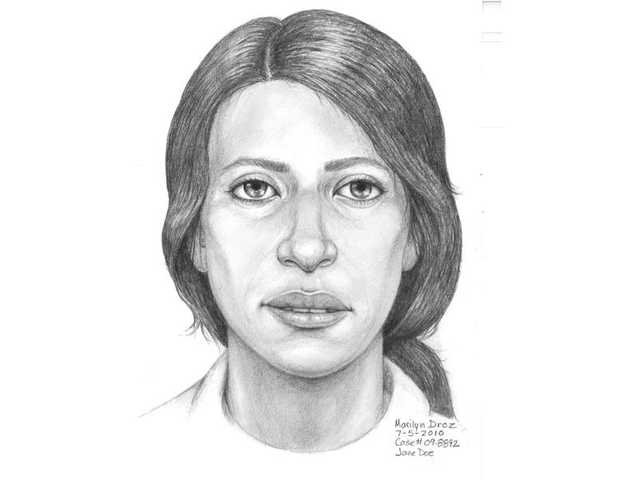
Hikers found her skull partially buried in a ravine west of Angeles Forest Highway at mile-marker 19.
The only thing left near her bones were a few pieces of yellow metal jewelry: a necklace and three bracelets — one with six pink stones, another with six blue stones and the last with six green stones.
Since the skeletal remains were found Dec. 26, 2009, in the remote and rugged forest east of the Santa Clarita Valley, investigators haven’t been able to figure out just who the bones belonged to. But now she is more than a pile of bones — she has a face.
Los Angeles County Coroner’s investigators on Wednesday released an artist’s sketch of what they believe the woman looked liked. They hope her picture will look familiar to someone — a family member, a friend — who will be able to give her a name.
Until then, she’s Jane Doe No. 87, an unsolved case in the County of Los Angeles Department of Coroner’s investigation bureau.
“It’s extremely difficult to identify someone if they’re not in the (DNA) database,” said Los Angeles Coroner Assistant Chief Ed Winter. “So, we have to go on any missing-person reports for anything that comes close. Eventually, we go to a composite drawing.”
The woman is believed to be either white or Hispanic, 20 to 40 years old.
Her bones may have been in the Lucas Creek area of the Angeles National Forest — south of Acton and north of La Cañada-Flintridge — several years before the 2009 Station Fire raged through the area, Winter said.
A second and even more mysterious set of bones were found near the woman, but investigators haven’t determined if they belong to a man or a woman.
The Coroner’s Office investigates about 300 unidentified skeletal remains found in Los Angeles County each year, Winter said, and about 90 percent eventually get identified.
Since December, its officials have been working with law enforcement from as far away as Jefferson City, Mo., to identify the woman, he said. Officers try to match the dental records of missing people with the skeletal remains.
So far, a match hasn’t been made.
“The anthropologist works with a composite-sketch artist, and they do reconstruction with clay. They’re able to approximate what the person looked like,” Winter said. “Sometimes, it’s right on. Sometimes it doesn’t quite represent.”