Part 2 of 2
In Part 1 last Monday , we covered John Palladino's early career as a top Hollywood recording engineer. We left off as he began to recall engineering many of the historic Frank Sinatra sessions for Capitol Records between 1953-1962. That's where we'll pick up today.
Frank Sinatra's affinity for musicians, especially the first-call, A-list players on his sessions, was well-known.
"Frank would crack wise with them and talk in their language," said John Palladino, 90, relaxing at his home in Friendly Valley. "He knew what his music should sound like and he was excellent at describing it. And he knew when he didn't perform well - he would walk out of the studio if it wasn't a good night. But when it was, he knew it. So we always tried to make it as comfortable as we could for him."
"The Voice" didn't like singing his part from a vocal isolation booth, and overdubs were equally disdained.
"He had to sing with the band," Palladino said. "There was no way we could cut tracks and have him come in later to do the vocals. So the musicians were up on the stage and I would put him down below on the floor to give him a little shielding, not a complete isolation booth. He wanted the musicians to see him, so they'd be able to interact.
"And he was a great singer in his knowledge of how to use a microphone," he said. "You knew how he was going to sing and he never surprised you with things that would get you in trouble. It was just a pleasure."
Sinatra wasn't a fan of mulitple takes, either, Palladino recalls. "So if you didn't have your balance right when he was ready to go, it was kind of tough for the engineer - there was a little tightrope-walking. If he happened to sing well and you happened to muff the balance, it could get a little unpleasant. He'd say, ‘You got it on the last one. Goodbye!' And that was it.'"
The singer did usually nail his "keeper" vocal within a few takes, but one famous exception was the 22-take marathon session for his cover of Cole Porter's "I've Got You Under My Skin," for 1956's "Songs for Swingin' Lovers" album with arranger Nelson Riddle.
"(Sinatra) was always so much a perfectionist - I could never fault him for that," Palladino said. "If a guy is that good and you have to suffer a bit, you have to go along with it."
Most of Sinatra's Capitol albums were themed, and the third, "In the Wee Small Hours," arranged by Riddle and recorded from March 1954 to March 1955, was a stripped-down affair showcasing the singer crooning ballads with spare piano/guitar/strings accompaniment.
The demise of Sinatra's relationship with Ava Gardner in fall 1953 apparently contributed to the singer's melancholy, which was not hard for his musicians and studio crew to translate to vinyl.
"The mood he created was just fantastic," Palladino said. "And that's the only album I got a NARAS plaque for. I didn't think it deserved one, though, because that wasn't the hard one to do. It was relaxed and didn't have a lot of strings or complicated arrangements, so it was an easy one to do."
In 1956, Palladino engineered the first session recorded at the new Capitol Studios in the Vine Street tower - "Tone Poems of Color," conducted by none other than Sinatra, in the smaller Studio B, the first room fully operational.
"He conducted a large orchestra, about 60 pieces jammed in the room, recording things by different arrangers," Palladino said.
None of the production crew, from Sinatra on down, was happy with the new room's sound, but fortunately they were able to fix the recordings in the mix for final release.
"I was never happy with the record," Palladino said. "It takes months to work out techniques for the proper use of a new studio, so it took time to develop those studios the way we wanted."
As a staff engineer, Palladino worked at one time or another with just about all the artists on the Capitol roster in the 1950s and into the ‘60s, as well as special projects including what came to be known as the world-famous Olympics theme song, "Bugler's Dream," which he produced as well as engineered.
Conductor Felix Slatkin, a veteran of Sinatra sessions among others, had commissioned French film composer Leo Arnaud to write a piece for Slatkin's "Charge!" album in 1958. Arnaud composed "The Charge Suite," a section of which included "Bugler's Dream."
A decade went by, and in 1968 Palladino got a call from Slatkin telling him ABC television was using "Bugler's Dream" as the theme music for its coverage of the Winter Olympic Games in Grenoble.
"It was a complete surprise that this unknown track received such recognition and became so well-known around the world," Palladino said.
In the mid-1960s, Capitol brass named Palladino a full-time staff producer and A&R rep. But the times, driven in part by music and pop culture, were changing fast that decade, fueled in part by The Beatles and various controlled substances.
And Palladino's old-school look - sport shirt, tie and crewcut - was often at odds with the colorful counterculture character of his charges.
"I was a little uncomfortable because I didn't think my image matched," he said. "But we experimented with different groups. We had Quicksilver Messenger Service, The Band, a girl group called Joy of Cooking, and The Steve Miller Band.
We tried getting into the San Francisco scene but we were behind. Most of the groups were already taken. Clive Davis at Columbia was a very smart guy."
Capitol encouraged its new groups to record in the label's studios, but by then, the idea was considered unhip. After all, that's where Sinatra had recorded, and young people did not revere him as the icon their parents did.
"Steve (Miller) thought I'd been in the Marines or something because of my crewcut," Palladino said. "He did finally make albums in the Tower."
(Miller, a protege of electric guitar and recording pioneer Les Paul, actually fled to London to cut his first Capitol album, "Children of the Future," in 1967 with producer Glyn Johns. Later, Miller recorded his biggest-selling multi-platinum albums, 1976's "Fly Like A Eagle" and 1977's "Book of Dreams," at his home studio, with Palladino serving as his in-house production/A&R contact at Capitol.)
Some of the groups were reluctant to cut at Capitol Studios for other non-musical reasons, too.
"They had a lifestyle that would not work in a studio that's frequented by all kinds of people," Palladino said, raising an eyebrow.
Translation: They wanted a studio open 24/7 where they could entertain guests (read: groupies), drink and do drugs without some producer hassling them.
"No, they couldn't do that stuff at Capitol," Palladino said. "They loved these small studios that sprang up all over the place. They could go in anytime and do anything they wanted."
"The Beach Boys would not come in at all," Palladino said. "Quicksilver came in, but The Band never did. For them, we had to rent a house in Beverly Hills that had a studio and we brought in our recording equipment, so they could feel free. They were a wild bunch. I liked a lot of the music they made."
In 1982, after 40-something years, Palladino hung up his professional ears.
"By that time, I was 62 and retired a little bit early," he said. "I was tired and didn't like what was happening. Suddenly, all the artists wanted control of their own product. The creativity that once existed between management and artist was gone. And artists were telling us what to do all the time."
In the last couple of decades, the wildest bunch Palladino's dealt with has been his fellow seniors at Friendly Valley and St. Clare's Catholic Church nearby in Canyon Country, where he's a volunteer.
"I joined the Friendly Valley Association No. 5 board in 1985-1986, and have remained on and off (the board) as the years have gone by," he said. "I still serve in an advisory capacity."
Palladino spends a lot of his time at St. Clare's. "We have a Mass every morning, so I get in there at like 7:30 and make sure all the vestments are taken care of and everything's ready," he said. "I look forward to starting a new day that way with my friends.
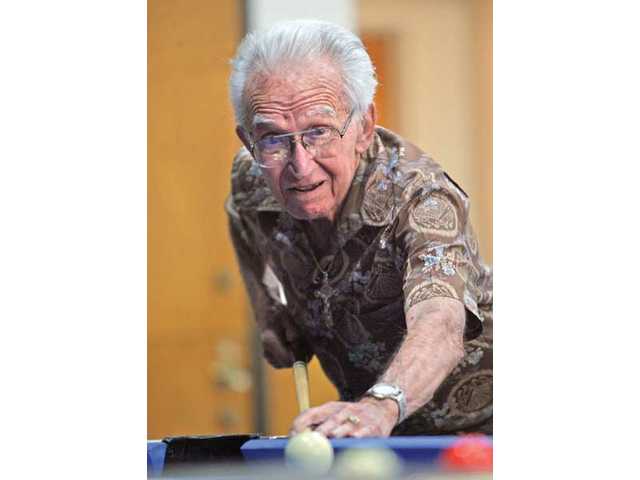
"After Mass on Tuesday and Thursday, the seniors retire to the hall, where the ladies knit or play dominoes and I do my best to shoot pool with the guys, although I'm such a sad example of a pool player, it's a big joke!" he said.
Palladino's wife of 48 years, Evelyn, died in 1999, but her son and his stepson, Hal Blanchard is alive and well, as are John's sisters Rose and Marie and brother Anthony (their fifth sibling, James, was a B-24 pilot killed during World War II). Palladino also has four grandchildren and 12 great-grandchildren, some of whom are just learning about his illustrious past.
Looking back down his long and winding road, Palladino is glad he wasn't in any other profession.
"To me, anyone in the music business when I started was very fortunate," he said. "That kind of career, and being in that environment - it was like, ‘How can I enjoy my work so much and still get paid for it?' There is no better job in the world than one where you can make music and get paid."
Peeples, Editorial Director in the Press & Artist Relations Department on the Ninth Floor at the Capitol Records Tower in Hollywood from 1977-1980, spent as much time hanging around in Studio A as senior engineer/producer John Palladino and senior engineer/studio manager John Kraus would allow.