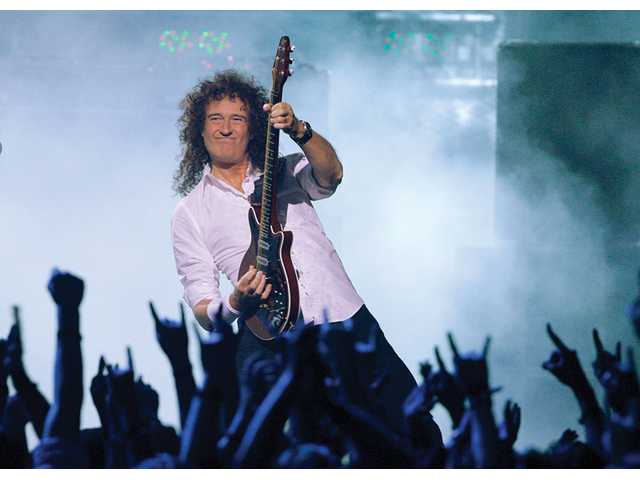
Queen released its first single 37 years ago — a song called “Keep Yourself Alive,” written by guitarist Brian May.
The irony behind the single is that Queen, despite the death of the incomparable Freddie Mercury in 1991, has kept its name alive through a variety of creative outlets.
Responsible for much of that is May himself.
The legendary guitarist says, though, he’s not sure what the future life of Queen is or how important it is to keep the band’s music in people’s streams of consciousness.
“I suppose I’ve lived with being able to be Queen for so many years, and I’ve now lived with not really being able to be Queen for so many years that the question is almost something I can’t answer anymore,” May says. “Queen’s music is still very much alive, which thrills me because it was such a big part of our lives, building it up and connecting with people. It makes me very happy that we’re part of people’s lives.”
Queen is one of the most successful bands in rock ’n’ roll history, having sold more albums than any band in U.K. chart history. They were inducted into the Rock and Roll Hall of Fame in 2001.
May, who wrote the seminal anthem, “We Will Rock You,” says that success opened doors for him to explore other creative outlets and bring them to the masses.
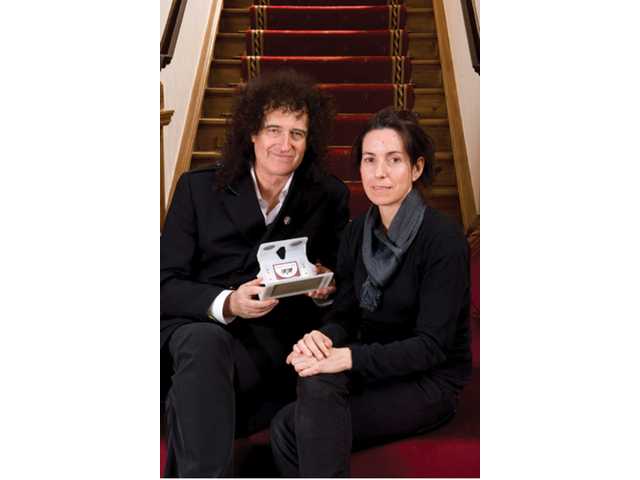
His latest project is a book titled “A Village Lost and Found” — a collection of the 1850s stereoscopic photograph series “Scenes in Our Village” by T.R. Williams.
May co-authored the book with photographic historian Elena Vidal. They will be together in Los Angeles conducting lectures and signing the book on Tuesday at the film and event venue Downtown Independent and next Thursday at the Leonard Nimoy Event Horizon at Griffith Observatory.
“I’m really channeling another artist,” May says. “This T.R. Williams man is somebody who I have a lot of empathy for, and I feel a lot of parallels in the way he was working with an art and a craft and science, as well and working with such inspiration and such perfectionism. So, I identify highly with this man.”
May turned 63 years old on Monday.
He keeps finding different ways to stay creative, musical and non-musical.
In 2005, May and drummer Roger Taylor went on the road for the first time as Queen since 1986, reforming with former Bad Company and Free singer Paul Rodgers. The trio also put out the 2008 album “The Cosmos Rocks” under the name Queen + Paul Rodgers.
In 2007, May completed his Ph.D. thesis in astrophysics.
“A Village Lost and Found” is his third book published since 2006.
May co-authored “Bang! The Complete History of the Universe” in 2006, and his thesis, “A Survey of Radial Velocities in the Zodiacal Dust Cloud,” was published in 2008.
Queen’s hit musical “We Will Rock You” has played in 21 cities across the world and is in its eighth year at London’s Dominion Theatre. It also had a run in Las Vegas.
May says he gets his drive and creativity from many places. First is his father, Harold, who, along with May, made the musician’s signature Red Special guitar out of a fireplace mantel and hodgepodge of other household equipment.
“For some reason, it’s in me,” says May of inspiration. “Maybe I felt it from my dad. My dad was always making things. He got great pleasure from fashioning things out of wood or metal or making machines or radios or televisions. I love making things happen and in some cases it’s making things, but more often it’s making a concept happen. I love to make an event happen which affects people or makes people happy or makes people think in some way, and I feel driven to develop ideas, I guess.
“I love the art of it, and I love the craft of it. I think most of those things have a part of this whole creation thing. There’s always the germ of an idea in a song, for instance, and the germ is a thing which is the art, in a sense. But the craft is turning that germ into a real song that means something, that sounds good and gets through to the listener, which makes him (or her) connect. So the art and the craft go together. I accuse myself of being more of a craftsman than an artist.”
At the moment, May’s art and craft is conducting research and writing books.
May, a stereo photograph enthusiast, spent the last 30 years compiling Williams’ stereo photograph cards of a small English village from the 1850s.
Seen through a stereoscopic viewer that accompanies the hardbound book and was designed and produced by May, the images appear 3-dimensional.
“This is the first time for 150 years that these pictures have been in one place and can be enjoyed in a complete work of art, and I think it’s a really great work of art,” May says. “It’s not my work of art. I’ve done a lot of craftsmanship on it, which I’m proud of bringing it into the 21st century. But this is the work of T.R. Williams, which I think is unique and special and very inspiring in the 21st century.”
May said he and Vidal are halfway through a book on the life and work of Williams, but the two have recently become distracted by another venture.
May and Vidal are collaborating on a possible book on French satiric stereographs from the 1860s called “diableries,” which depict little devils and skeletons in humorous and imaginative situations.
Musically, May has produced an album for English stage actress Kerry Ellis called “Anthems.” In it, he does a lot of the arranging and guitar work.
“I treated it like I treated a Queen project or my solo projects,” May says. “I don’t know any other way, really, to live it and breathe it and put everything you can into it, and she’s well worth it. She’s the most stupendous singer, amazing artist. And so really, that took the place of any solo work.”
As for a return to Queen, May said he’s not desperate to tour at the moment.
“Yes, if the right situation came up. We constantly toss ideas around. At the moment, I really don’t see a way,” he says.
“We had a very good adventure with Paul Rodgers and did some things we’re proud of, but that had a natural end. The thing we don’t want to do is put someone in there who will sound like Freddie and pretend to be Freddie. I would never regard that as a way of going forward. It would have to be something new and different, but something which we can continue to evoke the spirit of Queen.”
That spirit is something that is still very much alive as May’s drive continues to be as strong as when Queen was actively recording albums and touring.
But 37 years after that first single, and 35 after Queen broke through with “Bohemian Rhapsody,” May is reflective on what Queen has meant.
“I’d like to be remembered, I suppose, as people who lived and breathed and made music as passionately as it was possible to do. And who made people happy,” May says. “Queen was very much a people’s band. I talked about that fine line between art for art’s sake and art for an audience.
“We were very much conscious that we were playing to our audience, but we never played down to our audience. We always tried to lead them into a new place, an exciting place. So I guess I’d like to remembered as a group who was not afraid to be dangerous.”