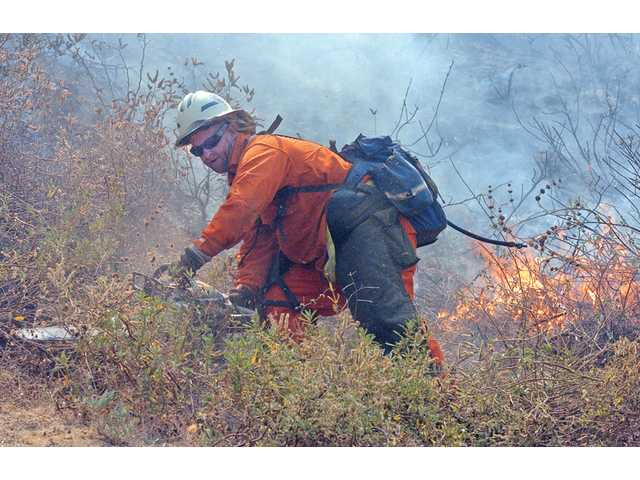
Los Angeles County Fire Department officials are urging Santa Clarita Valley residents to help protect their homes and prepare for the next brush fires, saying the area is among the most challenging in the world for firefighters.
Assistant Fire Chief Bill Niccum, who oversees the fire department’s response throughout the SCV, said the combination of a hot climate, drought conditions and brush with high oil contents make wildfires in the valley particularly fierce.
“In a Mediterranean, dry climate, brush has a high oil content that keeps brush alive during drought and triple digits,” Niccum said. “But when fire goes into that fuel, it burns very quickly.”
On Friday, two fires on opposite ends of the Santa Clarita Valley burned about 38 acres and left one person injured.
The first fire erupted east of Interstate 5 at Calgrove Boulevard. The second began along Escondido Canyon Road near Highway 14. Both threatened several homes, but firefighters contained them within a couple of hours.
Fire Department officials want homeowners in the Santa Clarita Valley to use its “Ready, Set, Go” plan to protect their homes. Residents should clear dense brush from around their homes, create an emergency plan in case of a wildfire and use metal mesh screens to seal vents from embers.
Niccum, 56, said embers are what spread fires the fastest.
“You have to ember-proof your house. When palm and Cypress trees burn, they shoot off millions and millions of embers,” Niccum said. “In the Buckweed Fire, five or six homes burned on Whites Canyon Road after a couple of palm trees blasted embers into those homes.”
Windy conditions only make the problem worse because hot embers can travel up to a mile, Niccum said.
Niccum, a Hart High School graduate, was promoted to assistant chief in June and has 37 years of experience within the Los Angeles County Fire Department.
Despite the difficulties firefighters in the SCV face, the department has an abundance of resources including a fleet of helicopters and planes, Niccum said.
“The Santa Clarita Valley is known worldwide for its complex, challenging wildfires,” Niccum said. “Division 3 is considered one of the most renowned fire fighting regions in the world.”