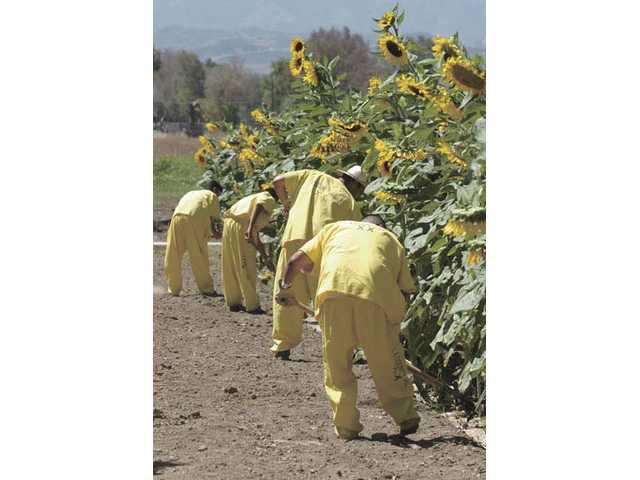
Beyond the Pitchess Detention Center’s barbed wire-rimmed fences are miles of white picket fences, pumpkin patches, horses — and a whole lot of history.
With the sun directly above, five prisoners using rakes and tills farmed a part of the pumpkin patch Wednesday afternoon while a prison guard yelled out orders. The inmates were dressed in bright yellow jump suits; “L.A. County Jail” was written in black letters on the back of the suits.
Most Santa Clarita Valley residents don’t know the Castaic jail compound includes 1,000 acres of farmland with a rich history that dates back more than 70 years.
But officials will open the prison’s gates Aug. 7 to give residents a tour of the detention center and learn all about it.
Proceeds from ticket sales will be donated to the Hope Gardens Family Center in Sylmar and the Southern California Special Olympics. Hope Gardens is a shelter for homeless woman and children.
“We’ve never done something like this before,” said Sgt. Gerri McCorkle. “We’re going to give a behind-the-scenes look. I don’t think people know what we do here.”
The prison can house up to 10,000 inmates on its 2,800 acres, McCorkle said, but the prison has been reducing the number of inmates it houses to save Los Angeles County money. Nearly all of the North Facility’s inmates were moved to other county jails in March. The North Facility, which can hold up to 1,800 inmates, was holding five inmates Wednesday, McCorkle said.
A Night at the Rancho will also give residents a crash course in the prison’s 72-year history.
Prisoners started coming to Pitchess in 1938, when the county bought the land where the prison was built, said Mike Fratantoni, a custody assistant. About 70 prisoners, mostly drunks and vagrants, were housed in a barn with little security. But this was before Interstate 5 was built.
“They could literally walk out if they wanted to, but there was no place to go,” Fratantoni said. ”There was a diner and old Newhall, but that was it.”
For inmates, prison wasn’t all that bad during the Great Depression, Fratantoni said.
“During the Depression, the prison gave them a home and a free meal,” Fratantoni said. “We got free labor, so it was a win-win.”