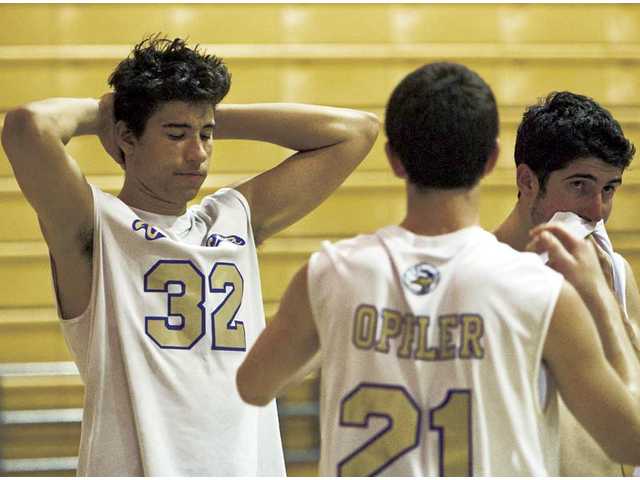
From 2001 to 2008, the Valencia boys volleyball team never lost before the CIF-Southern Section semifinals.
The past two seasons, the Vikings have done just that.
So why have they come up short?
Or have they?
"They've sort of created an expectation level that's so amazingly high with the years they made it to the finals," says Walt Ker, who coached Cal State Northridge to three national titles and established the Legacy Volleyball Club in Santa Clarita. "We talk about them making it to the quarterfinals like it's a terrible thing. You're talking about Southern California volleyball, which is the best in the United States. People need to have a little bit of perspective about it."
The perspective outside the Santa Clarita Valley is that volleyball is changing.
But not for the worst.
"I think it's just spreading the wealth," says Loyola head coach Michael Boehle, whose Cubs have won the last two CIF Southern California Division I Regional championships. "I think volleyball's becoming more and more popular out there. Now you're having more and more kids get interested, and more schools are becoming good at it."
One of the big reasons for the spike in popularity locally is Legacy, which counted no less than 34 Foothill League volleyball players among its five boys teams last summer.
Valencia used to have a vast majority of the club talent playing in the league. But Legacy has changed the balance, not by taking talent away from Valencia but by adding club players to other local schools.
According to Vikings head coach Mark Knudsen, that parity is what people should recognize about this past season, not his own team's perceived struggles.
"Golden Valley went farther than they ever have," he says. "Even though we didn't go as far, another team went farther. You could say the league is getting stronger because more teams went deeper than ever before."
Over the next decade or so, that parity should lead to more record-setting runs by local teams.
It should also help Valencia.
Ker uses an analogy with men's college volleyball. The Mountain Pacific Sports Federation is a 12-team conference home to strong programs like UCLA, Cal State Northridge and Stanford, and it receives an automatic bid to the semifinals of the NCAA Division I men's tournament every year. There are two other automatic bids that go to the other two major conferences, the Eastern Intercollegiate Volleyball Association and the Midwestern Intercollegiate Volleyball Association, and there is one at-large bid left over.
That at-large bid often goes to the second-best team from the MPSF because it's such a deep conference. Meanwhile, a school like Penn State plays with much weaker opposition in the EIVA and routinely wins the conference but struggles when it faces an MPSF team in the national tournament.
Ker doesn't blame other schools for whatever struggles Valencia may have. His point is that better competition will only benefit Valencia in the future.
"If they're playing better teams, it'll be better for all the teams," Ker says.
The Foothill League teams have already shown signs of improvement. In addition to Golden Valley's trip to the second round of the CIF-SS Div. II playoffs - where the Grizzlies lost to eventual champion Laguna Beach - Hart has gone from a doormat to one of the league's elite. Saugus has seen an infusion of talent, including setter Ryan Mason, who earned a scholarship to CSUN. Canyon and West Ranch have also seen infusions of talent.
The exposure to volleyball at an earlier age should help that talent base grow, considering the high concentration of good athletes in the Santa Clarita Valley.
"I think it would be inaccurate to imply that back in the day there was less talent in the league," Knudsen says. "We had outstanding athletes at other schools. There's been great athletes in the valley at all the schools all along, and I think there will continue to be."
How far those athletes and teams advance in the postseason over the next decade could be somewhat out of their hands.
For the past two seasons, the deep Marmonte League has competed at the Division II level in the Southern Section, which has made the field tougher.
For instance, Westlake and Thousand Oaks were both semifinalists this past season, and the year before, it was Royal that knocked Valencia out in the quarterfinals.
Boehle, who used to be on an advisory committee with the CIF, says that the league was moved down based on its performance in the 2008 postseason. He says the league will be back in Division I next spring, however.
"Until we determine a true Div. I policy or procedure, this is what you're going to get," Boehle says. "Some schools or some leagues need to go up and some need to go down."
Ker doesn't believe that boys volleyball in the Santa Clarita Valley is down. Instead, he believes that it will continue to grow and improve.
And the Vikings? It's more likely that they're victims of their own success than headed for mediocrity.
"There's a certain amount of, ‘What have you done for me lately?'" Knudsen says. "But the honest reality is winning a championship is an amazing achievement. It's a big deal. When it doesn't happen, you have to remember that it doesn't happen for a lot more people than it does happen for."