Headquartered in Indianapolis, Ind., the National Federation of State High School Associations is the governing body for prep athletics across the country.
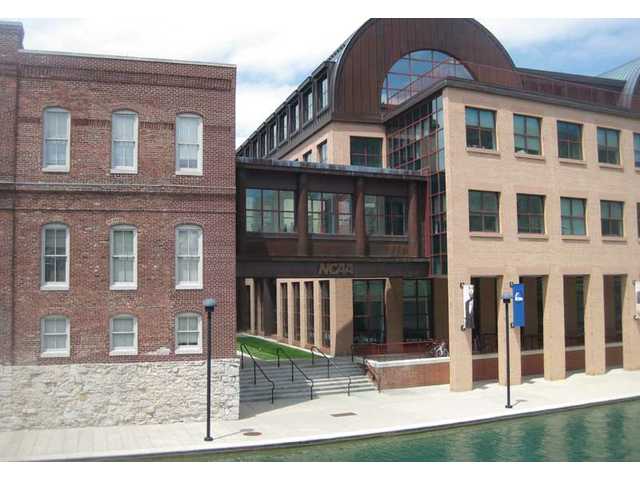
Not far from the NFHS are the main offices of the National Collegiate Athletic Association.
There’s a skywalk that links the two organizations, a bridge that represents the transition from high school to college.
The functions of the two organizations aren’t the same — or at least they shouldn’t be.
“As much as we are attached, they might as well be on Pluto,” says NFHS Director of Educational Services Elliot Hopkins.
The NFHS and NCAA are viewed on an equal plane, presenting options rather than progression.
In some ways, however, the nature of high school and college athletics are blending.
The college mentality is creeping into the high school setting, whether it’s transferring to a more successful program or enlisting the aid of private coaches.
“Administratively, we’ve had to deal with issues that are compounded by the NCAA model,” says Marie M. Ishida, executive director of CIF, the governing body of California high school athletics. “That model is really about competitiveness and about winning and losing to the point where we are getting, not a lot, but we are getting more high-profile athletes trying to transfer to schools where they might have a history of outstanding teams. Obviously, our rules are not conducive to that. We do eventually hit those (people) that attempt recruiting and school-shopping.”
There are regulations in place at every level of prep athletics that aim to preserve the essence of the high school experience.
But along the way, the benefits of athletic excellence developed a mentality that performance on the field outweighs performance in the classroom, according to local administrators.
“I think a lot of parents have to take responsibility for that,” says Greg Lee, the director of human resources and equity services for the William S. Hart Union High School District.
Lee handles athletic issues within the district.
“I think a lot of parents are driven by the allure of their kids becoming pro athletes, and I think sometimes they get a little ahead of themselves,” he adds. “There used to be a time where most of that kind of pressure was coming from the coaches themselves. I think now it comes from parents. Coaches are more reserved, saying, ‘Let’s have some more realistic expectations for your child.’”
As on-the-field expectations rise, high school athletes have become marketable commodities, advertised on websites and social mediums to get the attention of college programs or professional teams.
In elite cases, athletes are able to skip college altogether and jump directly into a pro career.
High school then replaces college as their proving ground.
These few players may be the exception, but other athletes often attempt to replicate those success stories, and some of them don’t work out.
As a whole, Hopkins says the NFHS is doing its part to ensure the exceptions don’t become the rule.
“High school sports are resisting it, and for the right reasons,” he says. “It will never be a college or pro model. It can’t be. It has always been an educational base and always will be. We’ve been writing rules for high school sports for 91 years, and (athletics) has always been second. What’s changed is people’s perception.”
In July 2008, Compton native and Oak Hill Academy guard Brandon Jennings opted to play professional basketball in Italy, rather than attend the University of Arizona.
The gamble paid off. In 2009, he was drafted 10th overall by the Milwaukee Bucks and subsequently captured the NBA’s attention with a stellar rookie season.
But for every Jennings there is a Jeremy Tyler, a center who took the process one step further.
Tyler skipped his senior at San Diego High School to play pro basketball for Maccabi Haifa in Israel.
After a lackluster stint with the club, he quit and returned to Southern California. He is ineligible to play in college.
“I think when we have kids jump from high school to an overseas pro team or semi-pro team, for the most part, unless they are Kobe Bryant, they are being sold a bill of goods,” Ishida says.
Therefore, athletes are left looking for a competitive advantage in high school.
Sometimes that means picking one prep school over another based on the quality of its sports programs. It is comparable to an athlete electing to play football at USC or UCLA for basketball.
“I’ve seen kids that have gone to four different high schools in four different years because their parents transfer them,” says West Ranch head coach Dody Garcia. “Sometimes, they are calling around because they want to see what is the best school for athletics. High school is primarily for academics.”
The William S. Hart Union High School District does not allow students to transfer for athletic-related reasons.
Paperwork is even filed by the original school regarding the athlete’s intent. If it arouses any suspicion, an investigation can be launched, Lee says.
Athletes can then lose a year of eligibility, but are still able to work out with their new team and can enlist the services of private trainers for additional help.
That is another area where issues can arise.
“There is a lot of pressure by outside sources and parents get involved with that,” says Hart High boys athletic director Mike Herrington. “I don’t think they realize that a lot of the pressure is from people out to make a buck — private coaches, combines and travel-ball teams.”
By high school, young athletes may already be specializing in their respective sport and taking calculated steps to improve their performance.
Schools can also develop a reputation for churning out stars at a specific position.
Hart turned out top quarterbacks and linebackers throughout the early 2000s, making the school an attractive landing spot for prospective signal-callers.
With potential scholarship opportunities, private schools like Chaminade and Alemany can become more enticing, especially if they are successful on the field.
“Nowadays, people are seeking something prior to the college level, whether it be a private school offering them an opportunity or (a public school),” says Valencia athletic director Brian Stiman. “But that seems to be a trend that is developing. Instead of focusing on the college level, it seems like the first focus is how (the athlete) could posture off something at the high school level. It’s kind of an interesting trend from that standpoint.”
Regardless of whether a program is private or public, booster clubs have taken a larger role in funding athletic programs over the years.
According to Hopkins, surveys conducted by the NFHS show that athletics constitute an average of 1 to 3 percent of the school’s overall budget nationwide.
Sports programs have had to become financially autonomous in order to cover expenses.
“Boosters are becoming more and more the source of funding for our athletics programs, and that’s good, that’s not bad at all, but it brings a different dynamic into play,” Ishida says. “The more money that a booster club raises, sometimes it causes friction with other sports; friction with how the money should be spent. For the most part, your booster clubs deserve a lot of credit for keeping programs alive, quite frankly.”
Even so, times are changing for high school athletics.
And with big money available shortly after graduation, the high school years could end up replacing college as the educational peak for many athletes.
For baseball prodigy Bryce Harper, that took the form of a GED.
The future superstar opted out of his final two years of high school to begin working out with the College of Southern Nevada.
He was drafted No. 1 overall by the Washington Nationals in this year’s MLB First-Year Player Draft.
“If an athlete can make millions of dollars now, why do they need an education?” says Golden Valley athletic director Robert Fisher. “Also, if they have the opportunity and pass it up, that opportunity may never come around again, especially with the possibility of injury.”
Even if the mentality of prep athletes is trending in that direction, that doesn’t mean the NFHS is ready to concede its emphasis on education and personal development.
Occasionally, athletics may be sacrificed, but the NFHS believes the individual growth of the student should never be.
“We’re concerned, but we are not worried because we believe in the leadership of schools and communities and at the state level,” Hopkins says. “You are going to find people that work the system. There is a group of people that work just as hard to do a bad thing, and those people will be successful from time to time. But we are going to win.”