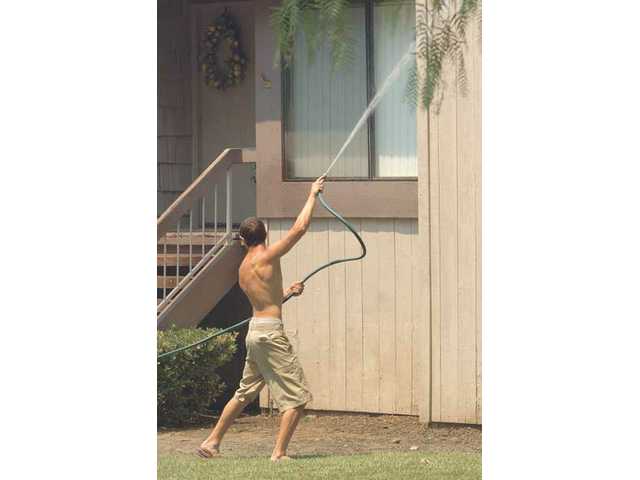
We’ve been pretty lucky with a mild summer so far. But even so, a bunch of small brush fires have popped up in recent weeks. The Crown Fire burned more than 13,000 acres up toward the Antelope Valley and Palmdale, taking out a few mobile homes and at least one house.
Los Angeles County Fire Department officials have been urging Santa Clarita Valley residents to help protect their homes and prepare for future brush fires, saying our area is among the most challenging in the world for firefighters.
Assistant fire Chief Bill Niccum, who oversees the Fire Department’s response throughout the SCV, said the combination of a hot climate, drought conditions and brush with high oil content makes wildfires in the SCV particularly fierce.
“In a Mediterranean, dry climate, brush has a high oil content that keeps it alive during drought and triple digits,” Niccum said. “But when fire goes into that fuel, it burns very quickly.”
And with those triple-digit days ahead, and Santa Ana winds to come, now is the time to fortify your home against brush fires.
Ready! Set! Go!
Though many homes and neighborhoods in the SCV already participate in brush clearance programs, there are probably many hundreds of others that would benefit greatly from brush clearance. And there are a number of other additional actions that any homeowner can take to protect a home against wildfires.
Last year, Los Angeles County Fire Department Chief Michael Freeman unveiled a wildfire action plan called “Ready! Set! Go!” (which is available at here ). The plan gives you the tips and tools to successfully prepare for a wildfire. It gives you guidance on retrofitting your home with fire-resistive features and helps you create a defensible space around your home. It helps you prepare your home, yourself and your family so that you can leave well ahead of a fast-approaching wildfire.
As Freeman noted at the beginning of the plan, “It’s not a question of ‘if,’ but ‘when’ the next major wildfire will occur in Los Angeles County. That’s why the most important person in protecting your life and property is not the firefighter, but yourself.
Through advance planning and preparation, we can all be ready for the next wildfire.”
Protect your home from fire now. As laid out in the “Ready! Set! Go!” plan, you can create a fire-defensible space, “harden” your home against fire and prepare your family for fast action when fire does threaten.
Defensible space
Defensible space is the area around a structure free of flammable plants and objects that creates a zone where firefighters can operate safely in order to help protect a home during a wildfire. The defensible space for each structure varies, depending on the type of vegetation and topography.
Zone 1: This zone extends 30 feet out from buildings, structures, decks, etc. Remove all flammable vegetation or other combustible growth within 30 feet of any structure or within 50 feet of any structure in areas determined to be high hazard. Single trees, ornamental shrubbery or cultivated ground covers may be permitted provided they are maintained in such a manner that they do not readily transmit fire from native vegetation to the structure.
Zone 2: Thin out and remove vegetation an additional 70 feet from the structure for a total of 100 feet. The inspecting officer may require an additional 100 feet of thinning or removal, for a total of 200 feet, due to high fire hazard.
Note: Special attention should be given to the use and maintenance of ornamental plants known or thought to be high hazard plants when used in close proximity to structures. Examples include acacia, cedar, cypress, eucalyptus, juniper, pine and pampas grass. These plantings should be properly maintained and not allowed to be in mass plantings that could transmit fire from the native growth to any structure.
A ‘hardened’ home
The ability of your home to survive wildfire depends on its construction materials and the quality of the defensible space surrounding it. Embers from a wildfire will find the weak link in your home’s fire-protection scheme and gain the upper hand because of a small, overlooked or seemingly inconsequential factor. However, there are measures you can take to safeguard your home.
Windows and doors: Embers can enter gaps in doors, including garage doors. Plants or combustible storage near windows can be ignited from embers and generate heat that can break windows and/or melt combustible frames.
Balconies and decks: Embers collect in or on combustible surfaces or undersides of decks and balconies, ignite the material and enter the home through walls or windows.
Roofs: A roof is the most vulnerable surface for embers to land, lodge and start a fire. This includes roof valleys, open ends of barrel tiles and rain gutters.
Eaves: Embers gather under open eaves and ignite exposed wood or other combustible material.
Vents: Embers enter attic or other concealed space and ignite combustible materials. Vents in eaves and cornices are particularly vulnerable, as are any unscreened vents.
Walls: Combustible siding or other combustible or overlapping materials provide a surface and crevice for embers to nestle and ignite.
Sprinkler system: To harden your home even further, consider protecting it with a residential fire sprinkler system. It protects your family year-round from wildfires and any fire that may start in your home.
Fire-wise landscaping
And though it isn’t detailed in the “Ready! Set! Go!” plan, you might also consider landscaping with fire protection in mind. Many plants are “recommended” by fire-protection agencies for your defensible space.
When deciding what to plant, the homeowner should select plants for the desirable attributes of fire resistance, low maintenance, availability and erosion-control effectiveness.
Personal action plan
The “Ready! Set! Go!” plan outlines steps and offers checklists so that you can to prepare your family for a wildfire. But the most important thing is to rehearse your plan with your family members and keep the checklists handy. You should also make an evacuation kit, which includes such things as important documents, phone numbers, prescriptions, irreplaceable memorabilia, credit cards and personal computers or external drives and disks.