The teenage hunter walked more than 60 miles across British Columbia in freezing temperatures.
But when an arctic snow storm made it impossible to see, and his broken leg made it impossible to move, the hunter laid down on a glacier and froze to death.
And there he remained for 550 years: Encased in an icy tomb, frozen in time.
But in a way, he escaped that frigid fate — his genes did, at least.
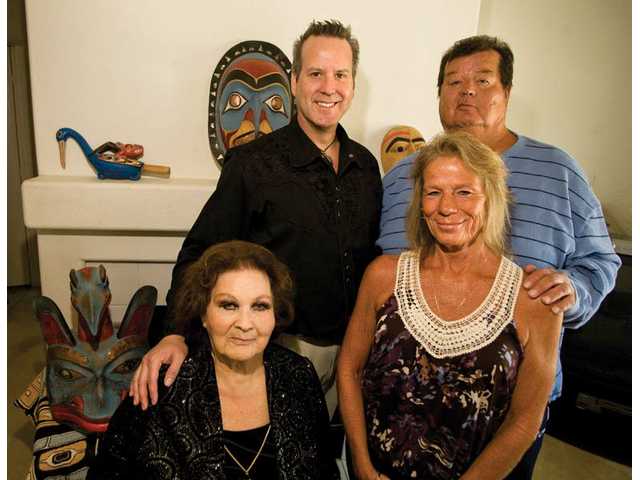
Just ask Dorothy Rosenberg, 82, of Canyon Country. She may be the recently uncovered iceman mummy’s oldest living descendent.
“Well I’m the only one living,” Rosenberg said with a laugh this week in her home off Sand Canyon Road. “All the rest of the family died off.”
Rosenberg moved from a small town in Alaska to Southern California in the 1950s. Her children, who live in Los Angeles and Alaska, take pride in their Native American heritage. Dorothy’s youngest son, Aaron, speaks his tribe’s language, Tlingit, and studied Native American folklore.
“Our father is Jewish so we have a lot of explaining to do when we tell people our name is Rosenberg,” the 44-year-old said, laughing. “I can sing you the national anthem in Tlingit and make you a great Matzah-ball soup.”
The first Americans
Three sheep hunters discovered Kwaday, whose name translates to “man long ago found,” at the base of a glacier in northwest British Columbia, east of Alaska, in 1999.
Anthropologists, biologists, forensic scientists and archeologists spent the next two years determining who Kwaday was.
How old was he when he died? What did he eat? And how did he end up frozen hundreds of years ago?
Scientists believe he was an 18- or 19-year-old hunter who froze to death about 550 years ago. The man stood 5 feet, 7 inches tall and had long, black hair, according to research published by British Columbia’s Ministry of Tourism, Culture and the Arts.
They think Kwaday slipped on the glacier and bumped his head on the ice around the year 1450 — around the time Christopher Columbus was born.
“We are the true Americans.” Aaron Rosenberg said. “You can’t go back any farther. We were the first. They came through the Bering Strait and settled the lower 48 (states).”
Kwaday is the only mummified body found in North America. Once an autopsy and forensic research was completed in 2001, the body was cremated and its ashes returned to the site where the body was found.
Myths and legends
Dorothy Rosenberg’s home is decorated with colorful Tlingit headdresses. A black-and-white photo of her family in Alaska taken in 1911 hangs on her wall.
“We all take great pride in our heritage,” Aaron Rosenberg said.
After Kwaday was discovered, scientists collected DNA from 250 Tlingit tribe members and discovered that Dorothy’s sister was one of 17 direct descendents of the ice man mummy.
The family learned about their link to Kwaday in 2008.
While studying at UCLA, Aaron Rosenberg interviewed tribal elders and collected stories of Tlingit folklore.
“They flew me to Indian villages and I transcribed the oration of the Tlingit native American history,” Rosenberg recalled.
“It was fascinating and down the road it came to reality for me.“
One story — similar to “Jack and the Beanstalk” — reminds him of Kwaday.
In the tale, a young warrior leaves his village. During a long journey, he ascends into the clouds, never to be seen again.