Editor’s note: Fourth in an occasional series on the people who keep the SCV humming while the rest of us are snoring.
It’s the middle of the night, and Bill Homeier is sitting alone in a control room facing more than a half a dozen computer screens.
Homeier’s office at the Castaic Lake Water Agency overlooks Central Park, and a peek outside the window shows the Santa Clarita Valley at night, complete with twinkling lights and a calm darkness.
The control room’s clock ticks past 2 a.m., and Homeier is keeping an eye on the agency’s millions of gallons of water that will flow through your sinks, showers and sprinklers.
He’s gearing up for his 12-hour shift as senior treatment-plant manager. He’ll be by himself 2:30-7:30 a.m. during the week and alone on weekends when the office is empty.
“The plant never shuts down,” he said. “People need water 24 hours a day.”
He’ll watch the sun come up, as well as the substantial jump in water demand that occurs each morning as local residents turn on their sprinklers and take showers for another day.
Of his 30 years at the water agency, Homeier, 53, has spent 28 of them working the 2:30 a.m. to 2:30 p.m. schedule, technically called the day shift. He works 12 hours a day for seven days straight.
He gets two weeks off a month, but the hours still end up being tough on Homeier. By the time he’s finally adjusted to sleeping at night, he finds himself back at work, getting up at 1:45 a.m. and heading from his Valencia home up the winding road to the Saugus plant.
His doctor even told him that he’s shaved five to seven years off his life because of his rough schedule.
But he finds the benefits. When he gets off from work, it’s just in time to pick his daughter up from school.
Mynor Masaya, 48, works the opposite of Homeier’s shift — a 2:30-p.m.-to-2:30-a.m. shift.
He commutes from Palmdale and has worked for the agency for 15 years.
Masaya doesn’t have to fight traffic to get to work; it allows time to be with his family.
“I’m a night person,” he said.
Most nights are quiet, and even though the pumps, tanks and other equipment have numerous backups in case of emergencies, there’s always one problem: summer power outages.
Each summer brings between three and five outages. Some of the equipment will restart on its own, while other outages require a manual reset, Masaya said.
If things get too tough, operators can call the on-duty maintenance worker for support.
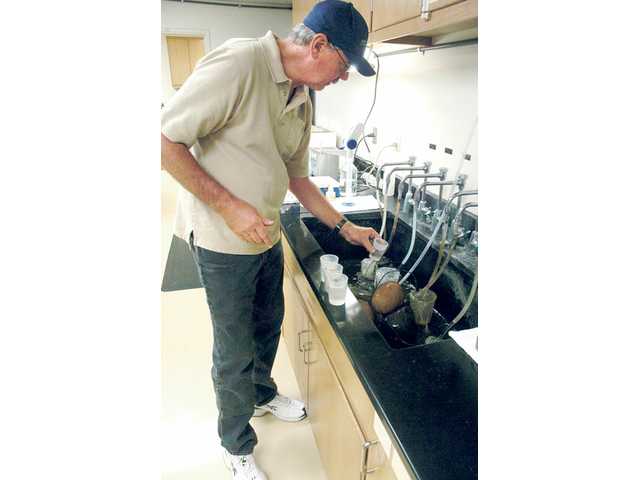
Along with monitoring the tanks and pumps, Homeier regularly tests the water downstairs in the agency’s lab as required by the state.
Surrounded by test tubes, beakers and machines, Homeier takes small samples of water in all steps of the cleaning process to check their chemical levels.
It’s one way operators check that the computers are accurate in their readings, he said.
“We want to make sure the water is really clean,” Homeier said.
And even though the two operators have dedicated decades to the water industry, there are still moments of awe over the power of water.
“If you don’t work in the field, you take it for granted,” Masaya said. “You open the faucet, and there it is.”
And back at the control room, Masaya reflects on his job and its demand.
“One person has all this water in his hands,” Masaya said.