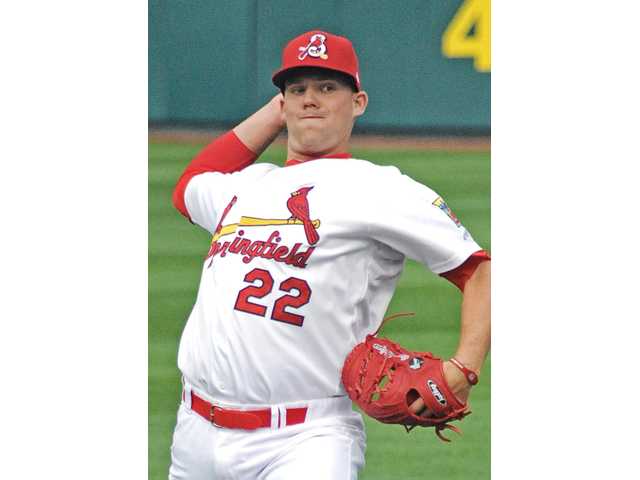
Valencia High graduate Casey Mulligan appeared to be on track for a spot in Major League Baseball.
The catcher-turned-pitcher's fastball was consistently in the 90s, his statistics were improving, and he was moving up through the St. Louis Cardinals organization.
Three months ago, he began to feel pain in his elbow.
He rested.
He came back.
He went back on the disabled list.
Needing Tommy John surgery to continue playing, his career is now over.
"I thought, you know what, just hang it up," Mulligan says.
A month ago, the right-handed pitcher was still mulling over the decision, and like many athletes who suffer severe injuries, the doubt crept in.
"Just the fact that I will not be able to pitch again until 2013, and I'll be a free agent in 2013," Mulligan said in July. "I won't be a Cardinal. Do I get the surgery and hope a team signs me when I haven't pitched in two years?"
During the 11th inning of the Double-A Springfield Cardinals' 7-6 loss to Tulsa Drillers April 22, Mulligan says his elbow "blew up."
"I've had arm pain before from fatigue. That was totally different," he says. "I lost 10 miles per hour on my fastball. I didn't lose 10 miles per hour because of me, but because it hurt so bad to throw the baseball."
Mulligan tore the ulnar collateral ligament in his right arm. To repair it, he would need surgery that would put him out 12-15 months.
What the elbow is for a baseball player, the knee is in basketball.
Hart graduate Megan Ford's left knee became the source of much fear and doubt two years ago.
As a freshman at Cal Poly Pomona, Ford took a hit while going for a rebound in a game against the University of California, San Diego on Jan. 10, 2009.
She tore her anterior cruciate ligament for the second time in her hoops career.
"If I could say it in one word, it's devastating," Ford says. "At that moment, you think your whole sports world is crashing down on you. Your career is over. You are never going to play again. As you go along farther, you gain a hope almost. Then you gain confidence back again."
During her six-month recovery process, she says she felt alone and isolated.
She watched her team playing the sport she loved, and her frustrations built.
"When you are sitting there after surgery and can't even flex one quad muscle, I didn't know how I'd ever run again, let alone play basketball," Ford says. "There is so much doubt that crosses your mind during rehab, it's
phenomenal."
For Golden Valley graduate Corey Chaisson, the prospect of never walking again was very real at one point.
During a football game against Santa Paula on Sept. 17, 2009, the three-sport athlete was blindsided after intercepting a pass. Chaisson injured a cervical vertebra in his neck and had to be taken off the field.
"When the injury happened, I noticed my teammates' faces, and it started making me worried a little bit. I felt like I did something wrong," he says. "When I went to the hospital, the doctor was like, ‘You are lucky that you are walking.' My mom was sitting there holding my hand, and when he said that, I started to cry a little bit."
The football, basketball and track and field athlete was in a neck brace for a month and a half.
After nearly a year of rehabilitation, he says he was finally able to resume athletic activities.
"I just prayed a lot because I'm a big believer in God," Chaisson says. "The main thing I was worried about is, I have a 1-year-old daughter, and I was scared I wouldn't be able to play with her."
All three athletes went through a process of coping and decision-making.
According to the Kübler-Ross model, also known as the Five Stages of Grief, the process goes stages of denial, anger, bargaining, depression and acceptance.
The support of friends and family pushed Ford and Chaisson to keep going, they say. There was a lot more that they wanted to accomplish.
For Mulligan, he had already accomplished much of what he set out to do.
"The only time it really bothers me is when I'm watching TV and watching a player I played against," Mulligan says.
He's not going to have Tommy John surgery, he says.
"It will only affect me when I throw a baseball. It won't affect my everyday life," Mulligan says. "If I want to play catch with my kids 20 years from now, I can still do that."
He's turning the page and looking forward to a new career in agriculture and coaching, he adds.
Ford wasn't ready to do that.
She had more basketball left to play.
"That's what was driving me the whole time. A lot of it was that I wanted to prove to myself that I could do it, and be even better after it," she says.
Two years later, Ford led the Broncos in rebounding (7.2) and was second on the team in scoring (13.0).
She was named the MVP of the California Collegiate Athletic Association Tournament, leading Cal Poly Pomona with 29 points in the championship game. The Broncos went on to win the West Region title, advancing to the NCAA Division II Tournament's elite eight.
Chaisson's return to football was also met with success.
A year after being told he likely wouldn't play football again, the senior recorded two interceptions in a 31-19 win over Simi Valley.
He finished the season with eight total interceptions and 8.6 tackles per game.
The potential for those statistics looked bleak.
There was fear and doubt.
But once all three athletes accepted their circumstances, they were able to rise above them and move on.
"I just feel like if you believe in something, don't give up on it. Just always try to attack it," Chaisson says.