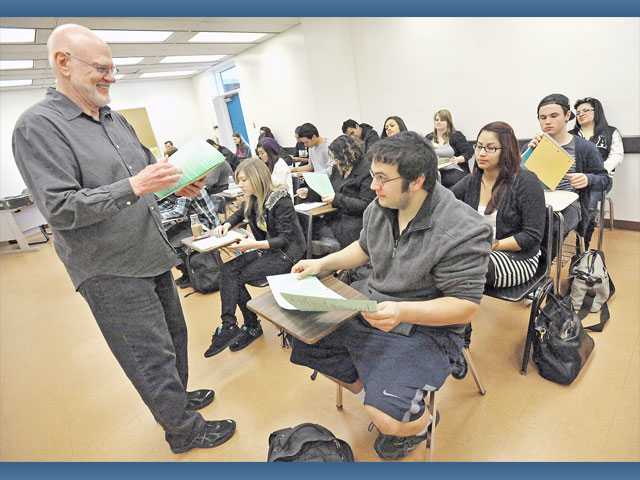
Monday marked the first day of the spring semester at College of the Canyons.
But for about a dozen students waiting outside Bob Tolar’s Intermediate Algebra class just before it began, Monday was the day to figure out if they’d even have a seat in the popular math class.
“Several of you are here to crash the class,” Tolar said, referring to the common college practice of students showing up for the first day of a class without being enrolled in hope the instructor will sign them in.
One by one, Tolar, a longtime COC mathematics instructor, read off about 30 names of those who filed into the Boykin Hall classroom on the Valencia campus.
By the end, the classroom was full and at least three students were left without a spot.
“That sucks so bad!” one student said as he walked away.
Like so many California community colleges, the Santa Clarita Valley’s only community college has experienced a surge in enrollment as students scour through hundreds of class listings trying to find a seat.
“I feel really bad having to turn these students away,” Tolar said as students shuffled out of class. “We need more sections.”
But state budget cuts have prevented community colleges like COC from getting additional funding to offer more courses. When a college hits its funding cap, it is unable to take in more students because the state won’t fund them.
This year, COC is offering 11 percent more classes than it did last year and, on Monday, it had more than 4,800 seats open at its Valencia and Canyon Country campuses, said Eric Harnish, COC’s director of external relations.
More than 90 percent of classes were full, a figure likely to grow as the first weeks of classes continue.
Every semester, COC leaders manage course offerings to fit student demand by eliminating traditionally low-enrolled classes and adding high-interest courses needed for transfer and certificate programs.
“Our funding comes from the state and is decided upon by the state Legislature,” Harnish said. “We’re allocated so much money, and that dictates the number of students we can serve.”
In the last three years, community colleges in California have lost more than $1 billion in funding, Harnish said.
“We absolutely don’t want to turn students away,” Harnish said.
In the case of Tolar’s class, students take his course to qualify for statistics, a popular class that students need to transfer to a four-year college of university.
“It is terrible to have a student be held back all because he or she cannot get into a course,” Tolar said.
Two students came into class between lessons about the y-intercept and graphing coordinates, prompting Tolar to pull out his roster and move two students back to the waiting list.
Without enough desks in the 32-desk classroom, two had to sit on the floor.
Among the students left out of Tolar’s math class were Sara Shahmoradian, who commuted from Glendale in the hope of getting the classes she needs. She’s already been locked out of Glendale Community College and tried her luck at College of the Canyons on Monday.
As a freshman, Shahmoradian doesn’t have high priority when it comes to registering for classes.
“It’s out of my control,” the 18-year-old said as she sat on a bench outside the classroom.
Shahmoradian was unable to get any of her classes and plans to spend the first week of spring semester trying to get formally enrolled in psychology, English, history and economics classes.
She hopes to study business and one day transfer to a state school, but her plans have been put on hold for now.
“It matters a lot because if I don’t get these classes, I can’t transfer,” she said. “And there’s nothing I can do about it.”