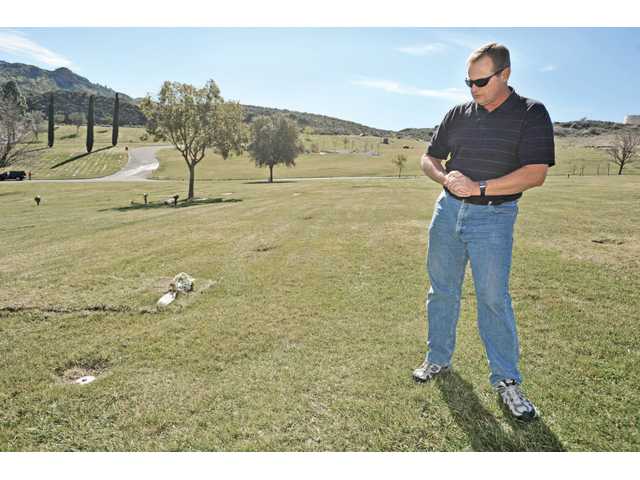
On a sunny February morning last week, almost five years after LaWana Clary was bludgeoned to death in her home, Mark Taylor looked for a spindly, leafless tree at the cemetery — his landmark for finding his sister’s grave.
“She’s buried right here,” he said, stopping on a stretch of grassy hillside at Eternal Valley Memorial Park & Mortuary, gauging his distance from the tree.
There is no gravestone or plaque to mark the grave.
The plot is owned by Clary’s widowed husband, David Wayne Clary. The Taylor family is unable to erect a plaque in LaWana Clary’s honor without his authorization.
Resolution on the gravestone issue appears remote, Taylor said, citing a schism that’s developed between his family and the family of his sister’s husband that makes it difficult to come together on even the simplest of issues and smallest of details.
Since April 5, 2007, when the body of 50-year-old LaWana Jayne Clary was found on a blood-soaked bed in her Castaic home, relations between the two families have chilled.
“The mortuary told us we could have a plaque put on here and that they would install it. But if he (Clary) comes by and sees it on there and doesn’t want it there, he could have it removed,” Taylor said.
“So we’re thinking of doing that, but we run the risk of having it removed.”
Taylor said he hasn’t talked to his sister’s widowed husband in a while.
Efforts last week by The Signal to reach David Clary by phone at his new home in Portland, Ore., were unsuccessful.
“It’s a double plot, for him and her,” Taylor says about the grave. “But he won’t be coming back here.”
Among those wishing David Clary would return to the Santa Clarita Valley are homicide detectives, who still consider him their “sole person of interest” in the case.
Lie detector test
David Wayne Clary, 43, is innocent, did not murder his wife and has nothing to do with her death, according to Clary himself, who took a lie detector test to prove it.
Clary also cooperated with detectives the night of the murder, talked to them at the local sheriff’s station and provided a statement, homicide detectives confirmed.
Two years after LaWana Clary’s body was found with her skull crushed by blunt force, Clary’s attorney Richard Moss told The Signal David Clary did not kill his wife, adding: “It’s almost a knee-jerk reaction that the husband always did it.
There is no evidence to prove that he directly or indirectly had anything to do with the murder of his wife.”
Homicide detectives Rich Lopez and Sgt. Robert Martindale of the Los Angeles County Sheriff’s Department have problems with the lie detector test taken by Clary six days after his wife’s murder.
The main problem?
Detectives were not present when the polygraph was administered and have no idea what questions were asked of Clary.
“If we had done a polygraph test as the one they did, we would be laughed out of any court,” Lopez said. “Our polygraph tests are videotaped; theirs wasn’t even recorded with audio.”
Detectives want Clary to take a polygraph test they administer and ask him the questions they want answered so they can eliminate him as a suspect.
“I would like the husband to come down and take another polygraph test,” Lopez said Thursday. “It’s been five years. Come on. If you didn’t do it, sit down with our polygrapher.”
Clary refused to take a lie-detector test administered by the Los Angeles County Sheriff’s Department, Lopez told The Signal two years ago.
As for Clary’s statement, Lopez said Wednesday: “He gave an initial statement, lawyered up and has never talked to us again.”
Clary has no obligation to do anything more.
The murder
David and LaWana Clary were married in the early ’90s.
She graduated from Hart High School in 1974, attended Cal State Northridge, where she learned to be a special education teacher and landed a teaching job at Saugus High School, then one at Valencia High School.
He was a longtime resident of Newhall, worked in computers and dabbled in writing science fiction.
They had a home in Castaic, where they lived with two dogs and raised a foster child — a girl born in 1989 whose drug-addicted mother died in a traffic accident on Christmas Day — who proved challenging, according to friends and coworkers of the murdered woman.
LaWana Clary was described by coworkers and students as a loving teacher and a devoted friend.
On April 5, 2007, David Clary left their home for work about 7 a.m., he told detectives. His wife was alive when he left, he said.
About 9:30 a.m., Barbara Frieling phoned LaWana Clary on her cellphone. But instead of reaching her friend and coworker, she spoke to a man identifying himself as David Clary.
About 5:15 p.m., David Clary, according to his statement, returned home and found his wife dead on their bed, lying on her right side, her skull fractured.
Dr. Solomon L. Riley Jr., who conducted the autopsy April 9, 2007, listed blunt force injuries to the left side of her skull as the cause of death.
In a preprinted section of his medical report that asks “If other than natural causes, how did injury occur?” Riley wrote: “Battered by another.”
But no weapon was found at the house and no weapon recovered since, Lopez said.
Detectives are looking for an implement similar to a baseball bat, golf club or walking stick.
The killer struck Clary on the upper left side of her head, leaving a laceration 1.75 inches long and almost a half-inch deep, according to the coroner’s report.
The blow caved her head in and was described by Riley as a “skull depression” measuring 2.5 inches by 3.25 inches.
Riley observed other “underlying multiple fractures” linked to the “skull depression.”
A bruise he noted on the back of Clary’s left hand is consistent with injuries expected for someone raising his or her hand in self-defense.
Eliminating suspects
Blood was splattered across the bedroom wall and ceiling above the dead woman’s head, but coroner’s Investigator Jerry McKibben concluded there was no sign of a struggle, robbery or forced entry to the house, and no blood was found elsewhere in the house.
Within a day, the murder scene was released and detectives, through interviews, began eliminating people from their list of suspects, as is routinely done.
“There was a gardener at the house,” Lopez said. “We’ve already interviewed him and eliminated him as a suspect.”
Detectives said David Clary suggested they look into the possibility the couple’s foster child met with drug dealers in Fresno and stopped at the house in Castaic on their journey down Interstate 5.
“We were unable to substantiate any of that story,” Lopez said. “We also interviewed the (foster child).”
“The first person to include or eliminate in a (woman’s) murder is the husband or boyfriend,” Lopez said.
The one they’re still trying to eliminate is David Clary.
Desire for motherhood
“She was a very loving and caring person,” Suzanne Veltri, a teacher’s aid who worked with LaWana Clary, said of the murdered woman. “If she called you a friend, you were a friend for life.”
But the woman who educated others’ children desperately wanted some of her own.
“She had been trying to become pregnant, I know that,” Veltri said. “There were things in the works to have a child.
“I think she would have done whatever she had to to become a mother, whether it was artificial insemination or through a surrogate. If she could have, she would have.”
LaWana Clary kept her brother and father updated on the couple’s plans to work through a surrogate in order to have a baby, both male relatives confirmed.
A woman from Northern California agreed to serve as a surrogate mother for the couple, they said.
In the days preceding her death, LaWana Clary phoned her father, Bud “Junior” Taylor, excited to report that the couple was in final stages of negotiation and ready to pay about $24,000 to the surrogate, the father said.
Those plans fell through and no such transaction happened, Taylor said on the phone from his home in Missouri.
The Castaic couple also faced a possible financial setback due to a lawsuit filed over a traffic collision.
Plaintiffs in the case sued the Clarys for injuries suffered in a collision in Commerce in February 2004.
Had LaWana not been murdered, she and her husband would have been expected to appear in court about 2 1/2 months later for a trial date set in that case.
As it was, the lawsuit was eventually settled with a payment made by the couple’s insurance company, according to Rod Terrazone, the Clary’s attorney at the time.
In the spring of 2008, LaWana Clary’s father retained attorney Roy Comer and filed a wrongful-death lawsuit against David Clary.
The civil suit, however, was expected to be far too costly — both financially and emotionally — and was dropped, Comer said Wednesday.
“My client didn’t want to go through the meat grinder,” he said.
Anniversary coming
As the fifth anniversary of her death approaches, friends and family of LaWana Clary say they are still awaiting justice.
“It’s good to keep light shed on this case,” Bud Taylor said. “Somebody knows enough out there about this case that could help.”
For detectives, the case has ground to a halt.
“We’re kind of in a rut right now,” Lopez said of the investigation. “We’re bogged down. We need something to give us traction.”
Lopez wants witnesses, he said.
This includes neighbors, friends, gardeners who work in and around the Clarys’ former home on Shadow Place.
“We need people who live in the neighborhood, people getting ready for work, possibly maintenance workers, gardeners, anyone who may have been in the area,” Lopez said. “We want to hear from people if they knew about her habits or his habits,” he said.
As for the troubled young girl, the Clarys accepted into their home as a foster child, the now-23-year-old woman moved East, “turned her life around” and became a mother herself just two months ago, according to LaWana’s father.