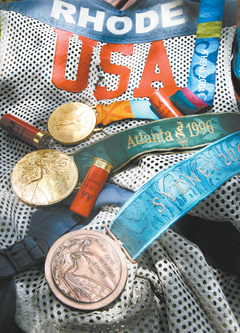
With the success that three-time U.S. Olympian Kim Rhode has had in competitive trapshooting, a fresh start doesn't have her worried one bit.
The International Olympic Committee introduced Women's Double Trap in 1996 at the Atlanta Summer Games, where the 16-year-old Rhode, a resident of El Monte, won the gold medal.
After a bronze in 2000 in Sydney and another gold in Athens in 2004, she was well on her way to being the most dominant woman in the sport.
However, the IOC eliminated the event, making her the first and last double trap gold medalist. It also forced her to find a new path to what should be her fourth Olympic appearance in Beijing in 2008.
"It's politics," says Rhode, who has trained at the Oak Tree Gun Club in Newhall since the beginning of her career. "(The IOC's) reasoning was that there wasn't enough women competing in the event. However we couldn't accept any more women in double trap at the last Olympics. Who knows what the real reason is."
The next mountain she's chosen to climb is the International Skeet event, where instead of the clay targets moving away from the shooter, the targets travel horizontally across the range at speeds of nearly 75 miles per hour.
Rhode spends every day of her life preparing for the next Olympic Games at a shooting range, most of which is spent at the Oak Tree Gun Club for up to 12 hours a day shooting 800 to 1,000 rounds.
In fact, the relationship between Rhode and the Oak Tree Gun Club has grown so close over the past decade that the club actually made major changes so that the two-time Olympic gold medalist could continue training for her featured events.
"They actually built a doubles trap field for me when there was no place to shoot doubles trap," Rhode says. "They actually put a field in and gave me pretty much unlimited access so that I could continue my road to the last couple of Olympics. When my event was eliminated, they built a field and put in brand new machines for International Skeet just so that I could go for the 2008 Olympics in Beijing. They really get behind their athletes and behind the kids. It's a great range to be a part of."
In Atlanta 10 years ago, she was the youngest member of the U.S. Olympic Team and became the youngest gold medalist in the history of Olympic shooting. Standing on the medal podium with Old Glory going up the flagpole and the national anthem playing over the loudspeakers, every possible emotion hit her at once.
"I think that's what keeps us as Olympians going back again and again - for that one singular moment," she says. "You want to run, you want to scream, you want to cry, you want to jump up and down and you just don't know which one to do first. Every Olympian works so hard to get to that moment for that one day and some people work their whole lives just for that one day or that one moment to stand up there and when you actually achieve it, it's overwhelming."
Rhode has since become the face of the sport.
She spends countless hours at the range, often times working with some of the up-and-coming stars of the sport. Recently, 14-year-old phenom Jon Michael McGrath II traveled from Oklahoma to train for a week with Rhode, while also spending time with several local prodigies.
She attends two to three events a week across the nation delivering speeches to different organizations informing the masses about, among other topics, gun safety and wildlife conservation.
She's even been a TV host for the past two years on The Outdoor Channel's "Step Outside" with National Shooting Sports Foundation (NSSF) President Doug Painter, where the two help introduce inner-city children to the outdoors for the first time.
On top of all that she's studying at Cal Poly Pomona where she is majoring in Animal Health Science, Business and Art.
And at the height of her career, the major change in events hasn't stopped the momentum.
"You still train hard no matter which (event) you do," Rhode says. "(Double trap and International Skeet) are completely different games, so in that sense going from one to the other is a challenge. Most people don't do that. It's just a lot more difficult to do. That just means more training, more practice. It's just like starting all over again."
Her long-term goals are more focused on the growth of the sport - especially for women and children. But because the physical limitations are minimal, her Olympic career could last as long as she wants to put the work in.
"The oldest medalist in the Olympics was 72," Rhode says. "I hope to do it for many, many more years. It's a combination that I can't give up with the people and the outdoors. It's something that I love to do."
The IOC can take away her event. That's just fine with her. She'll just take the challenge in stride and make another run straight to the medal podium.
"It's actually been pretty fun to switch to International Skeet," she says. "It's something that's completely different, completely new. I'm really excited and I'm really looking forward to the 2008 Olympics. Hopefully I can give those girls a run for their money."