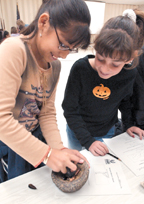
Animal pelts, acorns and baskets were just some of the items placed about the multi-purpose room at Old Orchard Elementary School on Monday as fourth-grade students had an opportunity to expand their studies on the Chumash Native American tribe.
Kyle Harris from the William S. Hart Museum brought tools and utensils to show the students some of the items the Native Americans once used as they lived in the Southern California area from Malibu to San Luis Obispo.
“The students have an opportunity to discover by handling and working together (with the objects),” Harris said.
The “Acorns, Sea and Sage” program is designed for the fourth-graders who study California during their social studies curriculum. Teacher Lynn Gurner said the program emphasizes the Chumash and how the Native Americans interacted with their environment and natural resources.
“This is great because it’s hands-on and the students remember what they saw today, and it gives everything they are reading more meaning,” Gurner said.
The students watched a 15-minute slide show that included a map of the different California tribes, explaining how they lived, traded and hunted for food. Chumash tribes were both desert and coastal dwellers and Harris told the students how hard it was for them to find food.
Alexis Sedivec, 10, said she like the feeling of the animal pelts and said, although she didn’t like the idea of killing animals, she understood how the Chumash had to kill them to survive.
Asher Elswick, 8, agreed.
“It’s not all right to kill unless you really need it for food and clothing,” he said.
His classmate, Yomali Ruiz, 10, said she thought it was probably easy for the Native Americans to hunt because there were more animals then, but she wouldn’t want to do that.
“My job would be making baskets,” she said. “It might be boring, but it was a hard life.”
At other stations the students learned to match up modern-day conveniences with items the Chumash might have used, such as a stone for a blender.
Janice Ashley helped students at another station who were drawing pictures of Chumash utensils and describing what they were made from and how they were used.
Harris said the Hart Museum has two other programs designed for third through fifth grade.
“Teachers can take what they need and adjust the program to their curriculum,” she said.
For more information about the Hart Museum and the programs, contact Harris at 254-4584.