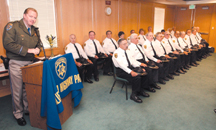
Rick Herrera didn’t leave his volunteering at work; he took with him to the California Highway Patrol‘s Senior Volunteer Program Academy graduation ceremony, Tuesday.
After receiving his badge and certificate, the seated Herrera turned to fellow newly appointed CHP Senior Volunteer David Gold of Stevenson Ranch and helped him with his new badge.
“He was trying to pin it,” Gold said. “(I figured) I have a long time to wear this badge.”
The ceremony at the Castaic Lake Water Agency was held to swear in three women and 19 men, ages 55 and up, from Newhall, Alta Dena, and West Valley into the CHP’s volunteer program.
Representatives from the offices of U.S. Rep. Howard P. “Buck” McKeon, state Sens. Tom McClintock, William “Pete” Knight, and Jack Scott; Assemblymen Dr. Keith Richman and George Runner; and Los Angeles County Supervisor Michael Antonovich were in attendance to acknowledge the commitment of the volunteers and present them with certificates of recognition.
Mayor Frank Ferry and Santa Clarita City Councilman Bob Kellar briefly spoke to show their appreciation, as well.
The volunteers were all thrilled with the association that they now have with the CHP.
“I am so nervous right now, I almost feel like I’m getting married again,” said Newhall resident Herrera before the ceremony.
Officer Denise Joslin, program coordinator and instructor, was very pleased with her students who put in a lot of work in their free time to complete the program.
“I’m extremely proud,” she said. “They are a tremendous group.”
The men and women of the program went through 80 hours of training, mostly in a classroom. They learned the policies and procedures of the CHP.
The volunteers will have to work 12 hours each month. Duties for local volunteers will include working at the Newhall station and answering phones, filing, and answering questions at the front counter.
Volunteers won’t be confined to the station, as some will work out in the field with traffic and school duties, but are not allowed to partake in any type of enforcement activities, Joslin said.
“They help us by freeing up with some of the duties that typical officers would do,” she said. “Our officers are able to get out and increase our response time to traffic collisions and work on concentrating more on traffic enforcement and motorist safety.”