Anti-war movement icon Tom Hayden said the protest to protect the Pico Canyon oak tree from relocation is a continuation of a growing state environmental movement.
The former state legislator and his family stopped by the ancient oak Saturday to check on tree sitter John Quigley, Hayden’s friend of 20 years, and to chat with environmentalists. Quigley is beginning his third week in the tree as he attempts to save it from being relocated by developer John Laing Homes. The developer announced earlier this week it would transplant the 400-year-old oak to a parcel of land one-quarter mile away as it complies with Los Angeles County orders to widen Pico Canyon Road to four lanes.
“People are taking direct action by sitting in trees in California,” Hayden said. “It strikes a cord in the average person that enough is enough.”
Hayden, a longtime environmental and special interest watchdog, said he is familiar with the issues in the Santa Clarita Valley. He said he drove north from his home in West Los Angeles because he wanted to take a closer look at the tree and the surrounding development. He is bewildered by the widespread interest in the protest, but offered a philosophical view.
“When people think there is no alternate to growth, we revive a beautiful memory of paradise lost,” he said.
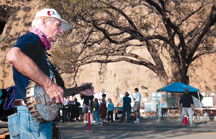
The atmosphere in front of the tree took on a ’60s flavor when folk singer Fred Starner played his banjo and sang folk songs for kids.
The Los Angeles-based songwriter saw the protest on local news reports and offered to entertain the children who assembled in front of the tree. Starner, a retired environmental economics professor, wrote a song in the 1990s for Northern Californian tree sitter Julia “Butterfly” Hill. She is an environmental activist who protested Pacific Lumber’s logging practices by sitting in a 200-foot-tall Redwood tree. He also performed with folk singer Pete Seeger and civil rights leader Fred Kirkpatrick in the 1960s.
“Folk singers have been doing this kind of stuff for a long time,” Starner said.
As he sang “Out in Santa Clarita,” an original song about the three-week protest, Starner appealed to Supervisor Michael D. Antonovich to speak to protesters and other supporters of the tree.
“I don’t understand a politician who is afraid of his constituency,” he said. “He needs to talk to the people.”
Meanwhile, Quigley steadfastly rests in the boughs of the controversial oak, knowing his finances are dwindling. He said the donations taken at the front of the fence that encloses the tree are paying for batteries, his food and cellular phone bill. Quigley and his girlfriend of five years support two children, ages 9 and 11. He said rent and other daily expenses have not been paid this month.
“It is getting tight,” he said. “I never imagined it would turn out like this.”
Quigley is an environmental educator and producer of a show that has been performed before local school and international audiences. Quigley describes his theatrical stage show as a story of humans struggling with energy issues and was first performed in Buenos Aires, Argentina in 1998. He said the show was staged in South Africa in September and presented during the 2002 Earth Day Los Angeles.