The Santa Clarita Organization for Planning the Environment has filed a lawsuit against John Laing Homes accusing the developer of reneging on a 1999 agreement to redesign the Pico Canyon Road widening to preserve a 400-year-old heritage oak tree.
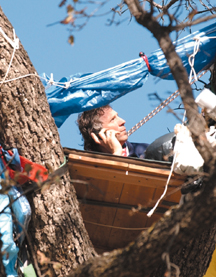
The tree, known as “Old Glory” among those trying to save it, has been making news for the past month as the developer and Los Angeles County have been engaged in a showdown with environmentalists, including tree sitter John Quigley.
The lawsuit, which SCOPE filed Nov. 20 and plans to serve upon John Laing Homes later this week, seeks a temporary restraining order and injunction so the developer may not cut down or remove the oak tree.
SCOPE contends John Laing Homes has broken a “good faith” agreement brokered in 1999, when the developer said it would redesign the widening of Pico Canyon Road to avoid destroying the tree, “Oak Tree No. 419.”
“The agreement was to get the road downsized,” said SCOPE president Lynne Plambeck. “They were supposed to do that. ... They never did anything.
“I don’t think it was a good-faith agreement,” she said.
Division President Bill Ratazzi of John Laing Homes said his company stuck to the agreement.
“Laing has used good faith to remove (other oaks in the area),” he said.
A 1999 letter from John Laing Homes to SCOPE stated, “Laing will redesign the alignment of Pico Canyon Road such that the southerly median curb will be approximately 20 feet to 25 feet south of the centerline of Oak Tree No. 419.
“The purpose of the modification is to minimize impacts on Oak Tree No. 419 from the construction of (the) south half of Pico Canyon Road. Oak Tree No. 419 will still require pruning/trimming to provide vertical clearance necessary for vehicular movement under the canopy of such trees,” it reads.
Ratazzi said John Laing Homes is abiding to this statement, and that the southern median of Pico Canyon Road will indeed be between 20 and 25 feet from the tree.
“The northerly curb will go through it,” he said.
Ratazzi said a map for the project area was approved three years ago, and that SCOPE saw that map and agreed on it.
Plambeck and Ratazzi met to discuss the tree in November. Ratazzi said they decided in the meeting that SCOPE would work out a contract for a resolution to the matter, and he still hasn’t heard back.
“I’m still waiting to get a draft of the agreement,” he said.
Plambeck said she called Ratazzi the next day, asking for another meeting to further discuss the issue. She said he never called her back, and has since refused to take any phone calls from SCOPE.
“We’re hoping we can still talk to them,” she said.
Plambeck said SCOPE has been holding off on serving the lawsuit until the developer agrees to negotiate.
Ratazzi said John Laing Homes is not willing to negotiate.
The developer agreed in November to move the oak to another location in the area. Several arborists have issued statements on this decision, saying that the tree is not likely to survive the relocation.
Martin Stoner, a plant pathologist with 40 years of research and teaching in the field, recommended that the tree not be removed from the site.
“There is a very high risk of extreme decline and/or death inherent in moving this tree to an alternate site,” Stoner wrote in a report for the Santa Clarita Oaks Conservancy. Trauma to the tree — such as soil changes, drastic root and/or canopy pruning in a short period of time — can result in “a greatly elevated likelihood of death.”
To relocate Old Glory, the tree would be contained and transferred in a 25-foot-wide box. The oak’s branch spread and root spread both measure about 100 feet in diameter.
Ratazzi said it is “pretty likely” the tree will survive, citing reports of several arborists contracted by the company.
The lawsuit accuses John Laing Homes of fraud, unfair business practices, breach of contract, and breach of the covenant of good faith and fair dealing.
“‘Good faith,’” Ratazzi said. “There are a lot of issues attached to that.”