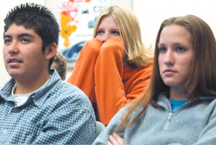
Driver’s education students at Canyon High School got a graphic look Wednesday at how certain choices behind the wheel can result in traumatic injuries or even death.
“Trauma Nurses Talk Tough” is a program launched by Henry Mayo Newhall Memorial Hospital in partnership with Frontier Toyota, which presents each semester to local high schools approximately 100 graphic images of victims involved in car crashes. It was initially started by a group of trauma nurses in Oregon.
The presentation coincides with Canyon High’s “Every 15 Minutes” program — a two-day program that starts today at the campus, in which student volunteers graphically re-enact a drunk-driving crash.
Wednesday’s slide show was presented by Newhall Memorial’s clinical education specialist Teri Sullivan. Her tough talk focused mainly on seat belt safety and excessive speeds.
“I really get on them about wearing seat belts and the consequences of driving at high speeds,” Sullivan said. “Most of the trauma and deaths that I’ve seen in the (emergency room) are due to victims either not wearing their seat belts or because they were driving too fast.”
The students were shown images of victims involved in car collisions while Sullivan explained the sometimes deadly consequences of the real stories behind those pictures.
One of those stories Sullivan talked about was that of a college sophomore.
“This is a picture of a young lady who was a sophomore in college,” Sullivan said, while going through the slide show. “This is the picture of her with friends, happy and having a good time. This was her after the collision. She had severe head injuries. She is completely paralyzed on her left side. She has to wear diapers for the rest of her life because the part her brain that tells her she needs to go to the bathroom was damaged. And she now has the mental capacity of a 10-year-old — all because she chose to drink a couple of glasses of wine. She also chose not to wear a seat belt.”
The images which received the strongest reactions from students were those of young children who were victims of accidents, which according to Sullivan, could have been avoided.
“This little girl died because her mother decided to get behind the wheel and drive while under the influence,” Sullivan said. “But also because her mother’s friends and family members made the decision not to stop the woman from driving. So remember, it’s about choices and the decisions that you make.”
Sirr Guy Shakir, who teaches health and driver’s education, said the program is a necessary tool, especially when dealing with students who are close to getting their driver’s license.
“This presentation is an invaluable resource,” Shakir said. “This is the age group that just passed driver’s education. So now they have their learner’s permits. They’re starting to get on the roads. They’re taking driver’s courses. This is essential to helping them make good decisions.”
One such decision students may need to make in the future is who to call if unable to drive due to alcohol or drugs. Keychains from the Safe Rides program were handed out to the class at the end of the presentation. Teens can call Safe Rides on Fridays or Saturdays from 10 p.m. to 2 a.m. if they are unable to drive themselves home. The calls are completely confidential.
Sullivan, who has been presenting the “Trauma Nurses Talk Tough” program for approximately one year now, said she is not sure just how successful the program has been with teens, but her goal is simple.
“If it reaches one kid, then we were successful,” she said. “But I do get a lot of interesting feedback from kids, that it scared them enough and that it will make them a safer driver.”
One student who got Sullivan’s message loud and clear was 15-year-old Sarah Saboumjian. She said she already has a learner’s permit and will probably start driving in a couple of months.
“This was very helpful,” Saboumjian said. “It was also really scary. This program definitely made me realize that I have to put my seat belt on every time I get in a car.”