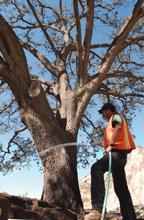
It could arguably be the most expensive tree in North America.
At a cost of $1 million, the centuries-old Pico Canyon oak that was dubbed “Old Glory” by environmentalists who tried to stop its removal has received nothing but tender loving care from the very start, a developer said Monday.
“The tree will dictate when it’s time to move,” said Bill Rattazzi, regional president of John Laing Homes. “We decided to box the tree two sides at a time, instead of boxing it all at once. It will allow the tree to adapt better to its new environment.”
Rattazzi also said it’s a misperception to believe developers are solely interested in making money.
“We could have spent $10,000 to chop this tree down,” he said. “Instead it has cost up to $1 million for us to transfer it down to the oak tree preserve (about a quarter-mile down Pico Canyon Road). We wanted to give this tree a chance to survive. So we obviously didn’t do this for the money.”
The price tag includes 24-hour security, perimeter fencing and after-care of the tree, which will be monitored for at least five years to assure its survival, Rattazzi said.
Laing has already transplanted eight other trees that had been slated for removal, Rattazzi said, and the company has taken steps to protect low-flow streams and a riparian area adjacent to the oak by realigning a portion of Pico Canyon Road.
But Laing is going forward with its civil suit against John Quigley, the environmental activist who perched in the tree’s branches for 71 days almost a year ago. Rattazzi refused to comment on lawsuit Monday.
Quigley said he’s surprised the developer is still going after him on allegations of trespassing.
“During my days in the tree, I felt that I had a good working relationship with Rattazzi,” Quigley said. “Given the relationship I had with Bill to that point, I’m quite shocked they’ve pursued the lawsuit.”
Quigley said he’s up for the fight.
“It’s an attack on free speech,” he said. “I won’t be intimidated by it.”
Lee Newman, whose firm, L. Newman Design Group Inc., was hired by Laing to transplant the tree, said he was bothered by environmentalists’ claims that the tree won’t survive the move.
“There’s no one out there who wants this to be a success more than me,” Newman said. “I’ve been taking care of trees for a long time, and there is no way I want this to fail.”
He said the tree has received regular treatments of moisture and bio-stimulants to ensure proper nourishment.
“All the nutrients we’ve given this tree have proved beneficial,” Newman said. “It will help its root to develop and we’ve determined this tree to be a good candidate for the move.”
Oak tree No. 419 is expected to reach its dormancy phase within the next several weeks. When leaves start to change color and begin to drop, the relocation process can begin, officials said. It could take anywhere from 40 to 65 days.
The process will involve bottom boxing. A crew starts tunneling under the tree to place wooden timbers at the bottom of the box. Then, hydraulic jacks are used to lift the tree and steel support beams are placed under it. Wheel attachments are added to form a giant makeshift dolly, and the tree is towed and replanted immediately into a pre-dug hole using soil from its original location to alleviate stress from the move.
Rattazzi said he hopes the transfer of the tree, which will be relocated with the help of a 128-wheel truck to help distribute the weight of the 400-ton oak, will be completed by mid-January.
Residents can keep track of the process by logging onto a special Web site. The idea, Rattazzi said, is to create an open line of communication with the community.
“I don’t want anyone to be kept in the dark about this,” he said. “I feel really good about what we’re doing. We’ve made a conscious effort to save this tree and we feel that we did the right thing.”
Activists are planning to gather at the tree for a reunion on the anniversary of Quigley’s ascent, Nov. 1, at 1 p.m.
“This is not meant to be a protest,” Quigley said. “It will really be a celebration of the tree. We will be holding prayers and giving thanks that after one year, the tree is still standing.”
Rattazzi said the public outcry to save the oak won’t stand in the way of what he loves to do.
“I really enjoy my job,” Rattazzi said. “I build homes where people can spend time with their families over the years. These families can later on sell that home and make some money from their investment. That’s a great thing to be able to provide.”
An in-depth look at the relocation process can be found at www.picocanyonoaktree.com.