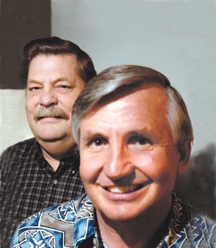
For Ralph Osler — and the other 50,000 people in the United States living with end-stage kidney disease (ESRD) — life is a balancing act of unpleasant physical symptoms, daily dialysis and serious concern for the future.
Osler, 53-year-old Saugus resident and retired Ventura County firefighter/emergency medical technician, must attach himself to a peritoneal dialysis machine each night. The eight-hour procedure, performed in his bedroom, filters excess fluid and waste material from his blood as well prevents further kidney damage.
It is a laborious regimen that Osler, also diabetic for the last 23 years, must endure along with continuous monitoring of his blood sugar and routine, self-administered insulin injections. Now on dialysis for two years, a kidney transplant remains Osler’s only hope for finding renewed health and maximum longevity.
A living donor with a good match has volunteered one of his own kidneys for Osler’s transplant — at this time slated for late August at the University of California, Los Angeles (UCLA). It is none other than Osler’s younger brother, Steve Osler, a 50-year-old building contractor who resides in Arroyo Grande.
“All the doctors told me that a living donor, especially a sibling (most preferably an identical twin) is the best way to go for a match for better durability of the graft taking,” Ralph said. “When I explained to Steve that there was about a seven year wait for a new kidney he immediately said he would be a donor. I was very excited to hear this.”
While the two have always been close, Steve feels this gift is the least he can do to help Ralph. After all, he owes his life to him.
“I had a severe SCUBA diving accident when I was 28 and Ralph saved my life,” Steve said. “I was 220 feet down and clinically dead.”
Ralph recalled that momentous event. “He went down too deep and my buddy went down to get him. When we got him to the surface he was basically dead,” Ralph said. “I did cardiopulmonary resuscitation on him and revived him.”
Ironically, throughout Ralph’s long career as a professional rescuer, the only patient he was able to save with CPR was his brother.
“I have seen a lot of dead people but he was the only one that came back,” Ralph said with emotion. “I feel it was a miracle then...and he is saving my life now.”
As the countdown to surgery ticks away, Steve is undergoing the requisite pre-operative tests. Blood and tissue typing are highest on the list of examinations for it is essential the donor and recipient match. This compatibility will help prevent the body’s immune system from fighting off, or rejecting, the new kidney.
Fortunately Steve’s in good health and gets regular exercise including running 10 miles on Sundays and in marathons. Inasmuch as he hopes surgeons will be able to perform the operation via laparoscopy, thereby negate his need for a larger incision and longer recuperative time, he is not wary of the surgery or its outcome.
“I have no fear or apprehension. I have a deep faith in God,” he said. “If anything happens to me it is still a gift to my brother and I would not do it any other way.”
Smiling at big brother Ralph, a fellow who, according to Steve, had a penchant for teasing him as a child, he spoke gentle words of caution about the upcoming transplant.
“He had just better take care of it after he gets it,” Steve said with a grin.
q q q
Ralph and his wife of 26 years, Cherie, have three children, son Ryan, a fireman with the Ventura County Fire Dept. in Fillmore, and daughters Julie Ann, 21, and Jeanine, 18, who both reside with their parents. The couple met in 1974 when each worked at the Los Alamitos Naval base, he as a crew chief/helicopter mechanic, she as an employee in the PX. Following their marriage in 1976 he embarked on his career with the fire department, first working for the West Ventura County Fire Dept.
Always an active man who worked hard, loved outdoor sports and aviation, Ralph became puzzled when he first experienced two of diabetes’ classic warning symptoms — extreme thirst and tiredness. A diagnosis of diabetes was quickly made. A disease brought on by impaired insulin secretion, diabetes can lead to many serious consequences besides kidney disease including heart disease, stroke, blindness, nerve damage and leg amputations.
Ralph immediately went to work trying to control the diabetes through diet, exercise and oral anti-diabetogenic drugs. But this honeymoon phase with the disease lasted only one year. After that time, he was forced to depend on insulin to stay alive. A stepped-up regimen of diet and weight management, monitoring blood sugars and taking his insulin worked well for 20 years. But then high blood pressure and kidney disease hit him hard about four years back. Soon followed atherosclerotic heart disease (where the coronary artery walls became thick and plugged, leaving Ralph at risk for a heart attack).
Following much-needed heart bypass surgery three years ago, Ralph’s fire department career came to an abrupt end and his kidney disease exacerbated.
Progressive renal failure made Ralph feel ill most of the time. While healthy kidneys clean and filter the blood, those in failure cannot. The body retains fluid ands waste products, blood pressure and fluids rise and dangerous hematological changes ensue.
“I really felt terrible...I do not wish this on anybody,” he said. “I was tired, would sleep all the time...I’d also be throwing up. Then my doctors told me I needed to go on dialysis. That was it.”
Ralph’s health care provider, Kaiser Permanente, quickly delivered Ralph to the care and education offered through their comprehensive Peritoneal Dialysis Team. A multi-disciplinary group of physicians and renal specialists, including nephrologists, registered nurses, dietitians, pharmacists and social workers, the team works closely with patients to ensure their treatment plan is working to maintain healthy kidney function while on dialysis.
“Of those who wind up on dialysis half are diabetic, the other half have other diseases,” said Dr. Fred Hauter, Chief of Nephrology at Kaiser Permanente in Woodland Hills. “Most do reasonably well. They are so sick in so many ways and we try to look at them as the whole.”
In addition to providing individualized care for ESRD patients, Kaiser strives to improve the odds for patients who require a transplant through the Kaiser Permanente Donor Awareness Program. The program educates physicians and other clinical staff about the key role they play in discussing organ donation with their patients and how to create a supportive environment for donor family members during the emotional and stressful event of losing a loved one. Kaiser’s multi-disciplinary approach considerably helps their dialysis patients, Hauter.
"We try to get transplants for any patient who is medically qualified and when we have worked them up and they are a good candidate we send them to a center of excellence where outcomes are good,” he said.
Hauter noted that in addition to UCLA, those centers include the University of California, San Diego (UCSD), the University of California, San Francisco (UCSF) and sometimes Childrens Hospital Los Angeles for pediatrics (although most of the peds cases are being done at UCLA).
Ralph speaks well of the team’s efforts. “They taken good care of me, showed me videos on the different types of dialysis, explained information I needed to know and let me talk with other kidney patients,” he said. “They have really helped me.”
There are two types of dialysis: hemodialysis and peritoneal. Hemodialysis utilizes an artificial kidney outside the body (a machine called a hemodialyzer) that removes waste and extra chemicals and fluid from the blood. With peritoneal dialysis, blood is cleansed inside the body via access through a plastic catheter that has been surgically placed in the abdomen. During the treatment, the abdominal area (called the peritoneal cavity) is slowly filled with a special solution (called dialysate) through a catheter. The blood stays in the arteries and veins that line the peritoneal cavity. Extra fluid and waste products are drawn out of the blood and into the dialysate. There are two major kinds of peritoneal dialysis: Continuous Ambulatory Peritoneal Dialysis (CAPD) and Continuous Cycling Peritoneal Dialysis (CCPD), the kind Ralph uses. CCPD is usually done at home using a special machine called a cycler. Each cycle, or exchange, usually lasts 1-1/2 hours and exchanges are done throughout the night while a person sleeps.
While dialysis does some of the work of healthy kidneys, it does not cure kidney disease. A person on dialysis will be on it for the rest of their life unless they get a successful kidney transplant.
Although the dialysis treatment itself is painless, occasionally there is accompanying nausea, weakness, headache or cramps. In addition, Ralph has a non-healing skin rash that he credits to a metabolic disturbance — due to dialysis not getting “everything out of his system.” He also lacks the really good sleep he used to get before he was hooked up to a humming electronic machine throughout the night.
On faring emotionally with this battle, Ralph said he is hanging in there. “I get depressed here and there but I know there are others out there worse off than me,” he said. “I have to look at it that way.”
q q q
The transplant network is operated by the United Network for Organ Sharing (UNOS) under contract with the federal government. UNOS maintains the national list of patients waiting for cadaveric (non-living, declared brain dead) donor transplants. While the good news is that one donor can save the lives of 50 people, the bad news is that donor organs are in low supply. Every 13 minutes a new name is added to the waiting list. On average, 15 people die each day because the life-saving organ they need does not arrive in time, that’s one every 91 minutes.
There are currently 80,000 people awaiting organ transplants in the United States, more than 2,500 are children. In addition to cadaveric donor transplants, patients may also receive organs from living donors, such as the donation Steve plans to give his brother.
“The closeness of my family being there is a gift that’s very emotional and meaningful to me. It’s really something,” he said. “If my brother died before me and I had his kidney it would be like I had a part of him for the rest of my life. Having a member of your family donate over a cadaver, a stranger, has a more spiritual feel to it.”
While kidney transplantation offers hope and better health it is not a cure. There is always a chance the body will reject the new organ, no matter how good the match or who the donor is. Acceptance of the kidney depends on age, race, and medical condition. Special drugs, called immunosuppressants, will be prescribed to help prevent rejection. They must be taken for the rest of one’s life. Should rejection occur, the patient will have to go back on dialysis and wait for another transplant.
“Our outcomes with kidney transplants are 90 percent of the operations are functioning five years after surgery which is very good,” he said. “They feel better, life is better.”
Mortality a big issue when waiting for a transplant, however.
“The wait time and availability of organs is not encouraging,” Hauter said. “The number of people in need of donor organs is expanding exponentially but the number of available organs not going up enough...that is why donor awareness is needed,”
Time is critical for patients on dialysis, Hauter said. “Diabetics awaiting transplants have a 10.8 percent per year mortality rate. If there is a 10-14 year wait, that is not good at all,” he said.
Another problem lies in the fact that persons who are on dialysis a long time do not do as well as those who get the transplant early.
“The earlier a transplant is done the better the patient will do and the longer they will live,” he said.
To avoid a patient winding up in need of a donor kidney, the Kaiser healthcare system looks out for anyone potentially headed in that direction. “Each is unique to us,” Hauter said. “We actually screen all our data banks looking for people with early diabetes and kidney disease and make sure they get into the system.”
Active searches for patients at risk for kidney failure are conducted via assessing laboratory abnormalities through a computer system at Kaiser. “People who fall outside of desirable parameters for kidney and diabetes are recruited into the Diabetes and Nephrology Clinic,” Hauter said. “In private practice many patients would not see be seen until there is advanced disease.”
q q q
When it comes to organ donation, some people fear their organs will be “walked-off” with (they are ill) and not doing well — but that is not true, the physician said. “The criteria is very strict. They have to be brain dead, that does not mean a vegetative state, they have to be totally brain dead and evaluated by organ procurement associates,” Hauter said.
Hauter urges people to think about becoming organ donors — and then act on their decision to do so. By discussing the matter, relatives are aware of their loved ones wishes should tragedy strike.
“The most important thing people can do is tell their family their wishes and then sign those pink donor cards on their driver’s license,” Hauter said. “If more people did that we would come a long way from this critical shortage.”
Life has been quite different for the Oslers since Ralph became so ill. “It has been very difficult to watch Ralph deteriorate and not be that outgoing, fun-loving “personality” kind of person he used to be,” Cherie said with tears in her eyes. “He is truly a genuine kind of guy and does not have a mean bone in his body.”
Cherie is hoping for that a successful kidney transplant will offer a new life for her husband.
“Steve donating his kidney makes me feel very grateful,” Cherie said. “I want Ralph to be here and be able to walk our daughters down the aisle and see our grandkids.”
Once recovered from the transplant and feeling stronger, Ralph has some serious plans for the future. “I will be a spokesman to talk to people about signing their donor card on their license. I will tell people about what I have experienced,” he said. “I know how I feel and how others feel to be sick and have kidney problems like this, it really changes your life. Maybe that is my destiny here, to do some good for others.”