“The eyes of the world are upon you. The hopes and prayers of liberty-loving people everywhere march with you.” — General Dwight D. Eisenhower, address to his troops D-Day 1944
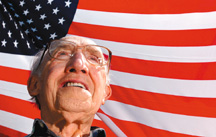
If valor is a gift, then Newhall resident Bernard Raskin may well have found his destiny in the pre-dawn darkness of June 6, 1944 when he, along with more than 3,000 paratroopers of the Battalion 507 Parachute Infantry Regiment, were air dropped across 50 miles of the Normandy coast of France to protect the Allied invasion’s western flank.
The campaign, officially designated “Operation Overlord,” would lead to the liberation of Nazi occupied France and the rest of western Europe, while forever etching D-Day as a pivotal point in history and the most dramatic single event in World War II.
In surviving a moment in history that would rescue Normandy from the grips of Adolf Hitler's regime of terror, Raskin became caught up in an adventure which thousands never lived to tell and one that he’ll never forget. For his service to his country during W.W.II, Raskin received a purple heart, the bronze star medal, three battle stars and several presidential unit citations.
Memories of that fateful day will soon come vividly to life for Raskin as he embarks on a return journey to Normandy — where he, along with more than 200 survivors of his regiment will be honored during the unveiling ceremonies of a special memorial dedicated to his 507 regiment. The unveiling of the granite monument, is scheduled to take place today in Amfreville, France, where scores of Normandy citizens are expected to turn out to pay their respects to the service personnel of the regiment who secured the freedom and prosperity they now enjoy.
“It’s rather exciting to go back — I’ve always wanted to go see the battle fields and also pay respect to those who didn’t get out of Normandy,” said Raskin, 88, who served as a radio operator during the invasion. Raskin has visited Europe several times in the years following service in the Army, but arranging a trip to Normandy has been somewhat illusive to Raskin.
“I was always so close, but getting to the battle grounds just never worked out, but now I’ll finally have a chance to see it — the people of Normandy are still very grateful even to this day and they have a great deal of respect for the sacrifice these men made,” Raskin said. Raskin and his son departed for Normandy on Friday, where the two will spend a week touring the historic sites of the area prior to attending the unveiling ceremonies of the monument. The granite monument, created by Memorial Fund, Inc., in conjunction with the American Battlefield Monuments Commission, was described to Raskin being divided into sections, in honor of those who served.
One section of the memorial will contain historical information about the regiment, etched in both English and French, while another section will depict a sculpted figure of a Normandy paratrooper whose toes just barley touch Normandy soil. A bronze plaque will detail the initial missions and successes of regiment 507 in both English and French. John Raskin, an executive in the health care industry, said he is proud of his father’s accomplishments. “Its exciting to see the people of Normandy dedicating a memorial to the regiment my father belonged to” John Raskin said.
On Sunday, Raskin and his son, visited Omaha Beach and the Omaha Beach cemetery. Later, on Monday, Raskin along with his fellow regiment members visited Chef du Pont where many of his regiment fought and lost their lives. Raskin will also visited Graignes and Ste. Mer Eglise where they attended ceremonies and visited airborne museums.
Raskin explained that Regiment 507 was attached to the 82nd Airborne Division that was air dropped behind Utah Beach to secure four causeways across a flooded area directly behind the beach as part of the effort to protect the invasion’s western flank. Other units landed on Omaha beach. But numerous factors caused the paratroopers to miss their drop zones and become scattered across the Norman countryside.
While the 507th was considered to be the most scattered of all the airborne units, they none the less managed to re-group and gather themselves throughout the night and into the day while organizing themselves in a way that they were able to continue the attack and accomplish their missions. Prior to his trip to Normandy Raskin recounted the stirring drama of that day.
“We landed in a swamp that wasn’t supposed to be there — it surprised a lot of us,” said Raskin who found himself trudging through about 4 feet of water while some of his other comrades found themselves covered head to toe in the swamp waters. Although Raskin had gone through rigorous training at Fort Benning Georgia prior to the Allied invasion, nothing quite prepared him for the challenges he faced in Normandy.
“I made the jump out of the plane and I survived the 33 days. When dawn came we got ourselves oriented and we swam to an embankment. We saw a train station and that helped to orient us. We arranged ourselves into various tight groups, though it was all very informal — I didn’t’ see anybody else from my plane until two days later. We fought most of the time and very quickly became use to being shot at — we were all caught up in a fair amount of hell,” Raskin said.
The regiment proceeded south along the railroad to Chef-du-Pont where they were to seize the town and bridge across the Murdered west of the center of town. The hodgepodge of troops from several units who had never trained together as a unit, didn’t even know one another, and were engaged in their first combat, had managed to accomplish their mission. But, as the end of D-Day neared, casualties were great and the regiment gathered the bodies of the dead, Americans and Germans, and covered them with parachutes. In an ironic twist of fate, the paratrooper’s wide dispersion actually benefited the invasion. With paratroopers in so many places, the German armies never developed adequate responses to the airborne and amphibious assaults.
The decision taken at Tehran was a final indication of American determination to stage the cross-Channel invasion The invasion was supported by more than 13,000 fighter, bomber, and transport aircraft. The campaign overwhelmed the Luftwaffe (the German air force) which was able to deploy fewer than 400 on D-Day. The British and American strategic air forces, deployed 11,000 aircraft, flew 200,000 sorties (troops) and dropped 195,000 tons of bombs on French rail centres and road networks as well as German airfields, radar installations, military bases, and coastal artillery batteries between April 1 and June 5, 1944.
During these preliminaries, two thousand Allied aircraft were lost, but the air campaign succeeded in breaking all the bridges across the Seine and Loire rivers while isolating the Normandy Invasion area from the rest of France.
Despite the hardships of the invasion, Raskin said the moral of his regiment remained positive throughout the ordeal. He observed that he is impressed with the patriotic spirit of today's service men and women in the face of a new terror in Afghanistan.
“War is a terrible and difficult thing. It seems to me that the challenge of these young men who are serving now, is the same as what me and my buddies had to face,” Raskin said.
Prior to his service in Normandy, Raskin served in Washington D.C. as a staff driver, just prior to the Pearl Harbor attacks. But Raskin said he longed for more physical activity and decided to become a paratrooper. Raskin had never flown in an airplane prior to becoming a paratrooper.
“It’s tough to serve in the army, but it’s even tougher when there's no physical activity. That’s why I became a paratrooper — I needed the physical activity. It was an adventure and something I just felt I had to do,” Raskin said.
Later in the war, Raskin’s regiment became a part of the 17th Airborne division in the Battle of the Bulge, which let the airborne division’s leap across the Rhine. That campaign, code named, “Operation Varsity,” was the largest single airborne drop of World War II and succeeded in ending the war in Europe. The 507 regiment was sent home and deactivated at Camp Miles Standish, Mass.
“We were taken back to England to form the 17th Airborn division. We were in England during the Battle of the Bulge and were immediately called, but we couldn’t get there because of the weather in December. We later took part in chasing them (the German army) back into Germany and spearhead the crossing into Germany. I was in Luxembourg just at the border and crossing into Germany in February of 1945 and I got knocked out. The German attack was very powerful,” recounted Raskin. To this day Raskin walks with a limp as a result of the wound to his leg.
Raskin was later discharged from a hospital in that area, and later left the army two weeks prior to the victory in Europe. A month later, the Japanese surrendered. Following his recovery, Raskin later went on to work in public relations, working for the most part, with unions such as the AFL and CIO, along with the National maritime Seaman’s Union.
Raskin’s daughter-in-law, Lori Raskin, said her father-in-law, rarely talks about his experience n WW II. Raskin moved from his home in San Diego, to Newhall to live with his son and his family two years ago. Raskin, who was born in Seattle, lived in San Diego for about 35 years after being a resident of New York for many years.
“I think it’s a great thing for the two of them to share and a nice experience for my husband,” Lori Raskin said. “What an amazing way to spend his birthday,” she said, adding that her husband celebrated his 50th birthday on Saturday. Raskin’s granddaughter Chelsea, 13, said she was happy that her grandfather had the chance to return to Normandy.
Of her grandfather’s trek to Normandy, Chelsea Raskin said, “I think he’s an amazing person and hearing his war stories gives me a whole new perspective on W.W. II because he lived it. It’s really awesome that he’s being honored and we’re all really proud of him.”