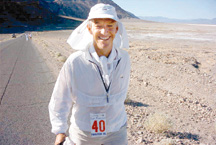
It was the adventure of a lifetime for 60-year-old Michael Haviland, who ran 135 miles this week in the 25th Annual Sun Precautions Badwater UltraMarathon, the most demanding, extreme, and prestigious ultramarathon in the world.
Haviland, the city of Santa Clarita’s economic development manager, placed 36th overall, with a time of 53:07:41. The international event was presented by adventureCORPS on July 22 through July 25.
Despite Death Valley’s searing 128 degree heat, of the 79 runners that started the race, Haviland and 58 others actually completed the blistering race within the 60 hour overall cutoff time.
The runners consisted of an international field of athletes ranging from 31 to 68 years of age, including 16 women and 63 men.
Pam Reed, 41, of Tucson, Ariz., placed first, with an overall time of 27:56:47.
The Badwater course (located in the depths of Badwater, Death Valley, the lowest elevation in the U.S. at 282 feet below sea level) covers three mountain ranges for a total of 13,000 feet of vertical ascent and 4,700 feet of descent.
Haviland said finishing the Badwater UltraMarathon marked the pinnacle of his career in the arena of ultramarathon running. An avid runner since the age of 50, Haviland helped establish the Santa Clarita marathon and half marathon and still assists with fund-raising for these events. He has completed 20 marathons in his 10 years of running, including eight 100-mile ultramarathons.
“This was not just another 100 miler,” said Haviland from his home in Fillmore after returning from Death Valley on Friday. “It’s in a category all by itself and it was significantly more challenging than anything I’ve ever experienced. It was over the top, even for me.”
Haviland embarked on the run on July 22 and sprinted through the finish line two days later without so much as a blister.
“It’s a big accomplishment in my life and it shows me what my potentials are — it was an incredible challenge,” Haviland said. Haviland said the race entailed a great deal of risk, but he was well prepared for the challenge.
“The heat was just oppressive — this was not an event for the weak at heart,” said Haviland, who traveled to Death Valley every weekend in June and most of July to train for the run.
In the course of his training, Haviland took on the toughest part of the run while taking in more than 50 miles of the terrain each weekend in preparation for the event.
Chris Kostman, event coordinator for the Badwater UltraMarathon, said the event provided plenty of interest for everyone involved.
“It went very smoothly. There were no incidents, but it was a very dramatic race,” Kostman said. “Pam Reed was not aware she was in the lead until the last 19 miles of the race. She didn’t stop, or sit down for the whole 28 hours of her run. She broke the women’s record by more than an hour and that’s quite an amazing feat.”
In accomplishing his goal of finishing, Haviland said preparation was the key to success in the race.
“It really takes all the focus a person can pull together and you have to be absolutely determined, but even then you might not make it,” Haviland said. “It takes an amazing amount of commitment and determination to do this. Training is absolutely essential. Without it, a person would not be able to do this.”
Haviland said the secret to his success in the ultramarathon was his decade of running experience.
“I attribute my success to experimentation and the refinement of an effective fuel and pacing strategy that works for me,” Haviland said. “At the age of 60, I’m a better runner than I ever have been. I am at the top of my game.”
In preparing for the trek, Haviland enlisted the sponsorship of Newhall Ice Co., which provided 51, seven-pound bags of ice; four 50-pound bags of ice; and 100 pounds of dry ice for the race. Newhall Ice also provided Haviland with ice provisions during his practice runs as well.
“Their support was absolutely vital to my success,” said Haviland.
Pacific Printing also sponsored Haviland and provided a colorful logo for Haviland’s support vehicle.
During the course of the run, Haviland took in a bottle of cold melted ice every few minutes. He drank his meals frequently throughout the run, getting sick just once during the first 30 miles of the run.
“That was the hardest part for me and a real hurdle to overcome,” Haviland said.
But Haviland persevered and never got sick again throughout the run.
Rooting Haviland on was his support team, which consisted of his son Jeff, 21, his brother Carl, sister-in-law Marci Haviland, and friend Trina Hirst.
Stewart Sorensen served as his pacer for 50 miles of the race.
The team loaded the ice, drink and food supplements onto a small truck. Haviland said he and his team’s diet consisted mostly of liquid foods.
“The hardest part was (going) without sleep. There were points when I would get so drowsy I felt like I would drop,” Haviland said, adding that a few of the runners experienced hallucinations during the course.
Haviland finished the unforgiving run at the Mt. Whitney Portals that reach nearly 8,300 feet. The Portals are the trailhead to the Mt. Whitney summit, the highest point in the continental United States.
Haviland and his fellow runners traversed Mushroom Rock, Furnace Creek, Salt Creek, Devil’s Cornfield, Devil’s Golf Course, Stovepipe Wells, Keeler and Lone Pine.
With the world's toughest ultramarathon now under his belt, Haviland is already planning ahead for his next marathon.
“My next goal is to push my limits at the Orlander National Championship 24 hour USA Track and Field National Championships held in Ohio in September,” Haviland said. This race challenges runners to run as far as they can in a 24 hour period.
For now, Haviland plans to report to work first thing this morning, while taking two weeks off from running until he is ready to get back into action.
“I really feel great,” Haviland said. “My feet were a little tender on Friday, and my leg muscles a little sore, but I was amazed at how good I felt.”
Of the ultimate challenge of ultramarathon running Haviland said he wouldn’t trade if for the world.
“You realize how frail we are as human beings, but it’s amazing to see just how much more potential you can extract out of yourself if you really give it your all,” Haviland said. “It really illustrates the range of what we can accomplish if we really focus our entire energy towards a goal and do all we can to accomplish that goal.”