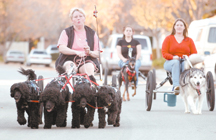
Once or twice a week, Darlette Ratschan enjoys a drive after dinner. So she hitches Jibby, and maybe his mom, Annie, to a surrey and zips through the byways of Valencia.
Jibby, also known as Cut of the Jib, is no ordinary steed. He’s a Portuguese Water Dog who barks up a storm when it’s time to ride the suburban prairie, and never says “neigh” when it comes to “driving” a cart.
Some may believe that Ratschan’s dogged insistence on putting a canine in harness is a bit unusual. But hey, dog carting — or driving, as it’s also known — is a fine, old tradition, and these pooches can’t wait to gambol through the park.
“It’s such a win-win for the dog,” Ratschan said. “My dog, Annie, was a big chubster until she started carting and getting out in the open air. Dogs love to pull.”
The best weight ratio is one-to-one, but a strong, adult dog can pull more than twice his or her weight.
“It’s good cardiovascular activity. There’s never any weight on the dog’s back, and no downward pressure, ever, on a professionally designed sulky,” said Ratschan.
Is this really a good thing for the pooch population?
“There are people who use this properly,” said Madeline Bernstein, president of the Los Angeles Society for the Prevention of Cruelty to Animals. “It’s not illegal.”
She noted, however, that amateur dog-carters sometimes can injure a dog and that the SPCA generally is not in support of the sport.
“If you were to cart a dog in a cruel manner, you could be charged with animal cruelty,” Bernstein said.
That warning doesn’t seem to apply to Ratschan and her friends as they showed off the safety features of their professionally made carts, explained how the weight doesn’t distress the dogs, and stressed that their pooches are never made to go carting when they become tired.
On a recent afternoon, Ratschan and three pals showed off their smartly made sulkies (carts made specifically for human riders). The sulkies are so beautifully designed that it’s enough to give you paws.
Ratschan has been going dog carting for more than four years, “just for pleasure.”
She’s not that interested in competition, but noted that contests for dog-carters include speed, slalom courses and handling.
Ratschan’s pal, Christina Barton of Northridge, works in Castaic as an animal trainer for the movies, and so it’s child’s play for her to get her two Doberman Pinschers to cooperate and not sulk in sulky harness.
Barton’s purebred Dobermans are named Draegin, a variation of the word “dragon,” and Mina, from a character in the films “Dracula” and “The League of Extraordinary Gentlemen.”
“She was named Mina,” Barton joked, “because she was so petite — and so dangerous.”
Immediately Mina affectionately licked a proffered hand to show her friendly nature.
As an employee of Studio Animal Service, Barton has trained animals for films including “Memoirs of a Geisha” and “Legally Blonde.”
Draegin is a doggone actor, too, having played in “Terminator 3” and in “Garfield” in supporting roles. On cue, he can bark, snarl, roll over, hide his eyes, take a bow and “attack” — although the “attack” is really a firm kiss planted against the “victim’s” face.
Nicole Gabriel of Canyon Country found out about dog-carting on the Internet and discovered that Ratschan lives nearby. Ratschan offered her neighbor a ride through the neighborhood — “And it was the coolest thing ever,” Gabriel said.
Her lead dog, Loki, of course, takes his name from the Norse deity who worked magic and loved to play pranks. But this dog is straight ahead, strong and full of energy, more like Loki’s half-brother, Thor.
Another pal in the group, Sandra Aubuchon of Newhall, has a large, enthusiastic Alaskan Malamute named Shadow Huntress that won’t dogleg to pull a cart. Shadow hates backtracking, but prefers to bound ahead and explore new territories.
Shadow is learning about the world of sulkies, and she’s picking up some smart animal tricks, too. Aubuchon showed off her Malamute’s talents-in-training, urging her to take a bow and wave “hi.”
The dogs take off, not at full speed, but at a sprightly walk. Even with Shadow in the group, this is no Iditarod Trail Sled Dog Race through Alaskan snowfields, but simply a light, dry “mush” through the streets.
However, in common with snowy fields, temperature is a factor.
“The colder the weather, the faster and further we go,” Ratschan said.
With the proximity of Christmas, one can barely resist shouting out encouragement. “On Jibby, on Loki, on Shadow, on Draegin.”
However, kids, don't try this at home. For one thing, there’s just no room to maneuver inside the house, especially with these elaborate carts.
Dog sulky designs include a dual-shafted sulky, which allows two canines, side by side, to pull the cart. A dorsal-hitch sulky comes down and attaches to the harness from the top, but that variety of sulky is still counterweighted to avoid putting pressure on the dog.
“The harnesses are custom-made for the dog’s size,” said Ratschan, who fashions harnesses for her own canines, and for others’ dogs.
There are optional hand brakes in some sulky models, a way to ensure the cart doesn’t bump into the dog.
Of course, there’s also the “Flintstones”-style option of braking, in which the riders simply stick out their feet to stop the cart.
Ratschan has a riding crop with bells on it that she uses to gently but emphatically fend off other, curious dogs who meander in to check out the cart activity.
And sometimes the crop is used on her own dogs — with a light touch.
“I sometimes give them a jingle bell butt,” she said with a smile.
Which reminds Ratschan: “We’ll be decorating the carts for Christmas, and adding more lights.”
That said, it was time to go. The dogs, with the encouragement of their owners, began trotting down the street, headed for the park and more photo opportunities. Envious canines in the neighborhood began barking furiously as the entourage moved on.
Yes, the neighborhood, at least for a few moments, was definitely going to the dogs.
For information about canine carting, e-mail Ratschan at [email protected].