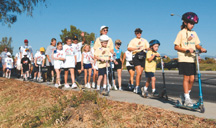
Attention all Santa Claritans interested in curing diabetes: the American Diabetes Association’s America’s Walk for Diabetes will take place on Sunday, Sept. 22 at Bridgeport Park in Valencia.
Teams are still forming for the aerobic community event and all ages are welcome to participate.
Presented by Kaiser Permanente and sponsored by UltraViolet Devices Inc., UVDI, the annual six-mile event will be emceed by KCBS Channel 2 news anchor and reporter Jonathan Elias. For those in need, there will also be a three-mile abbreviated Walk route alternative.
A national fund-raiser, America’s Walk for Diabetes will see some 100,000 participants in 245 cities across the country come together, each devoted to raising money to find a cure for the life-altering condition.
Don Kimball, team recruitment vice chair encourages community members to take part in the fun, enjoyable Walk, which formerly kicked off from the corner of McBean Parkway and Valencia Blvd.
“This is going to be the biggest and best Walk we have ever had,” Kimball said. “We have a unique opportunity this year being at the new Bridgeport Park...it has a nice grassy field and has plenty of parking.”
Tom Veloz, philanthropist, president of UVDI and grandfather of two granddaughters with diabetes, is honorary chair of the Walk. Located in Valencia, UVDI is a high volume manufacturer and supplier of ultra-violet related water and air disinfection products.
A volunteer-driven non-profit group, the American Diabetes Association is the nation’s leading health organization supporting diabetes research and public education. Almost 80 percent of every dollar raised funds diabetes prevention and research. Founded in 1940, the ADA has programs in all 50 states and the District of Columbia, reaching some 800 communities. The mission of ADA is to prevent and cure diabetes and to improve the lives of all people with diabetes.
Moneys pledged to America’s Walk for Diabetes team members will fund scientific studies to better understand the causes of diabetes, and its complications and treatments — as well as hopefully pave the way to a cure. The ADA also provides information via programs and publications for the public and medical professionals to increase awareness and lead to better health care and improved lives for those affected by the disease.
Walk teams can be comprised of family, friends, neighbors, religious groups and business associates. For employers who have matching gifts programs, that can double, or even triple, the fund-raising. A team is 10 or more people, with the average size being about 15.
Diabetes is a serious, life-long condition that can lead to blindness, heart disease, stroke, kidney failure, nerve damage, leg amputations, even death. It strikes one in 17 Americans; one in 20 people. One third of those with the disease don’t even know it. Nearly 800,000 people will be diagnosed with diabetes this year and more than 187,000 will die.
Diabetes occurs when the body does not make enough insulin, does not use insulin effectively, or both. Insulin, which is made in the pancreas, helps the body use glucose, its main source of energy. Unless the glucose gets into cells, the body cannot use it for energy. Dangerous complications can ensue when this happens.
Symptoms of diabetes include excessive thirst, frequent urination, hunger, fatigue and weight loss.
Most people with diabetes have one of two kinds: type I diabetes, an autoimmune disease that results when the pancreas produces insufficient amounts of insulin to meet the body’s needs. A trigger, either an illness or stress, causes the immune system to attack and destroy the beta cells of the pancreas, those responsible for producing the insulin. When this occurs the person becomes insulin-dependent to survive. Type 1 accounts for about 10 percent of all cases of diabetes (in addition to insulin injections, type 1 is managed through diet, regular blood glucose monitoring, and many other modifications); type II diabetes, far more common than type 1 (about 90 percent of cases of diabetes), is related to insulin resistance, obesity, high cholesterol, a sedentary lifestyle and high blood pressure. Dietary changes, medications, losing excess weight, and getting regular exercise are generally part of the treatment for type 2 diabetes.
In both types of diabetes, too much sugar remains in the blood and adverse health consequences can occur. (There is also a form of diabetes called gestational diabetes mellitus, which can occur during pregnancy.)
Risk factors for diabetes include: being over the age of 45; underactive; overweight; having family members with diabetes; being a woman who has had a baby weighing more than nine pounds at birth; being a member of one of the following ethnic groups: African American; Hispanic/Latino; American Indian; Asian American or Pacific Islander.
According to the American Diabetes Association, diabetes not only evokes severe physical consequences, it is an expensive disease that costs taxpayers and businesses more than $98 billion a year in health costs.
Finding a cure for diabetes is dear to the hearts of many Santa Claritans.
According to Dan Jones, local ADA chapter president-elect and son-in-law of Tom Veloz, there are about 17,000 people in this community with some form of diabetes.
“This (number) is staggering...I am told it is one of highest in California,” Jones said. “And there are people out there who do not even know they have it...”
Jones and his wife, Jenine Jones, daughter of the late Sheila Veloz, a local breast cancer advocate and benefactor who died in July of 2001, have three children; son Stephen, 3, and daughters, Bailey, 6, and Camille, 8. Both girls have type 1 diabetes.
“Our goal as parents is to find a cure for our daughters, hopefully sooner than later...this is obviously a big part in raising funds for research and to educate people so they do not have to go through this or if they must, it is diagnosed earlier,” said Jones, whose 48-year-old brother was diagnosed with type 1 diabetes in his 20s.
Being able to devote much time to children, especially those affected by a chronic illness, is very important, said Jones, who works in management at UVDI.
“Jenine goes to the girls’ school three times a day for shots...she really does a great job and takes such good care of them,” the father said.
The couple is looking forward to their daughters’ receiving insulin pumps in the next couple months. State-of-the-art technology made possible through ongoing diabetes research, pumps are indwelling devices that supply insulin and act as mechanical pancreas.
“The pumps will make life a lot easier and alleviate the need for shots,” Jones said.
Don Kimball and his wife, Linda, also look forward to a day when diabetes is a malady of the past. Cailee and Darin Kimball, two of their three children, are teens with the type 1 form of the disease.
At a time when most youths have freedom to chose what they want to eat and how they spend a lot of their time, those with type 1 diabetes must be constantly watchful of their food intake (particularly carbohydrates), blood glucose and stress levels, physical symptoms, exercise and serial insulin injections. Their lives have many necessary medical guidelines and restrictions. This is hard enough for an adult to comply with, let alone a teenager who wants to enjoy the world.
“We deal with it every day and it is obviously a challenge, particularly for teens,” he said. “We understand what this is about and are doing whatever we can to help find a cure.”
Kimball praised the city of Santa Clarita for helping to secure Bridgeport Park for the event.
“We are thankful for their help and look forward to a great family fun and fund-raising day,” said Kimball, who works as vice president of finance and controller for Newhall Land and Farming Co.
America’s Walk for Diabetes will start at 9 a.m. and follow along the scenic paseos and riverwalk regions of the Valencia lake community. Each backed with monetary pledges from friends, family, coworkers, etc., walkers will receive a colorful commemorative T-shirt for a minimum of $100. Other prizes include sweatshirts, children’s T-shirts and Pottery Barn gift certificates.
Last year’s Walk, held Sept. 30 on the coat-tails of the Sept. 11 terrorist attack, brought in $90,000 - down $10,000 from the year before, Kimball said.
“We are hoping to raise $105,000 this year,” he said.
Optimistic about the diabetes research currently underway, Kimball believes such efforts will ultimately pay off.
“I think we will have a cure for Type 1 diabetes within the next 10 years,” Kimball said. “We are walking to find that cure.”
Check-in time for the event is 8 a.m. Upon completion of the Walk, participants will enjoy a delicious lunch, entertainment, a raffle, and festivities. Bridgeport Park is located on Newhall Ranch Road between McBean Parkway and Bouquet Canyon.
Anyone interested in participating in, sponsoring or donating to the Walk for Diabetes to contact him at 255-4255 or call Lisa Esparza, walk coordinator at 1-800-828-8293 ext. 7474.