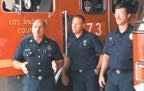
Jerry Thomsen began last Sept. 11 at Los Angeles County Fire Station 73 like any other day.
In the middle of a 24-hour shift, Thomsen began routine breakfast rituals, which included turning on the television to find out the news of the day. That’s when he witnessed every firefighter’s worst nightmare.
He watched the day’s events unfold and wanted to know what he could do. It was then Thomsen and his fellow firefighter brothers began a campaign to get them back to Ground Zero.
Thomsen was one of the two dozen firefighters from the Santa Clarita Valley stations who went New York to assist with rescue and recovery efforts. Even more amazing, all went on their own time and paid their own way.
Capt. Dean McGuire and Simon Sage, both from Station 73, went with Thomsen to New York in mid-October.
“We asked, what can we do here in California for our brothers back there?” Thomsen said.
Sage was home with his daughter when he heard about the attacks.
“It didn’t dawn on us then that 350 firefighters died,” Sage said.
After things were more secure at home, the department unofficially began organizing staggered trips back East to assist in the recovery efforts. Not everyone could go at once because of the on-going statewide threat, McGuire explained.
He said orchestrating the trips was “organized chaos,” but worth the temporary inconveniences.
“It’s sad for us to lose one person,” McGuire said. “To lose 343, that’s a disaster.”
The trio reflected back on the trip as their duty, both as firefighters and patriots.
“We needed something concrete that we can hold onto,” he said.
Sage said his first experience at Ground Zero was haunting.
“What sticks most in my mind is the smell and the sound,” he said about the burning jet fuel, paper and bodies. “I remember it. I taste it.”
McGuire recalled how he stood on the top of a building overlooking “the pit,” a nickname for Ground Zero, and seeing the State of Liberty standing on her pedestal in the harbor.
“All I could think of was that they didn’t get our freedom,” he said.
McGuire said when they weren’t sifting through and removing rubble, they attended funerals of their fallen comrades.
“The (firefighters’) families were grateful we were there,” he said.
Thomsen said he went to St. Patrick’s Cathedral where many of the victims’ families stood in vigil. It was there, he said, that he thought of his wife, who was pregnant, and was thankful for her safety.
“It brought it home here for me,” he said.
Coincidentally, McGuire ran into another McGuire, a lieutenant, with whom he still corresponds. They swapped shirts and hats, a common shared thread among departments.
Fitting enough, the men found refuge during off hours at FDNY Station 73 in the Bronx. There, the men learned about one of the hundreds of traditions imbued in that department’s culture: the station mascot.
It was after seeing FDNY’s 73 patch with the World Trade Center on the left side and their station, which dates back to the 1880s, on the right, with its mascot Oscar the Grouch in the middle, that the men got the idea to get one for their station.
“It’s called the Squirrel Cage because its always crazy,” Sage said about Station 73 on San Fernando Road.
Squirrel Cage sticker and patches adorn the vehicles and uniforms of all the station’s men.
“It’s tied to us. To me, that’s important,” he said.
The men didn’t realize how big of an impact their actions had on others until the plane ride home when the passengers broke out in applause when the pilot announced Los Angeles firefighters were on board.
“It continues to happen,” Sage said.
How have the three men’s lives changed since Sept. 11?
“I didn’t appreciate what I had before,” Sage said. “I had taken it for granted myself. I’m proud to be a fireman.”
Thomsen agreed.
“Driving ‘Big Red’ (the station’s hook and ladder) is every boy’s dream,” Thomsen said. “I get to do it for a living.”
McGuire said his experience at Ground Zero was the highlight of his career.
“Without question, I think this is the most important thing I’ve ever done,” he said.