Gone are the manufacturing days of assembly lines operated by employees fresh out of high school. Today’s manufacturing companies are looking for problem-solving, creative thinkers who are science- and math-savvy and can work in a teamwork-driven environment.
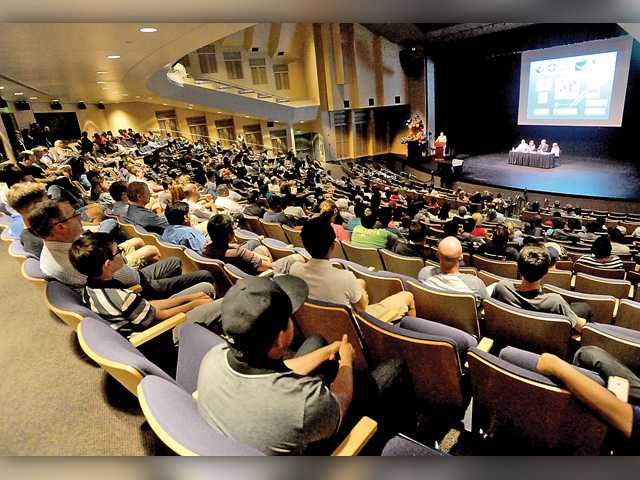
That was the message several Santa Clarita Valley manufacturing professionals delivered Thursday night to a crowd of more than 200 people at a public panel discussion at the Santa Clarita Performing Arts Center.
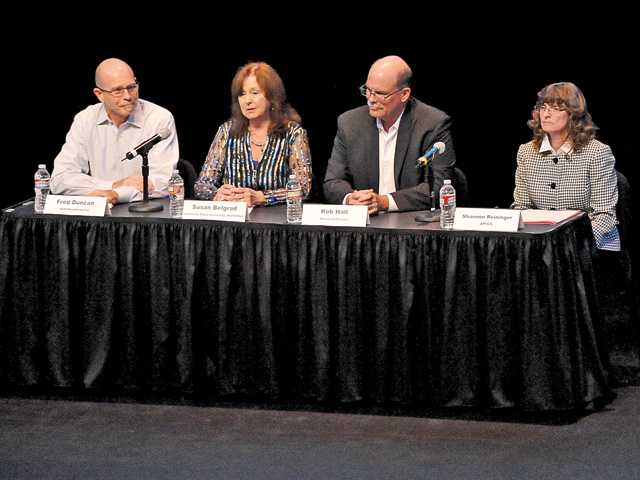
Experts from Santa Clarita Valley manufacturing businesses spent close to two hours trying to dispel the misconceptions people have of the industry today. Manufacturing jobs, once thought of as a gritty, straight-out-of-high-school positions, are much more technologically advanced today, according to four panelist who spoke to high school and college students at the 2015 Manufacturing Day event.
In short, they said, this is not your grandfather’s manufacturing career.
“Manufacturing as I remember was very non-technical,” said Rob Hall of Advanced Bionics. “It’s highly technical now. It’s not just ‘Show up, and if you have a pulse you get a job’ anymore,” Hall said.
Manufacturing industries aren’t dying, either; technology has rapidly changed how things work, the panelists stated.
The industry is also growing and is looking for job seekers who have studied science, technology, engineering and math — what educators call “STEM” courses.
Employers are also looking for younger candidates to update some of the culture within manufacturing industries and to replace retiring baby boomers.
“We need some youth in this industry,” said Fred Duncan of B&B Manufacturing, located in Valencia. “That’s going to drive change.”
Panelist Shannon Reininger of Aerospace Dynamics International spent much of her talking time promoting the more than 45 job openings at her Valencia-based company. Reininger said her aerospace company is hiring at least 15 people every Monday.
In fact, the human resources director suggested Reininger tell potential recruits to just show up to the door, she said.
“It’s a field that’s growing and in high need,” she said.
Online recruitment
The future of the industry is highly dependent on students immersed in STEM-related curriculum, which puts the burden on today’s teachers, said Susan Belgrad of the California State University, Northridge, Science, Technology, Engineering, and Mathematics Innovations program. She said it is imperative that educators teach STEM standards and try their best to involve students.
“We can’t afford for students not to love math,” Belgrad said. “Math is important. STEM education is important.”
Panelists urged those interested in seeking engineering or other manufacturing jobs to join professional organizations and earn specific credentials and certifications to help them win jobs in the field they want.
A college degree continues to be a standard in the industry, although a bachelor’s degree may not be needed for all STEM-related positions, the panelists said.
The panelists said most of their job recruitments are done by online applications or through job-posting sites like LinkedIn and Monster.
Getting your foot in the door could be more about who you know than what you have done, Hall admitted.
“One of the most important things ... is knowing how to relate to people, how to collaborate,” Belgrad said.
As for salaries, the panelists said pay in manufacturing industries remains high — but they did not disclose specific figures.
Extracurricular programs
Home-school high school sophomore Taylor Brown and Academy of the Canyons sophomore Olivia Smalley were two of those in the crowd who said they enjoyed the talk.
“To be completely honest, when I first thought about manufacturing I immediately thought of assembly lines,” sophomore Taylor Brown said. “So tonight turned out to be very different. I was surprise.”
Both girls are members of FIRST Tech Challenge team 8496, an organization created to inspire kids interested in science and technology through building robotics and other challenges. The panel discussion reinforced the importance of extracurricular activities like FIRST Tech in helping them achieve their goals, Smalley said.
“Coming here tonight validates that we are entering the right path in what we want to do,” Smalley said.
Both girls plan to pursue careers in some form of engineering.
The panel discussion was part of National Manufacturing Day, a countrywide event to helped bridge the gap between modern manufacturers and future generations. Students with the William S. Hart Union High School District toured manufacturing companies Friday morning.
Thursday’s event, which was free, was sponsored by the city of Santa Clarita, the Hart district, the Santa Clarita Valley Economic Development Corporation and other organizations.