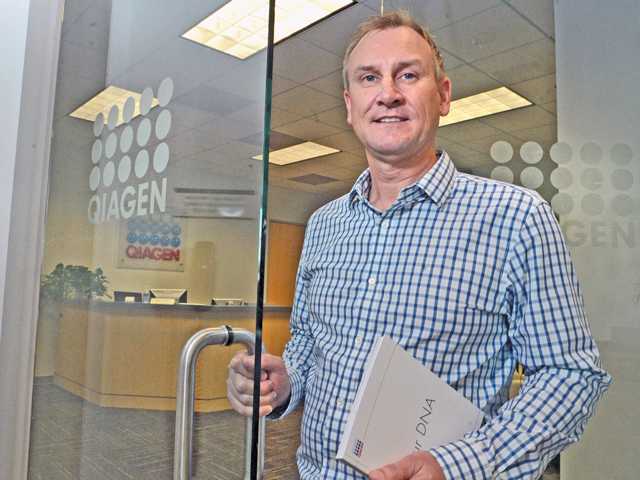
In an office on Turnberry Lane in Valencia quietly resides Qiagen (pronounced Ky-gen), a firm providing technical and sales support to its billion-dollar global operation in the life sciences industry. In a field that helps improve the quality and standard of life for people, Qiagen is behind the new blood test for tuberculosis – eliminating the under the skin test of the past – and helping actress Angelie Jolie to determine which DNA marker she carried for breast cancer, as well as to exonerate a man in July 2014 who was imprisoned 26 years for a murder he didn’t commit.
Working with biological materials like blood, bodily fluids or skin and other body materials, the company creates test kits used by medical personnel to provide reliable diagnoses for patients in laboratories and scores of hospitals and research centers like the Mayo Clinic, the Cleveland Clinic, and Johns Hopkins University.
But, perhaps Qiagen is most noted for its breakthrough in tuberculosis testing – a highly contagious airborne infectious disease affecting the lungs. In 2014, there were 9.6 million active cases of the disease that resulted in 1.5 million deaths, according to the World Health Organization.
“We have a blood test for TB to replace the skin test. It’s been in the U.S. and global markets for 15 years,” said Mark Boyle, vice president with Qiagen. “If you go to your doctor’s office, they can order the TB blood test now instead of the skin test.”
Tuberculosis
Younger generations won’t remember the dreaded iron lungs by which polio or tuberculosis patients lay inside a tubular case for months on end, with air being mechanically forced into the person’s lungs. But many will recall the multiple prick test administered just under the skin on the inside of the lower arm, after which they waited 48 to 72 hours to determine the results of the test based on swelling in the area.
Qiagen’s advancement of the newer test worldwide has led to them capturing 12 percent of the global market, Boyle said. There are in excess of some 60 million tests per year. But, it first made its mark in the medical sciences field with its extraction and purification kits it provided to universities and academic centers for the highest level recovery of DNA materials needed for testing.
And then, about seven or eight years ago, the company got involved in the diagnostics fields.
Life saving testing
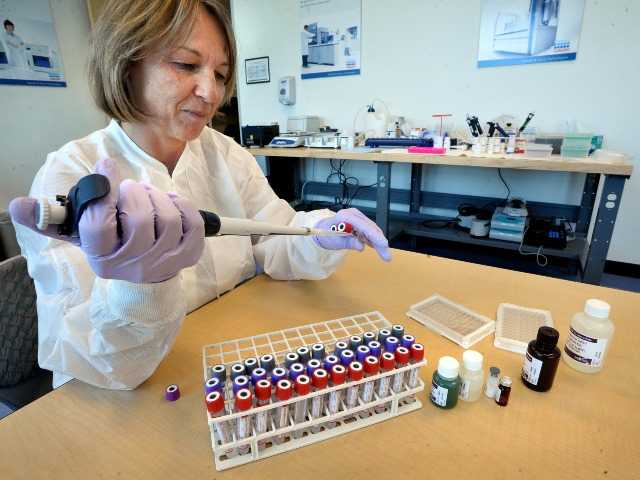
Using Qiagen’s re-agents – test kits – medical scientists are able to perform molecular diagnostic tests for the disease prevention and profiling fields – including forensics testing, Boyle said.
“Taking a piece of tissue or biopsy material, we can identify the DNA and see if a person is carrying the DNA for a certain type of cancer,” Boyle said. “Our re-agents were used to see if Angelie Jolie indeed had the DNA marker for the strain of cancer (that had killed both her mother and grandmother at a young age). They identified that she had the DNA marker for the kind of breast cancer that ran in her family.”
And then along came the case of Kevin Martin, imprisoned for 26 years for the 1982 killing of a 19-year old Washington D.C. woman. Martin had always claimed he was innocent, but couldn’t prove it to the satisfaction of officials. Sentenced in 1984 to 35 years to life, Martin’s case was picked up by the Mid-Atlantic Innocence Project. Using Qiagen’s test products, Martin was finally released in July 2014.
“The gentleman spent 26 years in prison for a crime he hadn’t committed,” Boyle said. “But performing a DNA analysis from biological samples that remained in holding, he was proved innocent. He was exonerated by evidence using our re-agents.”
The company had lower-profile beginnings, however, when it first began back in the 1980s as Cellestis, a life sciences company that was acquired by Qiagen in 2011 for some $355 million in cash. Boyle was with the company back then.
Profile
“We were the company involved in tuberculosis,” Boyle said. “Santa Clarita was our headquarters; and now it serves as the call center for technical support and sales.”
A billion-dollar company in terms of revenues, Qiagen’s local operation has some 50 to 60 people who sell the company’s innovations, and a technical staff to support all customers who use their products worldwide.
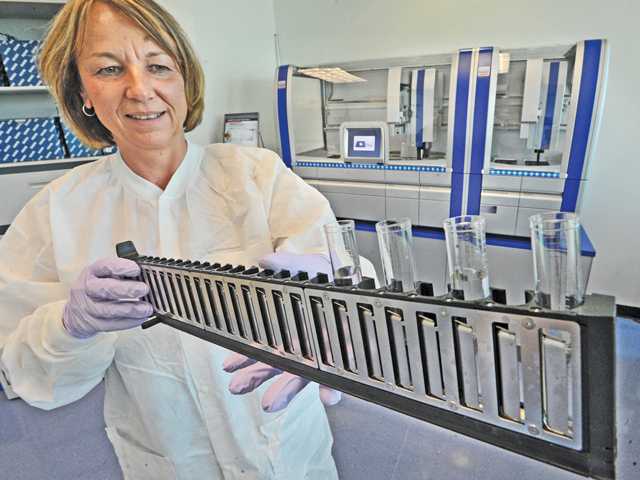
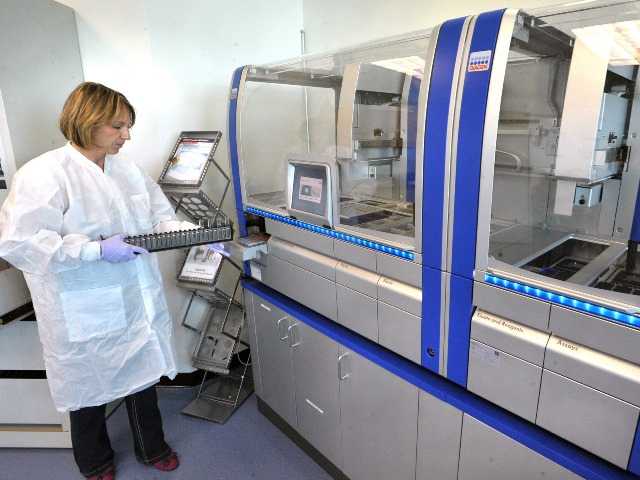
It has expanded from the basic life science field of providing materials to diagnose, to producing instruments that automate sample processing to isolate DNA markers. And, it now also provides software to interpret the enormous amount of genetic information produced by the testing. The software can sort through all of that data and produce an answer.
Sales team members specialize in various areas, allowing them to offer their expertise when working with clients. Ditto for the tech support team, where clients may call with questions and the staff will walk them through the testing protocols.
“Our people are very knowledgeable; some even have PhDs,” Boyle said.