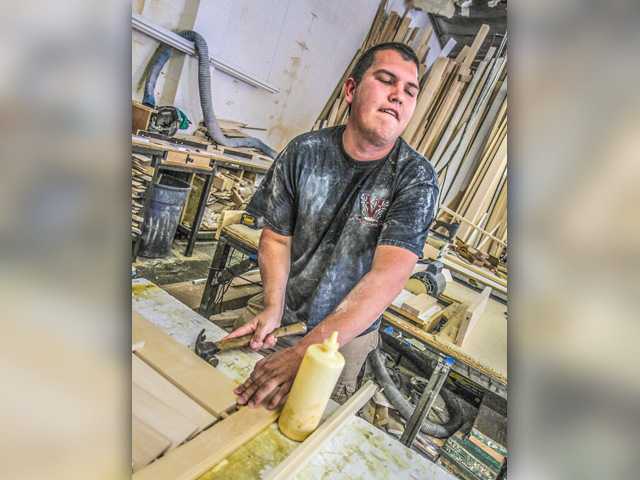
Louie Diaz hauls a stack of lumber from a dimly lit corner of the Chatsworth wood shop where he works, the wood blocks stacked up to his face.
“It’s a heavy load,” he mutters as he negotiates past cables dangling from the ceiling to deposit his load on a work table.
“There’s a lot that can go wrong in a shop, and very fast,” the 23-year-old Castaic man says, wiping sawdust from his cheek.
He places two strips of lumber on a rack and, with the flip of a red power switch, sets a table saw blade spinning.
As the whirring of the blade roars louder, Diaz — with a gaze fixed not on the razor-sharp metal below, but on the ceiling — slides a wood strip toward the fast-spinning blade.
It wouldn’t matter if he was looking up, down, left or right; Diaz has been completely blind since childhood.
Brain tumor
At age 2 a medical episode marked the beginning of Louie Diaz’s path to darkness.
“I woke up on a Friday morning and had a seizure,” Diaz said. “My right side was completely paralyzed and I couldn’t speak.”
The young boy was sent to Henry Mayo Newhall Hospital, where X-rays revealed a brain tumor had wrapped itself around his optic nerve.
Diaz was airlifted to UCLA Medical Center in Los Angeles, where doctors removed a majority of the tumor with hopes the remaining portions would die.
Two weeks after the surgery, additional testing showed the tumor had returned.
Doctors recommended surgery to sever and remove the nerve responsible for transmitting information between Diaz’s eyes and brain.
An immediate and successful surgery left him completely blind.
Today the 23-year-old says there’s a bright side to living in a world of darkness. Diaz, a College of the Canyons student, said he took up woodworking as a challenge to disprove those who believe blindness is a handicap.
“Yeah, there are things I won’t be able to do,” he said, adjusting a drill in the wood shop owned by his family. “Just because you’re not capable of seeing doesn’t mean you can’t do something.
“Beethoven was deaf and he still made music.”
New goal
However, Diaz’s upbeat outlook doesn’t mean he has no regrets.
“If I could see, I would love to be a firefighter,” he said as a Los Angeles City Fire engine thundered past the shop en route to an emergency.
“I was a little discouraged because that was my dream job,” he said.
A few firefighting friends encouraged Diaz to train to become a dispatcher, but limitations in technology aiding the blind shattered those plans.
But, he said, visual impairment doesn’t hinder curiosity.
He picked up a radio transceiver that scans police and fire emergency radio frequencies. The tool allows him to pinpoint where each fire apparatus is headed and the severity of the tasks faced by first-responders.
With the newfound resource, Diaz approached Dave Brill, a new-media journalism instructor at College of the Canyons, for guidance.
Brill, who is also a broadcast journalist at KABC in Glendale, encouraged Diaz to look into becoming a news assignment editor.
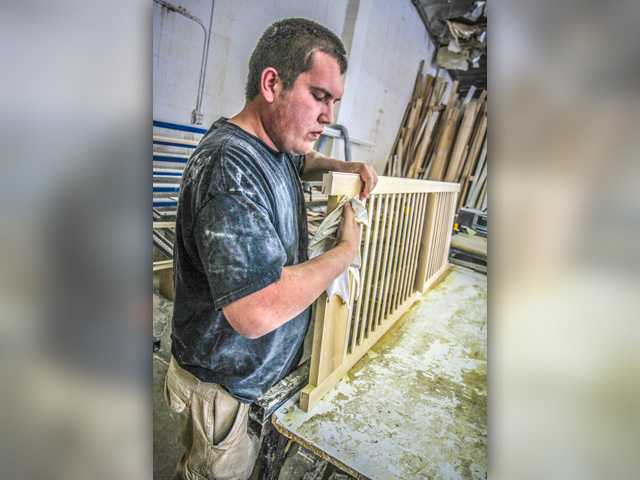
“You basically get paid to listen to a scanner all day,” he said excitedly as he put finishing touches on the wooden shutter he had been building during an hour-long interview.
Still talking about his new career goal, Diaz receives a firm handshake from the shop foreman for his flawless work on the shutter — a job some might have said was beyond the abilities of the blind young man from Castaic.