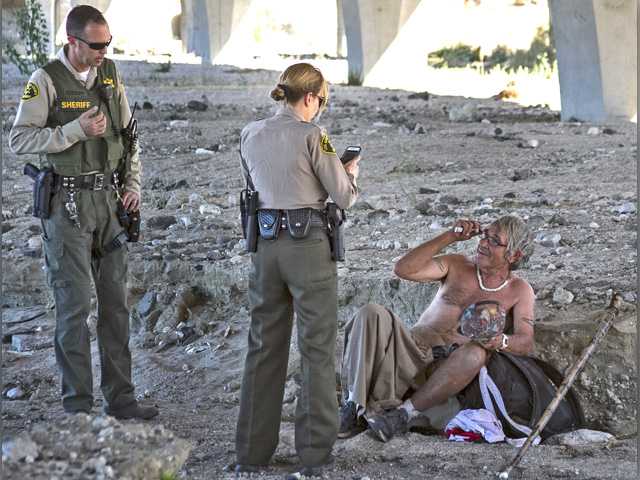
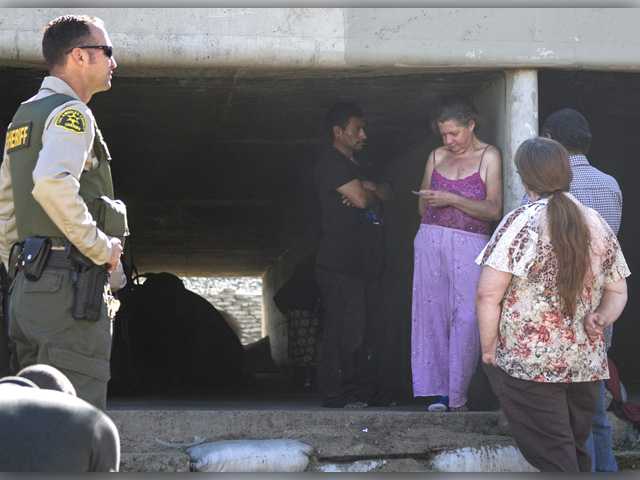
Editor's note: Updates captions to reflect photos were taken Friday.
Contracted cleaning crews fought the early-morning heat to pull heaps of trash from the Santa Clara River Monday.
Five Santa Clarita sites frequently targeted by transients as potential locations to camp were dismantled as part of an ongoing effort to reduce the amount of trash and crime in and around the riverbed.
As the summer sun beat down on a dry and dusty Santa Clarita Valley, crews continued their efforts to reach a goal of zero illegal campsites.
After more than 16 months of routine cleanings, the number of well-established riverbed encampments has come down as the transients react to the city’s cleanup efforts, said Daniel Rivas, Santa Clarita’s community preservation manager.
“There’s a 37 percent decrease in the amount of sites we have cleared,” compared to the 41 encampments dismantled between January and May 2015, Rivas said.
The program was launched in response to complaints of criminal activity from residents near the Santa Clara River.
Some of those complaints were related to fires initiated within the mostly dry, brushy channel.
“The goal was to decrease that activity,” Rivas said.
“We come out every week and we do our sweeps once a month,” Rivas said, attributing the decrease in transient settlements to the city’s increase in proactiveness.
Rivas estimated an 83 percent reduction in the amount of trash collected during the first five months of this year compared to the 33,000 pounds collected during cleanup efforts the first five months of 2015.
“We’re attributing that decrease to the mobilization of sites,” Rivas said.
Instead of constructing standing structures, transients are setting up camp in the river for one or two nights before moving on to another location, he said.
That shift was observed Monday as three of the five sites up for demolition consisted mostly of medium-sized tents and a few belongings in contrast to the cache of bicycles, tangled newborn clothing and strollers taken from multiple sites a year ago.
A homeless couple which was asked to vacate a small flood control section of Newhall Creek near Railroad Avenue had more than three shopping carts stuffed with blankets, severely tattered shawls on white plastic hangers and about a half dozen packed black trash bags.
One year ago, vagrants living in waterways were urged to leave the city’s creekbeds and take advantage of available housing opportunities in anticipation of a strong El Nino season, Rivas said.
As temperatures took an upswing past the century mark in June, the message remained the same.
“One of the goals of the program was to ensure the safety of the transients,” Rivas said, adding that city staff wanted to make sure they reached and educated those without a roof over their head.
The habitual transients are aware of the services available to them, Rivas explained, but for unknown reasons, they don’t take advantage of it – a problem many cities across the nation are experiencing.
Case in point: An apparently homeless man and woman in Santa Clarita were contacted by sheriff’s deputies, city code enforcement personnel and county services coordinators. The couple refused services because they didn’t want to give up a leashed dog.
“There are so many different avenues to take, but they have to be willing to do it,” he said.
A buck in the trend did come to the city’s code enforcement team Friday during the posting of 72-hour notices of intent to evict.
After many years of refusing services, one man – apparently with mental issues – was observed making verbal promises to utilize Bridge to Home services. The nonprofit provides outreach tailored toward taking homeless individuals off the street and placing them into permanent housing.
“We’re approaching it with more services in addition to going out there and cleaning up,” Rivas said. “I think it’s a job well done, and I don’t think we’re going to stop.”