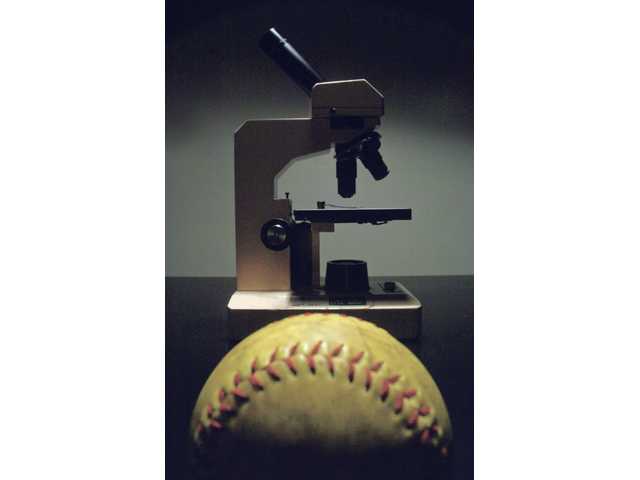
Sports medicine has come a long way from the days of pickle juice.
The pungent liquid has long been a remedy for muscle cramps in the world of athletics and is still used to this day.
Advancements in sports medicine have athletes back on the field faster than ever these days, and the future could yield even more impressive results.
"It's a little bit Star Trek or science fiction, but it is pretty cool, it really is," says Dr. David McAllister, director of the UCLA Sports Medicine Program, about the treatments on the horizon.
Ailing athletes could soon turn to biologics to stimulate growth or use manufactured tissue to repair muscle and tendon injuries as sports take a marked shift into a new age of medical influence.
It starts with research.
"NFL players 20 or 30 years ago would drink pickle juice because of the high amounts of sodium," says Chad Peters, a certified athletic trainer at the College of the Canyons. "Now, someone at BYU did real-life research and found that it works, but not because of the sodium, but something else that acts on the nerves."
Such research has also led to breakthroughs in recovery stimulants.
"By far one of the most exciting things on the horizon is biologics," McAllister says. "There is a lot of effort by big pharmaceutical companies and by financial investors to develop products that will accelerate healing and allow things to heal better than they would before."
According to the U.S. Food and Drug Administration, biologics include vaccines, blood and blood components, allergenics, somatic cells, gene therapy, tissues, and recombinant therapeutic proteins and can be composed of sugars, proteins, or nucleic acids or a complex combinations of these substances, or may be living entities such as cells and tissues.
The FDA goes on to say the field of "biological products often represent the cutting-edge of biomedical research and, in time, may offer the most effective means to treat a variety of medical illnesses and conditions that presently have no other treatments available."
With a lot of the research being conducted in the area of biologics at UCLA Medical Center, McAllister knows firsthand how effective these products can be.
"I think most of the thinking is aiming at what can we do to more quickly rehabilitate and have athletes recover from the injury so they miss less time," he says. "Surgery or non-surgery, I think there are ways that we can decrease the amount of time missed and speed up the healing time. And I think that really is where a lot of the focus is."
Biologics can be applied locally to the site of the injury, or injected.
One such treatment already in use is called platelet-rich plasma therapy.
In recent years, such athletes as Tiger Woods, Troy Polamalu, Hines Ward and Cliff Lee have sung its praises.
The platelets are separated from blood taken from the patient. The resulting high concentration of platelets are then reinjected into the patient to stimulate healing at the injured site.
"This is the first of what will likely be many such biologic treatments for sports injuries," McAllister says.
While debate continues regarding the effectiveness of these methods, biologics pale in comparison to the controversy surround another direction McAllister says sports medicine could go.
That direction leads straight toward stem cell research, or specifically, tissue engineering.
"If the athlete tears his ACL and needs surgery, not only does he have sit and is going to miss 6 to 12 months and rehabilitate the injury, he has to take a piece of tendon taken from his knee or a donor's knee to reconstruct the ACL," McAllister says. "We and others are trying to develop ways where that kind of tissue can be developed in a lab in a Petri dish."
Even with this level of science making its way into the sports world, the foremost focus of future sports medicine remains fixed on prevention.
The marketplace can attest to that focus.
For an example, HQ, Inc.'s CorTemp® Ingestible Core Body Temperature Sensor can send valuable data to on-site medical professionals during games and practices.
The product is swallowed and transmits data on the athlete's body temperature back to a data recorder, aiding in the prevention of heat stroke and other related ailments.
In 2007, Riddell Inc., one of the primary manufacturers of protective football equipment nationwide, introduced helmets with the Head Impact Telemetry System, which monitors impact location, magnitude, direction and duration of each hit.
The addition of the technology to the helmet has multiple effects, all of which relate to a player's well-being.
"You have multiple ways of fusing that improvement to the product," says Thad Ide, the vice president of research and product development for Riddell. "One, is the research that can be done with it. Two, it is the alert capacity. And three, is the data-mining aspect so that you can improve the protective nature of the helmet."
Since a concussion is one of the most common injuries in athletics today, the ability to stay ahead of the curve is essential to sports medicine.
And with the additional research and data collected from these types of products, treatment and practice continues to evolve.
"The standard practice whenever an athlete comes off the field with a concussion, as soon as there were no obvious symptoms - they no longer had a headache and were no longer dizzy - we would put them right back out there," Peters says. "Right now it is pretty much mandated by state practice that you don't play the same day of the concussion, even if the symptoms reside."
Combined with continuing education, technology and science are getting athletes back on the field faster than ever.
Even improved training methods and instruction for coaches will serve as a key factor for future treatment, McAllister says.
Though it is a simple concept, knowledge at all levels is the way of the future.
"An ounce of prevention is worth a pound of cure, so to speak," McAllister says.
The alternative could be a tall glass of pickle juice.