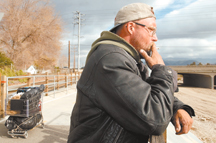
Beer bottle caps are skewered atop a chain-link fence in Canyon Country. Nearby, a half-dozen homeless men meet for their morning meal: 40 ounces of malt liquor washed down with a can or two of beer.
“This is what we call ‘The Breakfast Club,’” said panhandler Gary Meacham, who makes rounds with his German shepherd, Lobo.
The dog is part of the reason Meacham vows never to stay in a temporary winter shelter. Pets are not allowed. Other men standing around chimed in with other reasons.
“It’s very uncomfortable and there’re too many damn rules,” one said. “It smells worse than jail.”
Many of the homeless who use the shelter are either families, the elderly, the mentally ill or drug users, they said. The Breakfast Club, whose members for the most part are able-bodied men, have vowed to stay off drugs; some, including Meacham, said they’re recovering addicts.
Instead, they “go to the store and buy something legal” — said Kevin, one of the transients, while gripping a 40-ounce bottle of King Cobra.
They said they do their best to stay out of everyone else’s way, and not cause trouble, and they scoffed at rumors that Santa Clarita planned to ship its homeless to Los Angeles.
“That’s what they want to do, ship you down to ‘Crackland,’” Meacham said.
qqq
Santa Clarita and Los Angeles have battled over what to do with the Santa Clarita Valley’s homeless. In addition to the estimated 175 transients in the streets of the valley, thousands teeter dangerously close to homelessness.
In late August the city of Santa Clarita declined to renew the lease for a temporary winter shelter that operated for seven years at the Via Princessa Metrolink Station. Council members cited local residents’ complaints about the vagabonds.
The city sought proposals for alternative plans after deeming all alternative shelter sites unacceptable. Council members accepted a proposal that called for, among other things, busing local transients into Los Angeles. In response, the Los Angeles City Council last week passed a resolution stating no other cities may ship their derelicts into Los Angeles.
On Tuesday, county Supervisor Michael D. Antonovich stepped in, offering county land on Centre Pointe Parkway for a temporary winter shelter. The plan was firmed up Friday, with a projected opening date by Christmas.
But the solution is only temporary: Next year the site will not be available for a shelter.
qqq
Back at the Breakfast Club meeting Tuesday, the transients joked at each others’ expense. Lobo, the dog, periodically yipped and chased after rocks. Every rock in this wash is Lobo’s, Meacham said.
The men stood around listening to STAR 98.7 on a portable radio. They discussed the merits of being homeless in the United States — compared to Africa, at least. The consensus was that it is much more difficult to starve to death here.
Though, they said, finding a place to live in peace might be another story.
‘Ain’t Got Nothing to Lose’
On a bike path that runs along the bone-dry wash called the Santa Clara River, Kevin, homeless for more than a decade, sails across Canyon Country.
The buoyant, habitually chuckling ex-Navy sailor calls his loaded shopping cart “the boat,” and it goes wherever he goes. Its freight includes recyclables, a plethora of found items, a sleeping bag and tent, and his most prized possession: his guitar.
All the weight on the front end allows Kevin to stand on the back of the cart and skate downhill, grinning. Between bouts of kidding and laughter, moments of cold, sobering reality shaded his face.
“We joke around, but this is no picnic,” Kevin said. “You gotta stay on your toes — if they don’t freeze off.”
His almost did, he said. On Tuesday morning, Kevin woke to find his feet painfully cold and the sweat in his shoes frozen into ice crystals.
The Milwaukee native said he joined the Navy and worked on an aircraft carrier during the Persian Gulf War. After the ex-sailor returned from service, he lived on the streets of Lancaster.
It was too cold to be homeless there, he said, and since then, he’s wandered Santa Clarita. Kevin claims he’s tried to get a job but has trouble rejoining society. He doesn’t have family to help him get back on his feet.
“We watch each others’ backs,” Kevin said. “These guys (The Breakfast Club) are my family.”
Kevin bathes in runoff water in the wash; he has no single spot where he camps.
“I pitch my tent anywhere I can get away with it,” he said.
Once, on the banks of the wash he frequented, several other men were arrested for doing hard drugs. The police didn’t bother him about it, Kevin said.
“I’ll admit to the beer cans, but the needles ain’t mine,” he said.
Kevin often goes “dumpster diving,” collecting bottles and cans to exchange for money. He has a running tab at some Canyon Country liquor stores.
But he summed up the key to his contentment; it came in a lesson taught by a childhood tutor, who described the foolishness of suicide.
“The outcome of your trail is going to be death anyway, so you have until that long to live,” Kevin said. “Be bold; you ain’t got nothing to lose.”
It’s Just a Phase
Randy, 47, sifted through clothes in the Church of Hope’s thrift store on a particularly cold and clammy Tuesday. Boxes of empty cans and bottles cluttered the back of his 2000 Toyota Corolla, parked outside.
By cashing in his collection of recyclables, the bundled man had saved up $4. He used the money to buy worn but decent pants so he could use the phone in the unemployment office.
“I had no idea I was going to be homeless,” he said.
Homelessness may be a way of life for others, he emphasized, but for him it’s a phase.
Randy, who wouldn’t give his last name, used to live with his uncle and worked as a grocery store clerk during last summer’s strike, earning $17 per hour. He bought the used but clean Corolla during his stint at Vons.
When the unions and grocery chains settled their dispute, Randy was out of a job again, and his uncle kicked him out of his house.
For the first six months of his homelessness, Randy collected $410 per month in unemployment pay.
“For the first 26 weeks, it was a piece of cake,” he said. “The money ran out, and I liked the lifestyle.”
He said he invented a new toy after he became homeless, and he hopes to market it.
So, for the past nine months, Randy has been camping up Bouquet Canyon with several other men who don’t have permanent addresses, some who are there because they enjoy the solitude. Randy, who is not a member of The Breakfast Club, said he’s trying to pull his life together.
But for now, only a tent or a sleeping bag shields him from the elements at night.
“When it rains, we’re screwed,” he said. “Once your s--t gets wet, you’re gonna be sick.”
For this reason, the winter shelter is a necessity, he said, and he bemoaned its closure to families, the sick and the elderly.
The money he scrapes together is taken to food pantries like the Hunger Defense Fund near Centre Pointe Parkway. There he gets several days’ worth of supplies for $2.
“There is no reason for anybody in the Santa Clarita Valley to go hungry,” Randy said, standing next to his can-filled Toyota Corolla outside the Church of Hope. “The generosity of the people is extremely appreciated.”
The Church of Hope runs a food pantry, along with gift and thrift shops. The Santa Clarita Valley Food Pantry in Newhall and the Salvation Army are other sanctuaries the homeless frequent.
Those at Randy’s camp routinely buy cheap, 40-ounce bottles of malt liquor with their meager funds: two Colt 45s for $4.28, Randy said.
“Forties” is the slang for their brew.
They take the alcohol back to their camp site and drink.
“Most guys are alcoholics. They dropped out from society,” Randy said. “We sit around and joke — and that’s my life.”
Many, he said, are tired of working minimum-wage jobs and remaining unable to keep up with bills and responsibilities.
“You do the math on that, and you can see why we’re not in the rat race,” he said. “They’re OK with that.”
Defiance
William and Becky, both 27, sipped soda instead of suds with The Breakfast Club. From the club’s niche, the couple could see the apartments they had been evicted from four months earlier.
“We’re not trying to accept this life,” William said. “I’ve been out here four months. I’m never going camping again.”
They set rules for themselves to ensure they get their lives back in order: no panhandling, no drinking, no drugs.
The pair was wrapped in several layers of clothing. The newest layer, matching blue scarves and hats, were gifts from Becky’s mother, along with a cell phone.
“I have a wonderful mother,” Becky said.
Somewhere out there, Becky has three children of her own. Their father picked up the 3-, 7-, and 8-year-olds for one weekend and never brought them back, she said.
The time will come to deal with that, but first, Becky and William need jobs.
It’s not easy to clean up and collect a clean change of clothes for job interviews, but the couple keeps trying. Their lack of a vehicle compounds the problem.
In the meantime, William and Becky recycle and perform odd jobs throughout town.
For $10 a day, they haul miniature bikes inside and outside a furniture and Western accouterment store in Canyon Country. They help at Canyon Recycling behind the Church of Hope, where they said the owner has been good to them.
Becky has not had a job in three years. William was supporting her until he lost his job at the Department of Water and Power.
“Somehow, people know we’re homeless,” Becky said. “Even though we keep a low profile.”
She related a story about a trip to a local pizza store. The shop’s owner scolded a cashier for charging Becky, or any of “them,” full price.
William said he doesn’t care for the idea of staying in a shelter.
“Keep the shelters,” he said. “Give me a job.”
“I’d love to have a job and get the (expletive) out of this wash,” Becky added.
Accountability
Sometime in late spring, Rachel’s husband took the car from their Canyon Country home in search of work in Georgia.
He never returned.
The house they shared for about a dozen years went into foreclosure for nonpayment of property taxes, the 53-year-old woman said.
By late September, she was on the street.
With no means to travel to television locations where the Screen Actors Guild member once regularly appeared as an extra, Rachel could no longer support herself. She had been a certified nursing assistant, but her license had long since expired, she said.
“I’ve tried and tried to find help,” Rachel said in October. “I just need a place to live. I’m stuck on the street without an address.”
Rachel says she’s a Christian and rails against other Christians for not taking her in.
“If you see a brother or sister in need, you help them, period,” Rachel said. “Men of God should be held accountable.”
With her dog, Mr. Boo, in tow, she sought help at a number of local churches, including New Wine Christian Center in Bouquet Canyon.
There she was given use of the sanctuary restroom to clean up and a place to sleep overnight. The next day, John Ogg, a volunteer member of the congregation, drove her to Travelodge on Sierra Highway, charging one night for her on his personal credit card and giving her $100 from a communion offering to spend on another night.
“She’s called everybody, wanting a room at a residence,” Ogg said at the time. “We’ve done as much as we can for her. We gave her food and money — everything but what she wanted, which was a place to live and a job. But that’s the extent we can do because there are no major resources.”
But the money didn’t last very long. Rachel and Mr. Boo took to sleeping on Sierra Highway sidewalks.
“People tell me to dump the dog,” she said. “I can’t — he’s all I’ve got.”
Kathy Urias of the SCV Domestic Violence Center said she referred Rachel to a shelter in the San Fernando Valley after offering the woman clothes and food.
But Urias said Rachel resisted her suggestions and went on her way.
Ogg said Friday he hasn’t heard from Rachel since early fall, but he said Rachel had convinced Travelodge to charge a second night — without his permission — on his credit card.
Added Ogg: “When you’re out there and you’re fighting for survival, I guess anything goes.”
On the Brink
On Wednesday nights, cold, fluorescent light floods a small warehouse in the back corner of an industrial center near Centre Pointe Parkway.
Food stacks the Hunger Defense Fund’s shelves. Dozens of people, including many families, wait to check out boxes of the discounted supplies.
Many of them are single mothers, said Sharyn McArther, who sat at the front desk and checked in families.
“We’re not very big, but these are all the families that are signed up,” McArther said as she fingered a box stuffed with information cards.
For $2 per box of food and supplies, one to two people are permitted to take one box; three or four can take two boxes; and five and up can take three. Some items, like Ivory soap bars and toilet paper rolls, were limited to one per family.
The Hunger Defense Fund supplies these basics to people regardless of income, McArther said.
“I’m very thankful,” said Nancy Hernandez, 36, of Canyon Country, who cares for her 4-year-old daughter. “There’s times I can’t even afford milk. (The Hunger Defense Fund is) God’s blessing from above.”
Churches, schools and charities donate food to this pantry and others, such as the SCV Food Pantry in Newhall and the Church of Hope.
Angela Vandenberg waited in line at the warehouse with her two daughters. Vandenberg’s bright-eyed, 4-year-old daughter clung to her leg.
This was her second trip to the food pantry after she lost her job at Kaiser Permanente Hospital.
“It’s been like this for us all year,” Vandenberg said. “My husband is the only one working right now. Hopefully, next year will be better. It’s gotta be.”
“This year has been hard,” she said.
— Judy Ann Mook contributed to this report.